
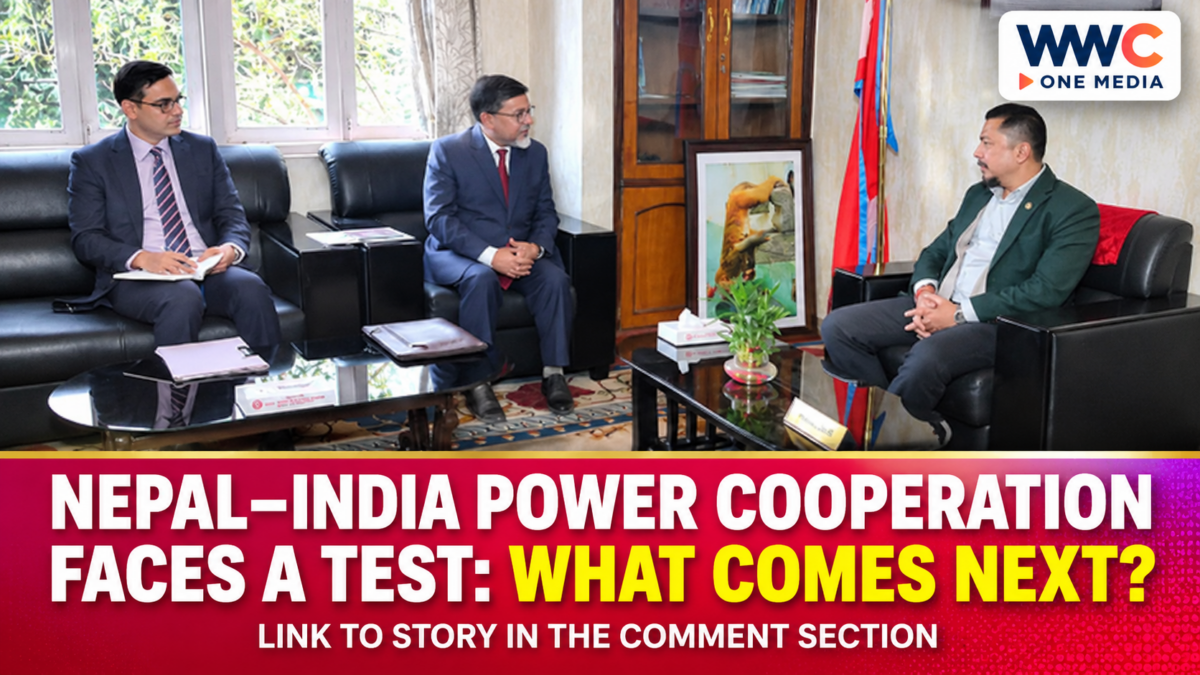
KATHMANDU, Nepal — Nepal’s Energy, Water Resources and Irrigation Minister Biraj Bhakta Shrestha met Indian Ambassador Sudhakar Dalela on Nov. 17, 2026, an engagement recorded by the Indian Embassy in Kathmandu. The meeting came as both countries continued work on electricity trade and cross-border infrastructure, while Nepal was operating under a temporary approval to import electricity from India through Dec. 31.
The diplomatic call was brief in the public record, but the policy backdrop is substantial. Nepal–India power cooperation now involves planned transmission capacity, long-term trade ambitions and near-term support for Nepal’s damaged electricity system. The central question is not whether the neighbours are talking, but how existing commitments become reliable power supply and completed projects.
Nepal–India power cooperation goes beyond one meeting
The embassy’s public gallery identifies Shrestha and Dalela and dates their meeting to Nov. 17. It does not provide a jointly agreed timetable, project budget or new signed instrument from that conversation. This matters: a diplomatic meeting can help sustain a relationship without creating a binding new electricity deal.
Dalela took up his ambassadorial responsibility in November 2026. His official biography records earlier service as India’s Secretary (Economic Relations), as well as previous work relating to Nepal. Those credentials establish his background, but do not by themselves determine what decisions the November meeting produced.
There is, however, a formal structure for the two countries to discuss power projects. Their Joint Steering Committee and Joint Working Group met in Pokhara on July 15 and 14, respectively. These meetings reviewed hydropower development, electricity trade and transmission infrastructure rather than treating the sector as a single diplomatic initiative.
Transmission lines are the practical test
At the July meetings, officials discussed progress on new lines, including the 400-kilovolt Gorakhpur–New Butwal transmission line. They also considered how to advance projects already under way or being planned. The official record did not convert every discussion into a completion date.
That distinction is important for consumers and businesses. Generating electricity and delivering it are different tasks. A hydropower plant may produce electricity, but cross-border trade depends on grid connections, operating coordination and approvals that allow power to move to the buyer.
The July statement also records discussion of coordinated grid operations, solar projects, green hydrogen and training for Nepali specialists. These areas widen the relationship beyond the construction of dams. They do not establish that new investments or power purchases were approved at the November ambassadorial meeting.
For background on the vulnerability of existing assets, WWC’s earlier coverage of rescue operations around Nepal’s hydropower tunnels examined how a major flood disrupted energy facilities and access routes.
The 10,000-megawatt ambition needs careful reading
The two governments signed a long-term power-trade agreement in January 2024, and India’s official reporting set out an ambition to expand Nepal’s electricity exports to India to 10,000 megawatts within ten years. This is a forward-looking objective, not proof that 10,000 megawatts is already being delivered.
India’s published account of its Nepal relationship also identifies a 2022 power-sector vision covering joint project development, cross-border transmission, two-way power trade and coordinated national grids. That framework helps explain why officials keep returning to the same technical subjects in successive meetings.
A trade target requires several things to happen together: power stations must generate enough electricity, transmission facilities must carry it, and buyers and system operators must be able to complete transactions within the applicable rules. Falling short in any one area can delay the economic benefits of the others.
A government target is therefore best judged through later operational disclosures and commissioned infrastructure, not simply through the number of meetings held or agreements announced.
India’s temporary exports show why trade works both ways
The immediate picture is not only about Nepal selling power. On Sept. 14, India’s Ministry of Power announced approval for electricity exports to Nepal Electricity Authority from Sept. 13 through Dec. 31, 2026, for 18 hours a day, between midnight and 6 p.m.
The approval allowed up to 600 megawatts over the Muzaffarpur–Dhalkebar 400-kilovolt line and up to 54 megawatts over the Tanakpur–Mahendranagar 132-kilovolt line. These are approved ceilings on specified routes, not evidence that the maximum amount was delivered every hour.
India linked the temporary measure to flood damage that reduced Nepal’s domestic hydropower generation and increased its electricity requirements. Its announcement said the volume authorised from January 2027 would be reviewed in December 2026.
The implications extend beyond generation alone. WWC’s report on Nepal’s flood recovery financing requirements explored the wider reconstruction challenge, including damaged energy infrastructure. An electricity trading arrangement can help bridge a short-term shortage, but it does not replace the work needed to repair facilities.
Why reliability matters more than diplomatic ceremony
Analysis: The official records suggest two related but different priorities. Nepal and India have a longer-term opportunity to expand regional electricity commerce, while Nepal also faces the immediate task of securing dependable supply after infrastructure damage.
These priorities need not conflict. An interconnected electricity system can support exports when generation is available and imports when supply falls short. But this flexibility depends on functioning lines, adequate commercial arrangements and coordinated grid operations.
Flood exposure makes the investment question more demanding. Resilience can affect where infrastructure is built, how it is protected and how quickly operators can restore services. WWC’s earlier coverage of the Nepal flood response and damaged infrastructure provides context for those risks; its earlier reported casualty figures should not be treated as a current toll.
The November meeting should therefore be viewed as diplomatic continuity rather than confirmation of a fresh power agreement. The measurable story lies in decisions still to be documented, infrastructure delivered and electricity actually traded.
What happens next
One immediate milestone is the December 2026 review of India’s authorisation for electricity exports to Nepal from January 2027. A revised decision would clarify the next permitted supply arrangement, although permission and actual power flows remain different measures.
Longer term, project commissioning, transmission progress and records of cross-border power transactions will provide stronger evidence of whether the 10,000-megawatt ambition is advancing. Public records reviewed for this article do not establish a new deal, fresh project deadline or financial commitment resulting from the Nov. 17 meeting.
Frequently asked questions
Did Nepal and India sign a new power agreement on Nov. 17, 2026?
The embassy’s public account confirms a meeting between Nepal’s energy minister and the Indian ambassador. It does not document a new signed power agreement from that meeting.
What is Nepal–India’s long-term electricity trade goal?
The governments’ January 2024 arrangement envisages expanding Nepal’s electricity exports to India towards 10,000 megawatts over ten years. That is a target, not a current flow figure.
Why was India exporting electricity to Nepal in late 2026?
India’s Ministry of Power linked its temporary approval to flood damage affecting Nepal’s hydropower generation and the resulting need for additional supply.
When will the next Indian power-export volume be reviewed?
The Sept. 14 official announcement scheduled a review in December 2026 of the quantity authorised from January 2027.










