
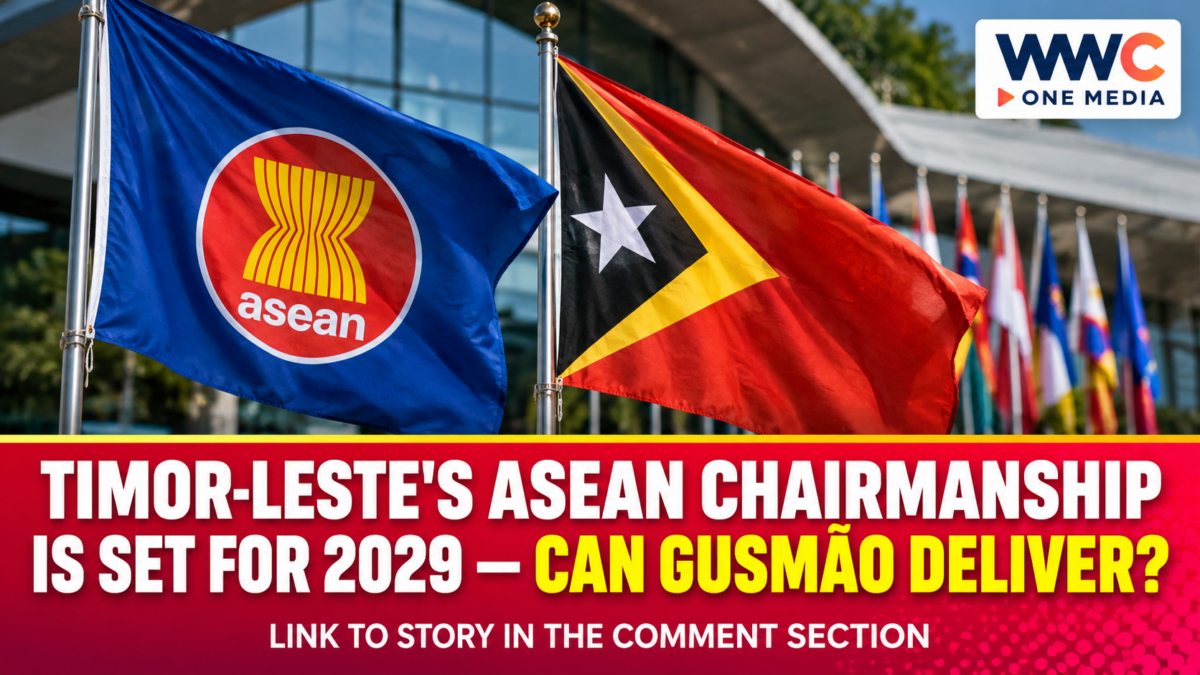
MANILA, Philippines — Nov. 22, 2026. Timor-Leste Prime Minister Kay Rala Xanana Gusmão attended the 49th ASEAN Summit in Pasay City on Nov. 15–17, where regional leaders confirmed that his country would assume the bloc’s rotating chairmanship in 2029. The decision places one of Southeast Asia’s newest ASEAN members on a timetable to lead the organisation just four years after its formal admission.
The confirmation gives Timor-Leste a significant diplomatic opportunity, but it also creates practical responsibilities. The country must strengthen institutional coordination, develop personnel and prepare the arrangements needed to organise meetings involving regional governments and international partners.
Beyond the ceremonies in Manila, the bigger question is whether Timor-Leste can turn its membership into effective regional leadership.
Timor-Leste ASEAN chairmanship moves into focus
The Manila summit provided an important milestone in Timor-Leste’s transition from aspiring ASEAN member to participant in regional decision-making.
The country’s government confirmed that the 2029 chairmanship was endorsed through the ASEAN Coordinating Council and recognised during the leaders’ plenary session on Nov. 15.
The sequence follows Singapore’s scheduled chairmanship in 2027 and Thailand’s in 2028.
ASEAN’s chairmanship rotates among member countries under the organisation’s governing arrangements. Holding the position carries responsibilities that extend beyond presiding over ceremonial events.
For Timor-Leste, the appointment represents recognition of its place within the regional organisation. It also establishes a deadline for preparations that cannot be completed through diplomatic declarations alone.
WWC ONE MEDIA’s examination of the 49th ASEAN Summit’s priorities and implementation challenges provides wider context on the difference between regional commitments and measurable delivery.
From a long membership campaign to regional leadership
Timor-Leste formally joined ASEAN on Oct. 26, 2025, during the organisation’s 47th Summit in Kuala Lumpur.
Its membership followed a lengthy process beginning with an application in 2011. ASEAN granted the country observer status in 2022 before adopting a roadmap in 2023 to guide its preparation for membership.
That roadmap addressed participation in ASEAN institutions and the adoption of relevant legal instruments.
Membership therefore represented more than a change in diplomatic status. It required Timor-Leste to begin operating within a system of regional obligations, agreements and decision-making arrangements.
ASEAN subsequently recorded additional steps involving the country’s accession to regional legal instruments.
These developments matter because membership and effective participation are not identical.
A government may gain a seat in regional meetings before completing every administrative and institutional adjustment necessary to make full use of that position.
The coming chairmanship will provide a visible test of Timor-Leste’s progress.
What Gusmão brought to the Manila summit
Gusmão’s official programme included the ASEAN leaders’ meetings and engagements involving parliamentary, youth and business representatives.
The sessions addressed matters with direct implications for national governments, including security, economic resilience, climate pressures and regional cooperation.
Timor-Leste’s government also confirmed that discussions considered developments in Myanmar and ASEAN’s established framework for addressing the political and humanitarian crisis.
For a newer member, participation in these discussions is an important part of developing diplomatic experience.
It means working within ASEAN’s institutions while engaging with problems that do not necessarily have straightforward national solutions.
The regional setting also makes the Philippines an important partner in broader conversations about economic security and cooperation.
These tensions form part of the wider policy environment examined in WWC ONE MEDIA’s analysis of ASEAN neutrality and Southeast Asia’s independence.
The central diplomatic challenge is maintaining cooperation among countries that have different political interests, economic structures and external relationships.
Why Manila mattered beyond the ceremonies
The 2026 gathering occurred during the Philippines’ ASEAN chairmanship under President Ferdinand R. Marcos Jr.
Its official theme was “Navigating Our Future, Together.”
The summit considered geopolitical uncertainty, regional economic resilience, transnational threats and the organisation’s longer-term development.
These were not simply abstract discussion points. The subjects involve government capacity, cross-border coordination and the ability of ASEAN institutions to implement collective decisions.
Timor-Leste’s participation placed its representatives directly inside those conversations.
Gusmão also attended the 21st East Asia Summit on Nov. 17, accompanied by Foreign Affairs and Cooperation Minister Bendito dos Santos Freitas.
That meeting brought ASEAN together with external partners to discuss strategic, political and economic cooperation.
For Timor-Leste, the significance is practical: future leadership will involve managing relationships beyond its immediate neighbours.
The wider regional agenda is also illustrated by WWC ONE MEDIA’s coverage of the ASEAN–US anti-scam cooperation initiative, where implementation remains an important question.
What the 2029 timetable means for Timor-Leste
Timor-Leste has already established an ASEAN Chairmanship National Organising Council to coordinate preparations.
The council is chaired by the prime minister and involves planning across government institutions.
Its responsibilities include personnel training, infrastructure, logistical arrangements and security preparations.
Those requirements illustrate the difference between obtaining a chairmanship and successfully administering it.
Hosting regional meetings involves scheduling, translation and documentation, protocol, secure venues, transport arrangements and coordination among multiple public agencies.
These are operational considerations rather than evidence that any particular preparation has failed.
The government’s own preparations acknowledge the need to build capacity before assuming its responsibilities.
For businesses, effective regional coordination could support more predictable communication with governments and institutions. Such benefits, however, depend on actual implementation and cannot be assumed from the chairmanship announcement.
The practical measure of progress will be whether the country’s institutions are ready to perform their roles when 2029 arrives.
What happens next
Timor-Leste’s immediate priorities are institutional preparation, staff development and continuing participation in ASEAN processes.
Singapore’s 2027 chairmanship and Thailand’s 2028 term will come before Timor-Leste takes its scheduled turn.
Those intervening years provide opportunities to observe how regional meetings are organised and how leaders manage agreements involving multiple governments.
Gusmão’s Manila appearance was part of a much larger diplomatic milestone.
For Timor-Leste, the lasting significance of the 49th ASEAN Summit is not the ceremonial welcome but a confirmed responsibility to help lead Southeast Asia’s regional organisation.
The question now is how thoroughly the country can prepare for that role.










