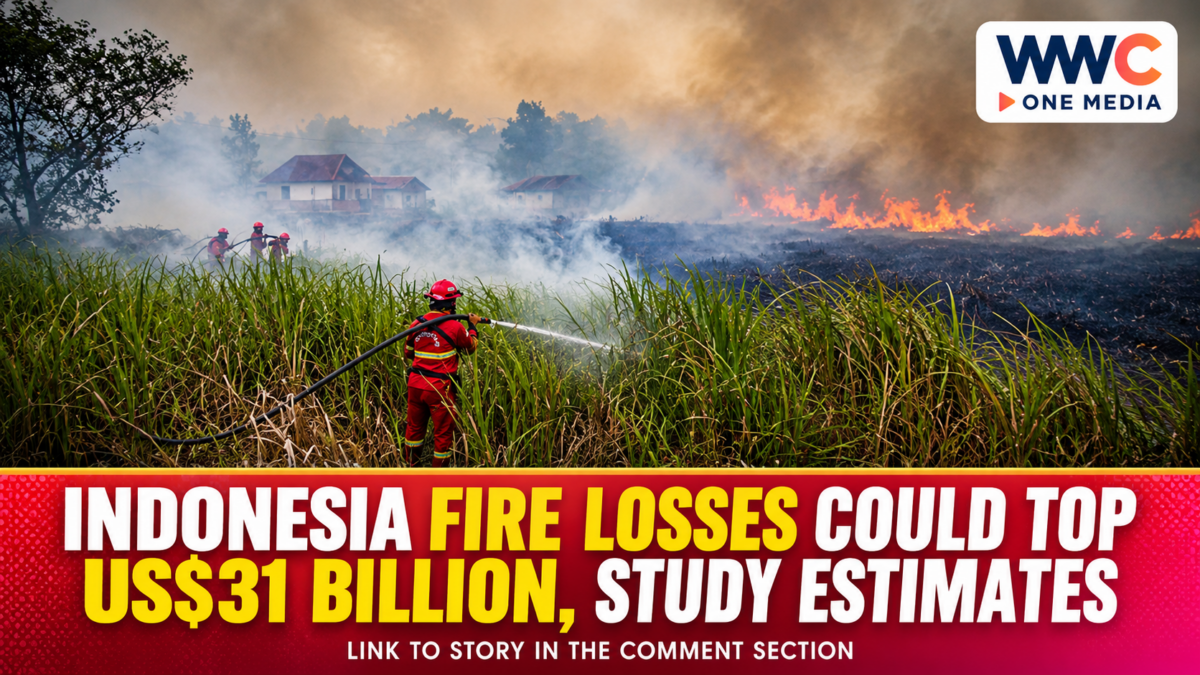
Indonesia’s 2026 forest and land fires could generate as much as US$31.12 billion in combined economic and health costs, a November research report by the Center of Economic and Law Studies (CELIOS) estimates. The study, which uses cumulative fire data available as of Oct. 20, puts the lower estimate at US$19.80 billion.
The figures point to a financial burden extending beyond the land directly affected by flames. The report includes damage to physical assets, interruptions to business activity, healthcare expenses and lost income associated with respiratory illness.
The upper estimate is not a confirmed government loss assessment or a final bill for damage already recorded. It is a research scenario that combines economic modelling with different assumptions about the number of people affected by acute respiratory infections.
Indonesia fire losses: what the research actually estimates
CELIOS divides the estimated burden into two broad categories: economic losses and health-related costs.
The report puts losses involving physical assets and disrupted economic activity at 340.38 trillion rupiah, equivalent to US$18.75 billion. It calculates this at 2.69% of Indonesia’s gross domestic product and estimates a further 4.06 trillion rupiah in potential lost regional tax revenue. CELIOS+1
The health component produces a much wider range.
For people formally diagnosed with acute respiratory infections, the report estimates total health costs of 19.20 trillion rupiah, or about US$1.06 billion. When people diagnosed with the illness and those reporting related symptoms are included, the estimate rises to 224.65 trillion rupiah, or US$12.37 billion. CELIOS+1
Combining the economic estimate with those two health scenarios produces the report’s overall range of US$19.80 billion to US$31.12 billion.
That distinction is important. The highest figure does not mean Indonesia has already paid or formally recorded US$31.12 billion in fire-related expenses. It represents the study’s broader estimate when symptomatic cases are included.
Why the damage reaches beyond forests
The report’s economic modelling suggests that the consequences are spread across industries rather than confined to forestry.
Forestry and logging account for an estimated 77.1% of total GDP losses, or 262.33 trillion rupiah. CELIOS explains that its calculation includes the loss of standing forest assets and land-restoration costs, not simply the value of timber production lost during one year. CELIOS
Other industries also face estimated losses. Wholesale and retail trade is assigned 18.20 trillion rupiah, followed by mining at 11 trillion rupiah, manufacturing excluding food and beverages at 9.88 trillion rupiah, financial services at 8.46 trillion rupiah, and transportation and storage at 6.94 trillion rupiah. CELIOS
This is where the report’s analysis becomes relevant to the wider economy. When fires affect production areas, transport, suppliers and local spending can also be disrupted. Businesses that do not operate in forests may still depend on goods, workers and services from affected regions.
WWC previously examined the livelihood pressures created by Indonesia’s haze crisis. The new CELIOS estimates add a national economic model to that wider discussion of how fires can affect work and local activity.
The health estimate depends on who is counted
CELIOS treats health costs as more than the money spent on medical care.
Its methodology includes direct expenses, such as hospitalisation, consultations and medication, alongside indirect costs. These include income lost when patients or caregivers cannot carry out their normal work.
The researchers use two scenarios for respiratory illness: people with a formal diagnosis and a wider group that includes people reporting symptoms without a formal diagnosis. The second approach produces the much higher health-cost estimate. CELIOS+1
The report also identifies limits to its geographic calculations. Its health-cost assessment covers 32 provinces, excluding DKI Jakarta, West Java, Central Java, DI Yogyakarta, Banten and Bali. For East Java, the calculation is limited to four regencies surrounding Bromo Tengger Semeru National Park. CELIOS+1
These boundaries matter when interpreting the results. The estimates should not be treated as a complete count of every illness, medical bill or lost working day across the country.
The fires spread across several regions
The CELIOS report says fires affected different parts of Indonesia between January and October 2026, with a total burned area of 1.92 million hectares based on the data it used.
South Papua recorded the largest estimated burned area at 319,119.68 hectares, followed by West Kalimantan at 277,127.29 hectares. East Nusa Tenggara, Central Kalimantan and South Sumatra were also among the five most affected provinces in the report’s ranking. CELIOS
The geographic spread is significant because the economic effects differ by location. CELIOS estimates the largest regional economic loss for the Papua grouping at 59.43 trillion rupiah. West Kalimantan follows at 41.91 trillion rupiah, with Central Kalimantan at 32.89 trillion rupiah. CELIOS
Indonesia’s National Disaster Management Agency, BNPB, separately documented the continuing challenge of forest and land fires in its October 2026 disaster bulletin. It identified fires as a major concern during the year, alongside prolonged dry conditions in several priority areas. BNPB+1
WWC’s earlier report on Indonesia’s fire risk under El Niño explored the weather conditions behind the concern. The economic study adds another dimension: the potential cost when fire damage spreads through regional production and public health.
Why the methodology matters
CELIOS says it used an interregional input-output model, which estimates how changes in one economic sector can affect other sectors within the same region and across different regions.
In plain terms, the model attempts to account for indirect consequences. A fire that damages forestry assets may also affect manufacturing, transport, retail activity and services that depend on the affected production network. CELIOS+1
This approach provides a broader picture than counting burned hectares alone. However, the results remain estimates built from data, assumptions and modelling choices. They should be read as an assessment of potential economic exposure, not as an audited account of actual losses.
The study’s findings also underline why restoration and prevention deserve attention alongside emergency response. WWC has previously examined the long-term work involved in recovering damaged Indonesian peatlands. Rebuilding damaged landscapes is a separate challenge from extinguishing an active fire, and the economic model suggests that the consequences can extend across multiple sectors.
What happens next
The next step is to compare the research estimates with updated official fire records, regional economic data and health information as more complete figures become available.
For policymakers, the report raises questions about how fire prevention, land management, healthcare capacity and ecosystem recovery should be reflected in public spending and regional planning.
For businesses, the findings offer a reminder that environmental disruption can affect supply chains, workers, transport and financial exposure far from the immediate fire zone.
The headline estimate is substantial, but its most useful message is not simply the size of the number. It is the way the report connects damage to land with the wider economic and health systems that depend on it.
Frequently asked questions
1. How much could Indonesia’s 2026 fires cost?
CELIOS estimates combined economic and health costs of between US$19.80 billion and US$31.12 billion, based on fire data accessed on Oct. 20, 2026.
2. How much of the estimated cost comes from economic losses?
The report estimates 340.38 trillion rupiah, or about US$18.75 billion, in losses involving physical assets and disrupted economic activity.
3. Why is the health-cost estimate so different between scenarios?
The lower scenario counts people formally diagnosed with acute respiratory infections. The higher scenario also includes people reporting related symptoms without a formal diagnosis.
4. Which Indonesian regions recorded the largest burned areas in the study?
South Papua ranked first, followed by West Kalimantan, East Nusa Tenggara, Central Kalimantan and South Sumatra.
5. Are the US$31.12 billion in losses already confirmed?
No. It is the upper end of CELIOS’s model-based estimate. It should not be treated as a final government damage assessment or a confirmed amount already spent.