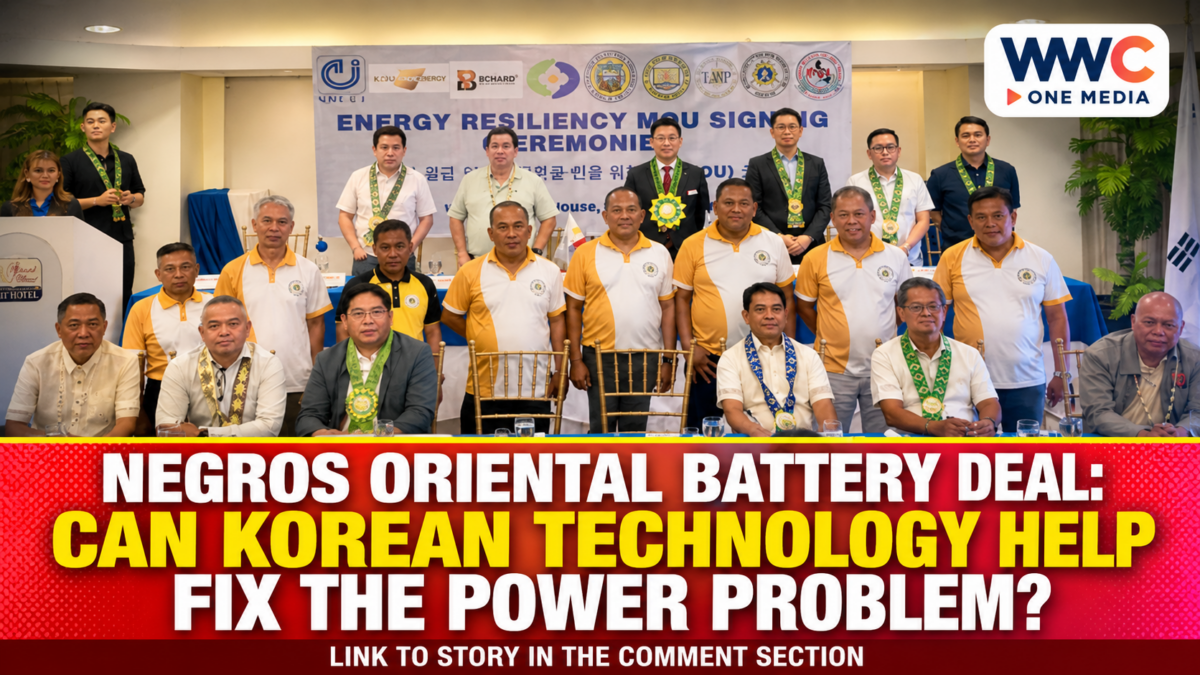
Negros Oriental I Electric Cooperative Inc. (NORECO I) has reportedly signed a memorandum of understanding with South Korean energy partners for solar-powered battery energy storage projects, with an initial installation proposed for its Mabinay substation. The reported agreement was signed in Dumaguete City on November 21, 2026, as the province continues to face concerns over electricity reliability and power costs. teapawt
The proposed development comes as the national government pushes additional battery capacity across the Visayas and regulators track existing energy-storage facilities. But the central question for consumers is not simply whether batteries will be installed. It is whether the projects can secure the approvals, financing, grid connections and operating arrangements needed to deliver dependable electricity at a competitive cost.
What the reported Korean partnership proposes
The reported memorandum involves NORECO I, South Korea’s IlCheoncheon Co. Ltd. and Bugang Energy Development Co. Phils. Inc. The initial plan described in the public announcement is a one-megawatt solar-powered battery energy storage system at NORECO I’s Mabinay substation, with another installation planned in Bais City. teapawt
The reported development also identifies possible future storage installations in Guihulngan City and Bindoy. Those locations should be treated as longer-term plans, not confirmed construction sites.
The distinction matters because a memorandum of understanding generally records an intention to cooperate. It does not, by itself, prove that construction funding has been secured, that permits have been granted or that a facility is ready to supply electricity.
The signed document has not been independently reviewed for this report. Project costs, battery duration, solar-panel capacity, construction schedules, ownership arrangements and expected consumer savings therefore remain unconfirmed.
For the cooperative, the potential benefit is diversification. A local solar-and-storage arrangement could give the distribution system another resource to manage electricity supply, depending on how the proposed installation is designed and connected.
Why Negros Oriental needs more flexible electricity supply
The proposal arrives against a wider Visayas power challenge. In a September 7, 2026 media release, the Department of Energy said it was working with power companies to deploy 253 megawatts of battery storage across Cebu, Panay, Leyte and Negros. The department described the facilities as a source of fast-response support when generating units unexpectedly go offline or electricity supply becomes tight. Department of Energy Philippines
That regional programme is separate from the reported NORECO I agreement. The two should not be combined into one project total or treated as though the cooperative’s proposed facilities are already included in the government’s operational capacity.
The DOE’s announcement also highlights an important point: batteries can help a grid respond to sudden changes, but they cannot solve every cause of electricity shortages. Power plants, transmission infrastructure, reserve capacity and distribution networks must work together.
WWC previously examined the pressure on the region’s electricity supply in its report on Visayas and Mindanao’s red-alert conditions and power-plant outages.
For businesses, the reliability issue extends beyond household inconvenience. Power interruptions can disrupt refrigeration, production schedules, digital services and daily operations. More flexible local electricity resources could help, but their contribution depends on actual operating performance.
Negros Oriental already has a recorded energy-storage facility
The province is not starting from zero. The Energy Regulatory Commission’s register of generation facilities with Certificates of Compliance or Provisional Authorities to Operate, dated October 31, 2026, lists the South Negros Energy Storage System operated by Energy Development Corporation in Barangay Puhagan, Valencia, Negros Oriental.
The register identifies 20 battery modules and four inverters, with a nameplate rating of 14,535 kilowatts. It also records a provisional authority to operate issued on October 30, 2026, valid from November 13, 2026, to November 12, 2027. Energy Regulatory Commission
This is a separate facility from the proposed NORECO I installations. Its presence demonstrates that battery storage is already part of the province’s documented energy infrastructure, but it does not establish that the cooperative’s proposed Mabinay or Bais projects have received the same regulatory status.
Negros Oriental also has an established renewable-energy policy record. The provincial government documented Executive Order No. 22-18, which declared March 5 as Renewable Energy Day in the province and set out support for renewable energy development. Negros Oriental Provincial Government
The wider generation mix matters, too. WWC’s coverage of First Gen’s geothermal upgrade in Valencia explains how dispatchable geothermal generation can complement solar and storage. These technologies serve different functions: geothermal produces electricity continuously when operating, while batteries store electricity for later delivery.
What battery storage can—and cannot—do for consumers
A battery energy storage system does not create electricity. It stores electricity supplied by solar panels or another source and releases that energy when needed.
A solar-powered facility could charge batteries during daylight hours and discharge them later, when solar production falls or demand rises. That may improve the timing of electricity availability and reduce reliance on other supply sources during selected periods.
However, a one-megawatt rating alone does not tell consumers how long a battery can provide electricity. The system’s energy capacity, measured in megawatt-hours, is also necessary to understand its discharge duration.
The economics are equally important. Battery systems involve equipment, installation, financing, maintenance, replacement and grid-connection costs. Savings depend on the cost of charging, the timing of discharge, the electricity procurement arrangement and how project expenses are recovered.
That means a promise of lower power costs should be treated as a project objective—not a guaranteed reduction in monthly bills.
The national grid is also preparing for much larger storage developments. WWC’s report on NGCP’s planned battery-storage expansion explains why battery capacity must be assessed alongside duration, grid connection and the availability of electricity to recharge the systems.
Regulatory approval and grid connection remain crucial
The reported NORECO I MOU should not be confused with a regulatory approval. Energy projects may need permits, technical assessments, connection arrangements and other clearances before construction and commercial operation.
A separate ERC proceeding involving NORECO I and Therma Visayas Inc. illustrates the regulatory work surrounding electricity supply. ERC Case No. 2026-171 RC concerns an application for approval of a Power Supply Agreement between the cooperative and the power company. It is not an approval of the Korean battery proposal. Energy Regulatory Commission
There is also a wider legislative context. House Bill No. 10141, listed in the House of Representatives’ legislative information system, concerns a franchise for NORECO I to operate and maintain electricity distribution systems in specified cities and municipalities in Negros Oriental. The bill’s listing is a legislative record, not proof that the proposed battery project has been approved. House of Representatives Philippines
For consumers, the most useful future disclosures will be the project specifications, financing plan, regulatory clearances, grid-connection arrangements and commissioning dates. These will show whether the agreement is progressing from cooperation into a deliverable energy project.
What happens next
The next milestone is the release of the MOU’s full terms or an official project announcement from NORECO I and its partners. That would allow the public to assess the exact capacity, locations, investment requirements, responsibilities and implementation schedule.
The cooperative and its partners will also need to clarify the regulatory and technical pathway for each proposed installation. The status of the Mabinay proposal should be tracked separately from the Bais plan and any longer-term locations.
For Negros Oriental, the real test will be measurable results: whether the systems are built, connected, commissioned and operated reliably—and whether their costs and benefits are reflected transparently in the electricity arrangements serving consumers.
Frequently asked questions
1. What is NORECO I planning with South Korean partners?
A reported memorandum describes cooperation on solar-powered battery storage, beginning with a proposed one-megawatt installation at the cooperative’s Mabinay substation and another planned for Bais City. teapawt
2. Which companies are involved?
The reported agreement involves NORECO I, IlCheoncheon Co. Ltd. and Bugang Energy Development Co. Phils. Inc. The signed MOU has not been independently reviewed for this report.
3. Will the battery projects immediately reduce electricity bills?
That has not been established. Any savings will depend on project costs, financing, electricity procurement, operating performance and applicable rates.
4. Does Negros Oriental already have a battery storage facility?
Yes. The ERC’s October 31, 2026 register lists the South Negros Energy Storage System in Barangay Puhagan, Valencia, operated by Energy Development Corporation. It is separate from the proposed NORECO I projects. Energy Regulatory Commission
5. When will the proposed NORECO I facilities begin operating?
A verified construction or commissioning date has not been established. The MOU’s full implementation timetable is still needed.