
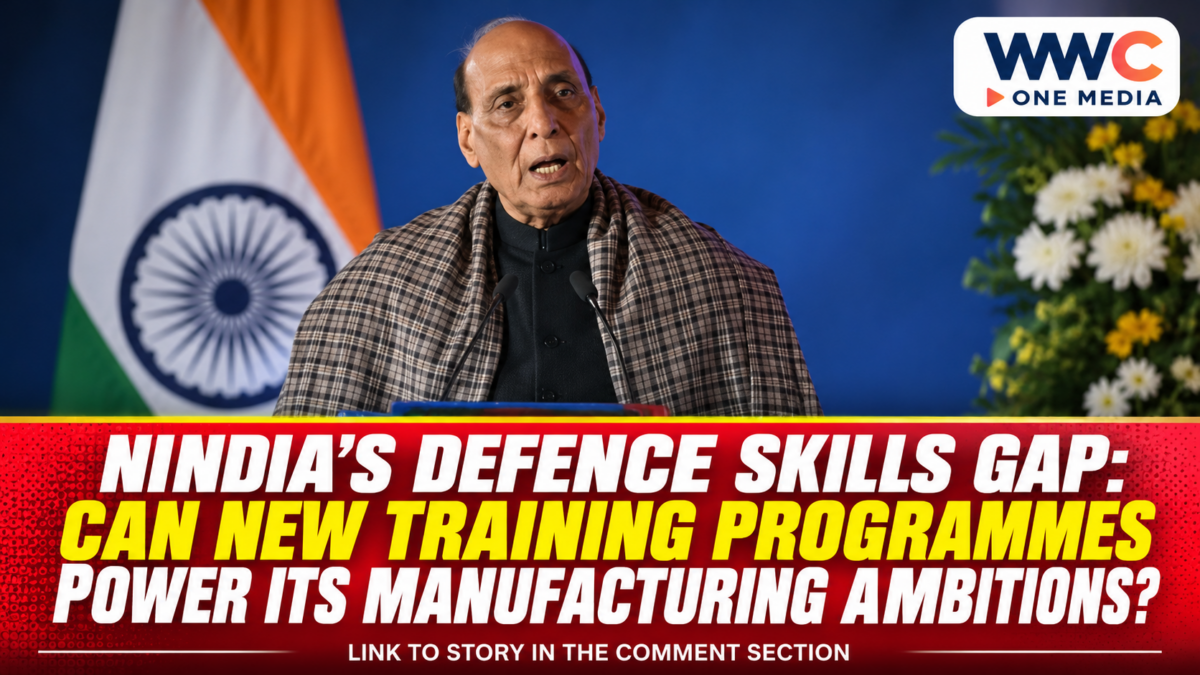
India is expanding its domestic defence manufacturing capabilities, but its industrial ambitions also depend on developing enough qualified workers to support increasingly sophisticated production. The government’s PM-SETU vocational training initiative and its growing partnerships with defence manufacturers are part of an effort to connect technical education with the country’s industrial requirements.
The workforce question is becoming particularly important as India seeks to strengthen domestic production, expand defence exports and reduce reliance on imported technologies.
For the defence industry, manufacturing independence involves more than purchasing machinery or establishing factories. It requires engineers, technicians, precision manufacturers, quality-control specialists and workers capable of maintaining complex equipment throughout its operational life.
India’s defence skills challenge extends beyond factory recruitment
India’s Ministry of Skill Development and Entrepreneurship organised the PM-SETU Industry Conclave in Lucknow on Aug. 30, 2026, bringing together government officials, defence manufacturers, industry representatives and vocational education stakeholders.
Defence Minister Rajnath Singh participated in the gathering alongside Minister of State for Skill Development and Entrepreneurship Jayant Chaudhary and other government representatives.
The official programme identified several industries experiencing increasing demand for specialised technical capabilities, including defence manufacturing, aerospace, electronics, drones, robotics, precision engineering and automation.
The government also emphasised the importance of connecting training institutions with companies that can provide practical industry experience.
This is an important distinction. Graduating from a technical programme does not automatically mean a worker is ready for a specialised defence manufacturing position. Employers also need people who understand production standards, technical documentation, equipment operation and quality assurance.
The challenge is therefore to ensure that vocational qualifications translate into capabilities that manufacturers actually need. Press Information Bureau+1
PM-SETU puts industry participation at the centre of training
The Pradhan Mantri Skilling and Employability Transformation through Upgraded ITIs, known as PM-SETU, is designed to modernise Industrial Training Institutes and strengthen their connection with employers.
Under the programme’s cluster model, each project can comprise one Hub ITI and four Spoke ITIs.
The government’s Aug. 30 announcement states that a cluster can attract investment of up to ₹241 crore, with a funding arrangement divided among the national government, state governments and industry partners.
The proposed funding structure assigns:
- 50% to the Government of India.
- 33% to state governments.
- 17% to industry partners.
The programme also introduces an ownership arrangement for its proposed special-purpose vehicles. Anchor industry partners are assigned 51% ownership, while the central and state governments each hold 24.5%.
The structure gives participating companies a direct role in the development and operation of training clusters rather than limiting their involvement to occasional corporate social responsibility activities. Press Information Bureau
The same government announcement reported that approved industry partnership proposals represented more than ₹1,500 crore in committed industry-led investment across seven clusters in five states.
In Uttar Pradesh, 32 ITIs across eight clusters had been identified, with seven clusters still open for collaboration at the time of the announcement.
These figures demonstrate the programme’s intended scale, although committed investment and identified institutions should not be confused with completed upgrades or fully operational training facilities.
Defence manufacturers need more than basic technical qualifications
The industrial requirements of modern defence manufacturing are becoming increasingly specialised.
Aircraft engines, electronic systems, advanced materials, unmanned platforms and precision-engineered components require different technical disciplines.
The scale of the challenge is visible in India’s aerospace manufacturing sector.
On Oct. 6, 2026, Rajnath Singh witnessed Hindustan Aeronautics Limited’s delivery of its 2,000th aero-engine at its Koraput Division.
The government record also identifies HAL’s work in engine repair and overhaul, with more than 9,000 engines overhauled by the division.
The same announcement outlined plans to increase annual AL-31FP engine production capacity from 30 to 50 engines through an investment of ₹335 crore. A second Shakti engine production line was also announced, involving ₹218 crore and a planned capacity of up to 100 engines annually. Press Information Bureau
These industrial activities illustrate why workforce development cannot stop at general mechanical training.
Aerospace manufacturing requires specialised expertise in metallurgy, precision production, testing, advanced materials and quality assurance.
For India, developing those capabilities locally could strengthen the domestic supply chain and improve the country’s ability to maintain equipment over longer periods.
DRDO is opening more opportunities for private manufacturers
Another part of India’s strategy involves expanding the participation of smaller companies in defence technology development.
During the VIMARSH DRDO-Industry Synergy Meet on Sept. 15, 2026, Rajnath Singh unveiled initiatives intended to reduce technical and financial entry barriers for micro, small and medium enterprises (MSMEs) and deep-tech start-ups.
The announced framework includes direct funding, incubation support and dedicated access to DRDO testing facilities.
The government also reported that nine licensing agreements for the transfer of technology were handed to 13 manufacturing partners.
A separate framework was introduced to facilitate the secure sharing of DRDO-developed software source codes with licensee industries. Press Information Bureau+1
This approach matters because defence manufacturing involves an extensive network of suppliers.
Large manufacturers may handle major systems, but smaller businesses can contribute components, electronics, software, specialised materials and engineering services.
WWC’s earlier examination of India’s proposed military procurement expansion explains why domestic industrial participation is an important part of the country’s modernisation strategy.
For smaller manufacturers, however, entering this supply chain requires more than access to funding. They must also meet technical standards, demonstrate reliability and employ appropriately trained personnel.
Record production creates a higher expectation for workers
India’s defence manufacturing industry has already reached a substantial production scale.
During a Sept. 1, 2026 performance review involving 16 Defence Public Sector Undertakings, the Ministry of Defence reported that India’s defence production reached approximately ₹1.8 lakh crore in financial year 2025–26.
The 16 public sector undertakings contributed ₹1.29 lakh crore to that total. Press Information Bureau
The production figures provide an indication of the industry’s growing industrial capacity.
However, continued expansion requires the workforce to keep pace with changes in technology, manufacturing processes and quality requirements.
A factory may have advanced equipment, but production can still face limitations if there are not enough qualified technicians to operate, maintain and troubleshoot its systems.
Training institutions therefore have an important role in supporting industrial growth.
A useful comparison can be found in Toyota’s expansion of its Filipino automotive technician pipeline, which illustrates how technical education and industry participation can be connected to actual manufacturing and service requirements.
India’s defence sector faces a different regulatory and technological environment, but the underlying workforce principle is similar: training must remain relevant to the equipment and processes employers use.
What happens next
The next test for India’s workforce strategy will be implementation.
The Directorate General of Training’s Nov. 10, 2026 invitation and guidelines scheduled the fifth Kaushal Deekshant Samaroh for Nov. 21, 2026, in Lucknow, alongside the PM-SETU programme.
The document also directed Industrial Training Institutes and National Skill Training Institutes to organise local convocation activities and promote career pathways, apprenticeships, job fairs and further training. Directorate General of Training
The broader industrial question is whether these initiatives can produce a consistent supply of workers who meet the technical requirements of defence manufacturers.
That will depend on employer participation, training quality, access to modern equipment, apprenticeship opportunities and measurable employment outcomes.
India’s defence production ambitions are substantial, but industrial self-reliance cannot be measured only by the number of factories or equipment produced.
It must also be measured by the country’s ability to develop the people who design, manufacture, test, repair and continuously improve those products.
Frequently asked questions
1. Why does India need more skilled workers for defence manufacturing?
Modern defence equipment requires specialised expertise in electronics, aerospace, precision engineering, robotics, automation and advanced manufacturing. A qualified workforce helps manufacturers produce and maintain complex systems.
2. What is the PM-SETU scheme?
PM-SETU is India’s Pradhan Mantri Skilling and Employability Transformation through Upgraded ITIs initiative. It aims to modernise vocational training institutions and strengthen industry participation.
3. How much investment can a PM-SETU cluster receive?
The government’s Aug. 30, 2026 announcement states that a cluster comprising one Hub ITI and four Spoke ITIs can attract investment of up to ₹241 crore.
4. How much did India produce in defence equipment during FY 2025–26?
The Ministry of Defence reported approximately ₹1.8 lakh crore in defence production for FY 2025–26, with 16 Defence Public Sector Undertakings contributing ₹1.29 lakh crore.
5. Are private companies involved in India’s defence manufacturing expansion?
Yes. Government initiatives include technology-transfer agreements, support for MSMEs and start-ups, access to research facilities and greater cooperation between DRDO and private manufacturers.










