MANILA, Philippines — Nov. 21, 2026. The Philippine National Police’s security arrangements for the 49th ASEAN Summit included coordinated monitoring of delegates’ movements, transport-hub protection and flexible deployment across Metro Manila. With the high-level meetings concluded, the public record also points to an unfinished question: how should the operation be assessed beyond preparations and official expressions of confidence?
The answer matters because major diplomatic gatherings affect more than visiting officials. Airport passengers, commuters, emergency responders and people exercising constitutional rights all share the spaces in which heightened security measures are introduced. A useful post-summit review must therefore consider operational coordination, public inconvenience and legal safeguards together.
PNP ASEAN Security Extended Beyond Conference Venues
Before the summit, police identified airports, major transport terminals and key access roads as part of their security responsibilities. The National Capital Region Police Office (NCRPO) coordinated with transport agencies to prepare for the movement of foreign delegates and ordinary travellers through Metro Manila.
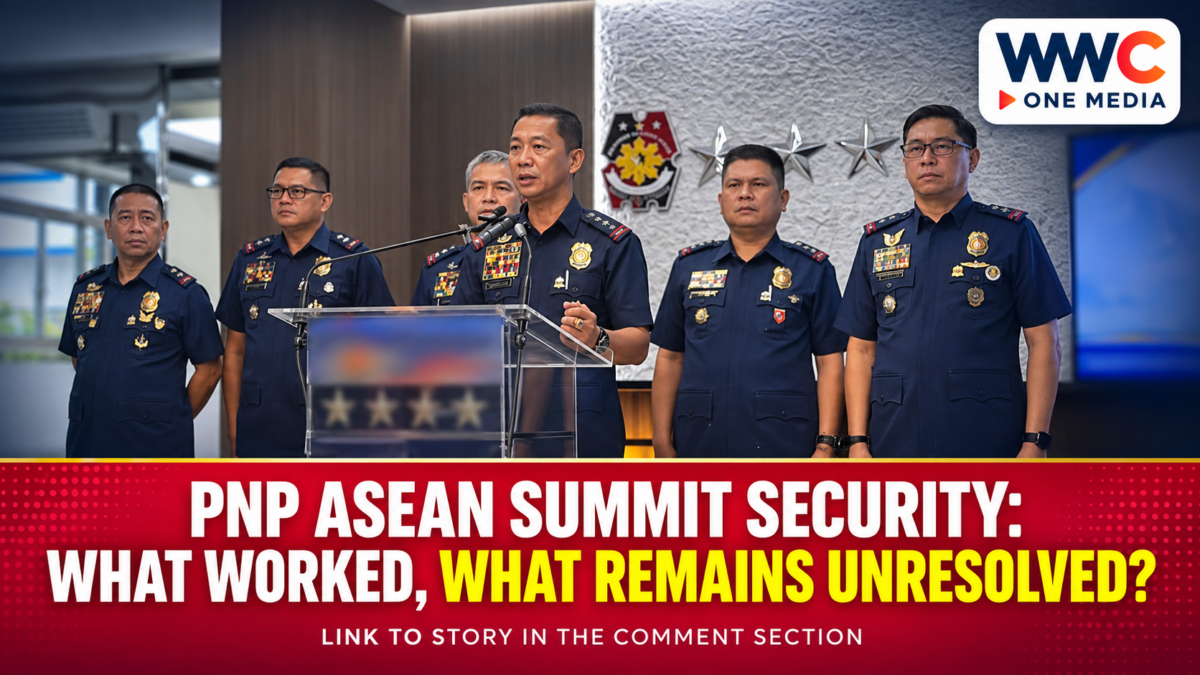
PNP chief General Jose Melencio Nartatez Jr. and NCRPO acting regional director Brigadier General Christopher N. Abrahano inspected a Multi-Agency Coordination Center at the PTTC Building in Pasay City. The centre was intended to support CCTV monitoring and coordination among agencies tracking delegates’ movements.
Such arrangements illustrate why event security cannot be measured simply by counting officers at a venue. Police also have to manage movements between locations, communicate with other agencies and respond when ordinary travel patterns intersect with official convoys.
WWC previously examined the deployment and traffic restrictions planned for the ASEAN summit. The post-event question is whether those arrangements can now be evaluated against documented results, rather than their original objectives.
Emergency Response Was a Separate Part of the Plan
On Nov. 12, government agencies activated an emergency preparedness and response task group for the summit. The announced deployment included 774 personnel and 119 specialised assets, among them ambulances, fire engines, engineering equipment, transport vehicles and communications resources.
The Office of Civil Defense headed the Joint Task Group on Emergency Preparedness and Response, operating under the government committee responsible for summit security, public order and emergency readiness. Interior Secretary Jonvic Remulla led the deployment ceremony.
These figures describe a particular emergency-response mobilisation. They should not be added to police deployment figures or presented as the total number of officers assigned to summit duties. Different agencies and reporting periods can produce different counts.
The distinction is important for a credible review. A large announced mobilisation demonstrates the scale of preparation, but not, by itself, the quality of emergency response or the absence of operational problems. Those assessments require incident logs, response data and an explanation of how agencies worked together.
Police Adjusted Their Security Posture During the Summit
The NCRPO’s Nov. 17 operational communication described a system in which deployment decisions were to change with conditions on the ground. Abrahano directed commanders to assess crowd movements, road congestion and emerging security concerns, then redistribute personnel when necessary.
That approach recognised a practical limitation of security planning: predictions made before an event may not match what actually happens. A traffic bottleneck, unexpected crowd movement or communication problem can require an immediate change in how personnel are used.
For the public, the most meaningful measure would be whether necessary changes were communicated quickly and carried out without unnecessary disruption. For police managers, useful measures could include response times, the handling of congestion and the effectiveness of coordination between units.
WWC’s earlier report on NCRPO security coverage beyond summit venues explained why protecting visiting delegates and keeping public facilities accessible were connected responsibilities. The available official communications outline those intentions but do not provide a complete independent performance audit.
The Public-Rights Questions Have Not Disappeared
On Nov. 18, the Commission on Human Rights (CHR) issued a statement expressing concern over allegations connected with protests on Nov. 15 in Manila, Muntinlupa City and other areas. The commission did not treat every allegation as established fact. Instead, it said it would verify the legal basis of arrests, custody conditions and the treatment of affected individuals.
The CHR also reported that its lawyers and investigators initially faced delayed access to Camp Bagong Diwa on Nov. 15, before being admitted later that evening. That is a specific issue raised by the commission about its ability to undertake independent monitoring.
Police have legitimate duties to protect people and maintain order during international gatherings. At the same time, the Constitution protects freedom of expression and peaceful assembly. Whether individual police actions complied with the law requires evidence about those actions, not assumptions for or against the officers involved.
WWC has separately detailed the CHR’s review of ASEAN protest arrests. Its relevance here is not to prejudge misconduct, but to recognise that a full assessment of summit security must include protections for people who were not delegates.
Why the Post-Summit Review Matters
Analysis: The main institutional opportunity is to convert a temporary, multi-agency operation into lessons for routine public safety. Shared monitoring, clear responsibilities and rapid operational adjustments can be valuable beyond an international conference if they are evaluated and adapted appropriately.
But a security operation should not be described as conclusively successful in every respect merely because its scheduled meetings ended. That would confuse the completion of a diplomatic programme with independently tested outcomes for policing, traffic management, emergency response and civil liberties.
A balanced review should also distinguish between allegations, recorded incidents and verified findings. This is especially important when public discussion includes contested accounts of police conduct. Transparent documentation would provide a fairer basis for assessing both complaints and the work performed by personnel.
The Philippines’ handover of the ASEAN chairship to Singapore on Nov. 17 closed a diplomatic chapter, but it did not remove the value of examining how public agencies performed during the summit.
What Happens Next
The CHR has said it will continue gathering records and examining the circumstances surrounding protest-related arrests. Its findings, if issued, will be relevant to any final assessment of police compliance with legal safeguards.
For security planners, the next useful step would be a public after-action account distinguishing deployment totals from actual results: what worked, where disruptions occurred, and what procedures should change. No such comprehensive independently verified assessment was established by the official records reviewed for this article.
The strongest measure of the operation may ultimately be whether it improves future emergency planning and everyday policing while preserving the rights of the people those systems are intended to protect.
Frequently Asked Questions
What was the PNP’s role during the 2026 ASEAN Summit?
Police helped secure routes, transport hubs and delegate movements, coordinating with other agencies and adjusting deployments as conditions changed.
Did the ASEAN security operation include emergency responders?
Yes. A government announcement on Nov. 12 identified a separate emergency-response deployment of 774 personnel and 119 specialised assets.
Were all allegations about police actions during the summit proven?
No. The CHR’s Nov. 18 statement described allegations and an ongoing verification process, not final findings on every reported incident.
What should officials review after the summit?
A meaningful review would examine operational coordination, public disruption, emergency readiness, individual enforcement decisions and compliance with legal safeguards.