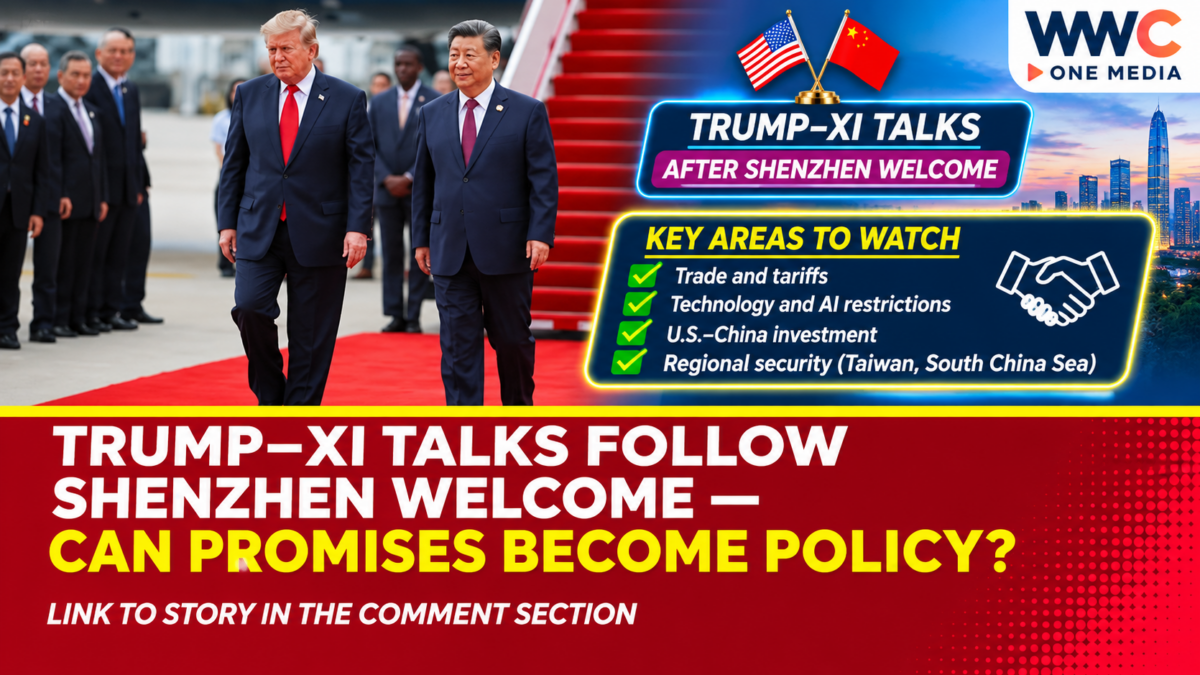
SHENZHEN, China — Trump–Xi talks returned to the diplomatic agenda after Chinese President Xi Jinping welcomed US President Donald Trump at Shenzhen Bao’an International Airport on Nov. 18, 2026, ahead of regional meetings hosted by China. Beijing also announced that Xi would hold a Nov. 19 summit involving Trump and Russian President Vladimir Putin, but the official records reviewed do not yet establish the outcome of that gathering.
The immediate question for businesses is whether diplomatic engagement will produce practical changes to tariffs, investment barriers and technology rules. The governments have already established channels for those discussions; a welcome ceremony, however, does not itself change commercial obligations.
Trump–Xi Talks Begin With a Documented Welcome
China’s Foreign Ministry recorded Xi’s personal welcome for Trump on Wednesday afternoon. The ceremony included military honours and national anthems. Xi expressed an intention to discuss relations between their countries, Asia-Pacific cooperation and international questions, while Trump welcomed the opportunity to advance their relationship.
The account confirms their encounter and statements of intent. It does not announce a fresh bilateral trade agreement or disclose the results of the scheduled three-leader meeting.
WWC ONE MEDIA has already covered Xi’s personal welcome for Trump. A separate financial-policy question is whether subsequent meetings produce rules that companies can actually apply.
September US–China Agreements Set the Baseline
Xi and Trump met in Washington during the Chinese president’s September state visit. The Chinese account described their aim of maintaining a constructive relationship through cooperation, managed competition and continued discussions.
The White House’s Sept. 25 fact sheet documented the operation of bilateral Boards of Trade and Investment, established after the leaders’ May talks. Under the trade mechanism, both sides reached consensus on recommendations for more favourable tariff treatment involving US$30 billion of non-sensitive goods in each direction.
Recommendations should not be confused with effective tariff schedules. Importers still need the relevant implementing measures, covered product categories and starting dates to know which duties apply.
The investment board was established as a channel for discussing opportunities and obstacles. Its existence does not approve individual company deals or override domestic investment reviews.
Tariffs and Critical Minerals Test the Relationship
The US announcement identified several sectors considered for more favourable market treatment, including agriculture, seafood, timber products, cosmetics and medical devices. It also described continuing work on shortages involving rare earths and other critical minerals.
These specific subjects make cooperation potentially meaningful. But no blanket removal of export restrictions or proof of completed mineral shipments follows merely from an agreement to keep working on the problem.
WWC previously examined Xi’s APEC comments on protectionism and the unresolved trade agenda. The distinction between political commitments and enforceable trade procedures remains important for manufacturers planning future costs.
Analysis: An effective outcome would be measurable through published regulations, customs decisions and completed commercial transactions. Friendly remarks alone cannot establish a cheaper input price or unrestricted market access.
Technology Discussions Offer Another Channel
The September American fact sheet also announced a dialogue covering emerging intelligence technologies, including mechanisms for discussing risks and incidents. China’s account similarly identified AI cooperation and risk management among the subjects raised by the presidents.
Those discussions could help officials exchange information when technology developments create international concerns. They do not establish that existing rules affecting advanced chips or computing services have been cancelled.
Nor should a technology dialogue be treated as evidence that commercial competition has disappeared. Companies remain responsible for meeting the rules in each jurisdiction where they operate.
APEC Gives the Visit Wider Economic Importance
The Shenzhen visit coincided with the 33rd APEC Economic Leaders’ Meeting, held Nov. 18–19. In a separately published Nov. 18 speech to business leaders, Xi promoted a more open regional market, stronger industrial cooperation and innovation-led development.
Those priorities matter beyond China and the United States because regional supply chains connect companies across many economies. Yet a speech at APEC is different from a bilateral treaty, and a trilateral diplomatic summit is different from APEC’s institutional work.
WWC’s earlier preview of the planned Trump–Xi–Putin gathering describes why the meeting attracted particular attention. Its announcement confirmed a diplomatic forum, not a negotiated settlement of security disputes.
What this could mean: For Philippine importers and exporters, more stable relations could improve planning conditions. But no specific Philippine tariff preference, investment contract or peso-denominated gain can be inferred from the reception or the summit schedule.
What Happens Next
The next evidence to examine is an official readout of the Nov. 19 meetings, the implementation of trade-board recommendations and any new published rules affecting investment and supply chains.
For now, the public records support a narrower but important conclusion: the two presidents renewed their stated commitment to dialogue, and both governments have existing mechanisms for working on disputed issues. Whether that effort produces enforceable economic changes remains unresolved.
Frequently Asked Questions
Did Xi Jinping and Donald Trump meet in Shenzhen?
Yes. China’s Foreign Ministry confirms that Xi welcomed Trump at Shenzhen airport on Nov. 18. It separately announced a Nov. 19 summit involving Xi, Trump and Putin.
Did the meeting produce a new US–China trade deal?
The official airport-reception account does not announce a new agreement. The outcome of the subsequent summit was not verified in the records reviewed.
What did Washington and Beijing announce in September?
They described bilateral trade and investment mechanisms, proposed more favourable treatment for selected goods and further discussions involving technology and critical minerals.
Are all the proposed tariff changes already in force?
The September fact sheet describes recommendations. The applicable laws, schedules and effective dates must be checked separately.
What does the visit mean for the Philippines?
Better regional policy predictability may help planning, but no specific Philippine benefit follows automatically from the leaders’ diplomatic statements.