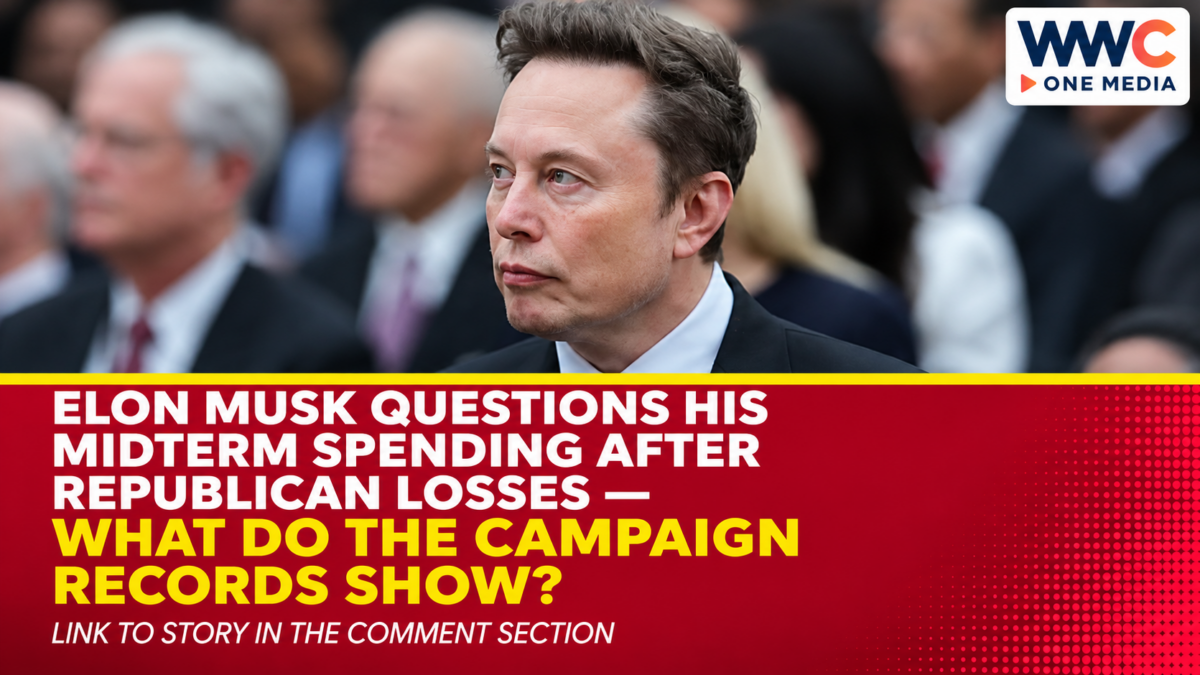
WASHINGTON, United States — Elon Musk’s political spending is facing renewed scrutiny following the Nov. 3, 2026, US midterm elections, which left Republicans preparing to surrender control of both chambers of Congress. The billionaire’s public discussion of the election at the Nov. 18 DealBook Summit has put fresh attention on the campaign-finance records of America PAC and the limits of political money.
Federal Election Commission (FEC) records confirm substantial fundraising and expenditure by the political committee. However, they also reveal an important distinction between money raised by a political organisation, money spent supporting candidates and the total political contributions attributable to an individual donor.
That distinction matters when assessing what wealthy donors actually financed and whether election results can be treated as a straightforward measure of their political influence.
Elon Musk Midterm Spending Raises New Questions
Musk discussed the Republican election losses and his involvement in the midterms during a Nov. 18 interview at the New York Times DealBook Summit.
His appearance followed an election that transformed the political balance in Washington, with Democrats preparing to assume congressional leadership when the next Congress begins.
The debate surrounding Musk’s spending goes beyond whether Republican candidates won or lost. It raises a broader question about how independent political organisations use their resources and how much influence financial support can exert over an election.
WWC ONE MEDIA previously examined Musk’s election spending and the Republican defeats.
The latest development invites a closer examination of the official filings rather than another assumption about the effectiveness of every dollar spent.
An important limitation remains: the reviewed FEC committee summary does not independently verify the full personal political-spending total widely attributed to Musk during the 2026 cycle.
America PAC’s Financial Records Show Substantial Activity
America PAC is registered with the FEC as an independent expenditure-only political committee, commonly called a super PAC. Its registration dates to May 22, 2024.
The committee’s displayed financial summary for the period from Jan. 1, 2025, through Oct. 14, 2026, records total receipts of US$215,977,673.63.
During the same period, it reported total disbursements of US$171,687,764.50, including US$103,462,691.80 in operating expenditures and US$51,436,851.03 in independent expenditures.
Those figures describe the financial activity of America PAC. They should not be treated as a complete accounting of Musk’s personal political contributions across every organisation or funding channel.
The distinction is especially important because money may move through multiple committees, each with separate reporting obligations.
Adding figures from interconnected organisations without tracing the transactions can lead to double-counting.
The FEC also warns that newly filed financial summaries may take time to appear in its public database. Consequently, the figures should be read with their reporting-period limits in mind.
Why Political Donations Cannot Guarantee Election Victory
Super PACs are permitted to receive unlimited contributions from eligible individuals, corporations and labour organisations for independent political activity.
They are not permitted to make direct contributions to federal candidates.
This legal distinction separates independent political spending from contributions that candidates receive through their own campaign committees.
Independent expenditures may finance political advertising and other communications supporting or opposing a candidate, without being treated as direct campaign contributions.
WWC previously covered Trump- and Musk-aligned political spending in competitive congressional races.
The election results now create an opportunity to assess the broader limits of that strategy.
Analysis: Spending can help campaigns communicate their messages, reach voters and encourage participation. But election outcomes also depend on candidate appeal, public concerns, political conditions and the choices of individual voters.
A candidate’s defeat does not establish that independent spending had no effect. It demonstrates that financial support was insufficient to secure the desired electoral outcome.
Equally, a candidate’s victory does not prove that a particular donor caused the result.
Democrats’ Congressional Gains Change the Political Environment
Democratic congressional leaders have publicly outlined their priorities following the November elections, including affordability, healthcare and government accountability.
In a Nov. 9 joint statement, House Democratic Leader Hakeem Jeffries and Senate Democratic Leader Chuck Schumer described plans to address household costs and other policy disagreements with the Republican administration.
Those positions reflect the leaders’ stated agenda, not proof that every voter supported the same policies or rejected the same political donors.
WWC’s coverage of the 2026 midterm results and the incoming Congress’s affordability agenda provides further context for the transition.
The next Congress is scheduled to begin on Jan. 3, 2027. Until then, the incoming majority does not automatically possess the legislative authority of the next congressional term.
For Musk and other politically active business figures, the change may alter the environment in which federal policy, corporate oversight and government spending decisions are debated.
However, the election outcome alone does not establish misconduct by any donor or company, and it does not automatically change existing government contracts.
What Musk’s Spending Debate Means for Campaign Finance
The FEC’s broader election-cycle figures demonstrate the scale of political fundraising in the United States.
House and Senate candidates reported raising a combined US$2.8 billion and spending US$2 billion between Jan. 1, 2025, and June 30, 2026.
Independent expenditures disclosed through June 30 totalled US$643.4 million, of which US$529.6 million came from independent expenditure-only political committees.
These figures cover an earlier reporting period than the November election and should not be presented as final cycle totals.
What this could mean: The debate surrounding Musk’s political spending offers an opportunity to examine whether campaign-finance disclosure provides voters with enough clarity about who funds political advertising and how the money is distributed.
It also reinforces the difference between political influence and political control.
Donors can provide financial resources to organisations, but they cannot guarantee how voters will respond.
What Happens Next
The next important development will be the availability and reconciliation of more complete campaign-finance records covering the closing weeks of the election cycle.
Those disclosures can help establish how much was raised, which organisations received contributions, and where the reported spending was directed.
Future public statements may also clarify how Musk intends to approach political spending ahead of subsequent elections.
For now, the established financial record supports a narrower conclusion than many sweeping interpretations of the election: America PAC operated a substantial political-finance programme, Republicans experienced major losses, and those outcomes do not permit a simple dollar-for-vote calculation.
The unresolved question is how much of Musk’s overall spending can be traced through official records without double-counting funds transferred between political organisations.
Frequently Asked Questions
How much did Elon Musk spend on the 2026 midterms?
A complete personal spending total was not independently established from the primary records reviewed. America PAC’s displayed filings show US$171.69 million in total disbursements through Oct. 14, 2026, but this is the committee’s expenditure figure, not Musk’s verified personal total.
What is America PAC?
America PAC is a federally registered independent expenditure-only political committee, or super PAC, established in May 2024.
Did Republicans lose control of Congress in 2026?
The November midterm results put Democrats on course to control both chambers when the new Congress convenes in January 2027. Final certified results must be distinguished from post-election projections.
Can billionaires donate unlimited amounts to political campaigns?
Eligible donors may give unlimited amounts to independent expenditure-only committees, subject to applicable rules. Direct contributions to federal candidates are subject to different legal restrictions.
Does campaign spending guarantee an election victory?
No. Political spending can support advertising and voter outreach, but the final result depends on voters and many other electoral factors.