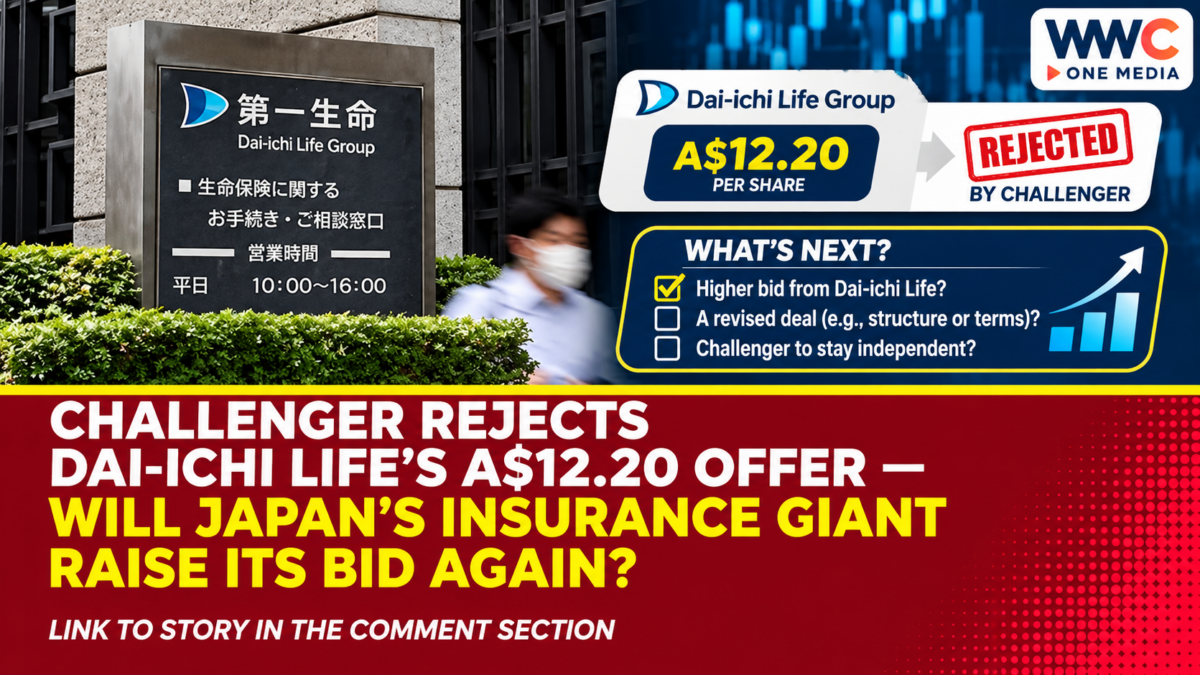
SYDNEY, Australia — Challenger Limited disclosed on Nov. 19, 2026, that its board did not support an increased takeover approach from TAL Dai-ichi Life Australia, which proposed A$12.20 a share for the remaining 79.5% of the Australian retirement-income company. The revised indicative offer follows an earlier A$11.80 proposal that Challenger’s directors also judged insufficient, leaving a potential acquisition unresolved.
For shareholders, the central question is not simply whether a Japanese insurance group wants full ownership. It is whether an offer recognises the value of Challenger’s existing operations, growth prospects and the premium normally associated with gaining corporate control.
Challenger Dai-ichi Life Bid Rises to A$12.20
Challenger’s Nov. 19 market release identifies the buyer as TAL Dai-ichi Life Australia Pty Limited and describes the revised approach as non-binding and conditional. TAL wants the ordinary shares not already in its hands, rather than purchasing an entirely unrelated business.
The new price is A$0.40 a share higher than the previously announced A$11.80, an increase of approximately 3.4%. That is a calculated comparison of the two public offer prices, not a premium to the latest traded share price.
After considering the terms and receiving financial and legal advice, Challenger’s board concluded that the revised offer did not adequately reflect fair value in a transaction involving control of the company.
The company instructed shareholders that they need take no action. No binding acquisition contract or successful shareholder vote was announced in the release.
The October Approach Explains the Disagreement
The first proposal, received after the Australian market closed on Oct. 16 and announced on Oct. 19, offered A$11.80 per share by way of a scheme of arrangement. Challenger described that offer as carrying a 17.7% premium to its one-month volume-weighted average share price of A$10.03 at that stage.
The initial terms included due diligence, agreement on implementation documentation, regulatory approvals and a recommendation from Challenger’s board. None of those conditions should be treated as automatically satisfied because TAL later raised its proposed price.
On Oct. 26, Challenger said the original price was below a level directors could recommend. Nevertheless, it described TAL as its largest shareholder and a commercial partner and said it intended to engage further.
The Nov. 19 announcement shows that engagement produced a higher indicative price, but not agreement over value. It does not disclose a new deadline for another offer or commit either company to further negotiations.
What Is Actually Being Bought?
TAL’s existing holding matters. The Nov. 19 release says the bidder already owns 20.5% and is seeking the other 79.5%. At A$12.20 a share, the offer would value the outstanding shares being sought separately from the bidder’s pre-existing interest.
A price applied to 100% of Challenger’s shares would produce an implied whole-company equity valuation, but that is not the cash TAL proposes to pay for shares it already owns. The two figures should never be presented interchangeably.
The ownership relationship dates back to TAL’s 2025 investment. Challenger’s earlier disclosures described the Japanese group’s acquisitions of interests from existing institutional shareholders, building the strategic minority position that precedes the present takeover approach.
This distinction also arises in other acquisitions. WWC previously examined a Japanese insurer’s reported interest in Australia’s Suncorp, where a possible deal and a completed change of control were separate questions.
Challenger’s Earnings Provide a Valuation Starting Point
Challenger’s August results reported financial-year 2026 normalised net profit after tax of A$468 million, up 3%, and statutory net profit after tax of A$506 million, compared with A$192 million a year earlier.
The group reported A$6.2 billion in annuity sales, up 19%, alongside normalised earnings per share of 68.1 Australian cents. Its board also declared an ordinary full-year dividend of 31.5 cents per share and a 1.5-cent special dividend.
These figures describe business performance, not an independent valuation of Challenger shares. A purchaser and target board may differ over future profitability, capital needs, control premiums and the risks attached to long-term retirement products.
The company also announced a larger share buyback programme during 2026. A buyback, however, does not prove that a takeover proposal is inadequate, just as strong annual earnings do not guarantee that future earnings will continue rising.
Analysis: The board’s refusal may indicate a higher view of the company’s prospects than the bidder’s proposed price reflects. But neither the release nor the audited historical results establish what amount would win board support.
Cross-Border Financial Deals Have Different Endpoints
Australia has attracted other international financial-services investment, though transaction structures vary widely. WWC’s report on RBC’s proposed purchase of Australian investment manager Yarra Capital examines an announced agreement still subject to completion conditions.
In contrast, the current Challenger proposal has not passed the target board’s valuation test. The stage of negotiations is therefore earlier and less certain.
An additional comparison is the proposed transfer of a controlling stake in India’s IDBI Bank, where ownership percentages and regulatory steps are central to understanding what buyers would acquire.
What this could mean: Shareholders may see further proposals, or negotiations may end. Neither outcome is assured. For retirement-income customers, a change of corporate shareholder is also different from an announced change to annuity payment terms; no such alteration was established in the takeover release.
What Happens Next
The next material event would be a fresh company announcement describing renewed terms, a binding agreement or the conclusion of talks. If a mutually acceptable transaction emerges, investors would still need to examine its structure, any required approvals and the timetable specified in binding documents.
Until then, Challenger remains a separately listed company and TAL remains its substantial existing shareholder. The firm fact is that A$12.20 a share did not secure a board recommendation. Whether the bidder returns with a higher price remains unanswered.
Frequently Asked Questions
How much did Dai-ichi Life offer for Challenger?
TAL Dai-ichi Life Australia proposed A$12.20 per share for the 79.5% of Challenger shares it did not already own. The proposal was non-binding and conditional.
Did Challenger accept the revised takeover bid?
No. Challenger’s Nov. 19 announcement said its board did not consider the revised price an adequate reflection of fair value in a control transaction.
What was the previous offer price?
The earlier indicative approach was A$11.80 per share, announced on Oct. 19, 2026.
Does TAL already own shares in Challenger?
Yes. Challenger’s latest release states that TAL already owns 20.5% of its ordinary shares.
Must Challenger shareholders respond now?
No. Challenger explicitly said shareholders do not need to take any action in response to the revised indicative approach.