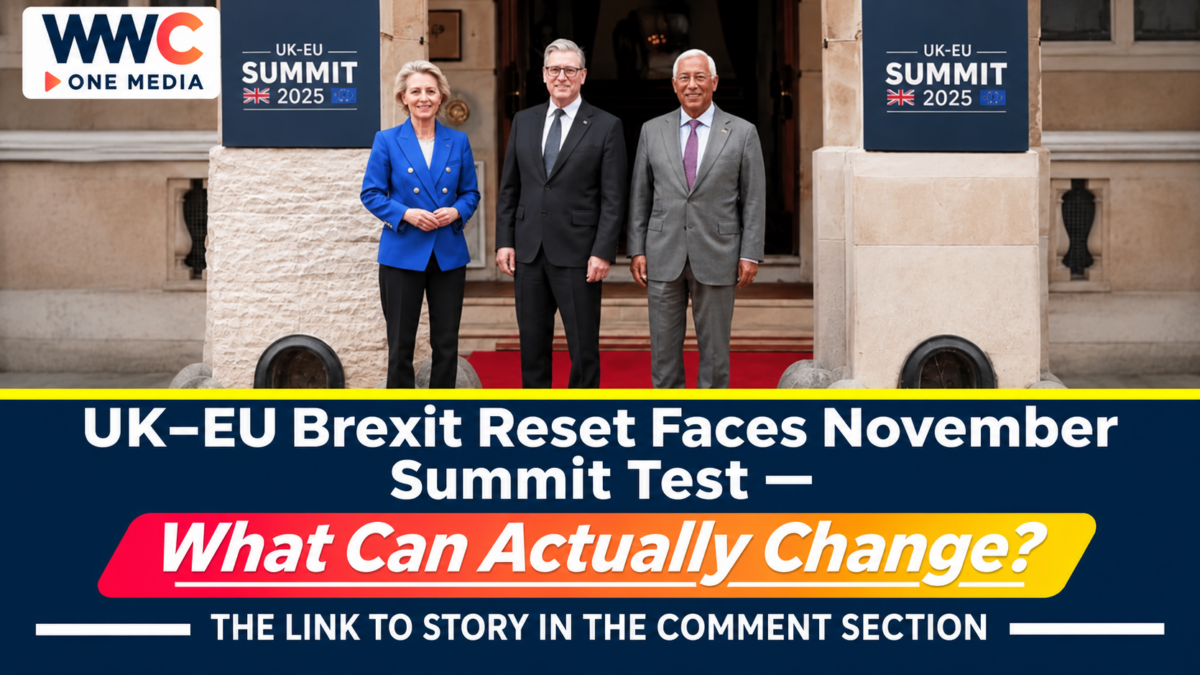
The British government will meet European Union leaders in Brussels on Nov. 20, 2026, to seek closer cooperation on trade, energy and mobility after years of post-Brexit friction. Prime Minister Andy Burnham confirmed the second UK–EU summit ahead of the meeting, while European institutions have outlined negotiations that remain subject to final agreement and implementation.
The immediate question is not whether the United Kingdom is rejoining the EU. It is whether a UK–EU Brexit reset can remove identifiable costs for businesses and households without reopening every choice made after the 2016 referendum. The distinction is particularly important when politicians describe proposed benefits before the agreements are legally effective.
UK–EU Brexit Reset: What Is Actually Under Negotiation?
The agenda spans several subjects with different legal and economic consequences. An agricultural and food-trade agreement would align selected sanitary and phytosanitary rules, potentially reducing certification requirements and physical checks on affected products crossing the border.
A separate proposal would connect British and European emissions trading systems. That could simplify how covered industries manage carbon costs, but it would require agreed operating rules rather than a single political announcement.
The EU has also authorised discussions about Britain’s participation in its internal electricity market and an appropriate contribution to EU cohesion policy. A youth experience scheme is under negotiation, while the EU has separately agreed arrangements allowing UK participation in Erasmus+ for 2027. These are different initiatives; approval of one does not mean the others are already in force.
Why the Trade Figures Matter
Official UK statistics released on Nov. 12 show that the country’s total goods-and-services trade deficit widened to £10.4 billion in the third quarter of 2026, excluding precious metals. The goods deficit stood at £61.5 billion, partly offset by an estimated £51.1 billion services surplus.
In September, goods exports to EU countries reached £16.7 billion, while imports from the bloc were £29.9 billion. These are monthly, seasonally adjusted figures, not an estimate of the economic cost of Brexit.
That difference matters. Trade balances move with exchange rates, demand, energy prices and other conditions. They cannot be used alone to prove how much a new agreement will add to economic growth.
Britain’s fiscal watchdog maintains an assumption that the post-Brexit trading relationship will reduce long-run productivity by 4% compared with a counterfactual in which the UK remained in the EU. It is a forecast assumption about a comparison with a hypothetical alternative, not a measured four-per-cent fall in today’s gross domestic product.
Food Trade Could Offer an Early Practical Test
The British government’s earlier technical explanation estimated that removing export health certificates could save eligible businesses up to £200 per consignment. The potential benefit is straightforward: fewer forms and checks can reduce administrative work for producers and importers.
Yet savings quoted in government policy materials are illustrations, not proof that every supermarket item will fall in price. Costs must first change for individual firms, and any resulting savings may be distributed among producers, transporters, wholesalers and shoppers.
A joint agricultural statement issued by Britain and Germany in November expressed support for completing an ambitious food-trade agreement at the upcoming summit. Such public support is meaningful politically, but the final text, coverage and start date remain more important for judging practical results.
Energy Cooperation Brings Opportunities and Trade-offs
Linking carbon markets could reduce complexity for energy-intensive businesses trading across Europe. Electricity-market cooperation could support cross-border arrangements and resilience, although neither proposal guarantees cheaper bills in every season.
These negotiations require choices about alignment, oversight, financial contributions and enforcement. The UK and EU may gain from common rules, while accepting less freedom to change those rules independently. Whether that is worthwhile is a legitimate policy judgment, not a fact established by a summit photograph.
The November meeting also comes amid continuing European security discussions. Britain and EU partners have established a security and defence partnership, and official meetings in November covered issues including financial regulation and the implementation of the existing Withdrawal Agreement.
Why the Philippines Should Watch the Talks
A change in the UK–EU relationship is relevant to Philippine exporters and investors even though the Philippines is not negotiating the European agreements. Businesses with British and European customers may face changes in procurement decisions, distribution costs and the relative attractiveness of operating in different markets.
WWC has already covered the British Chamber–ASEAN business partnership, showing how companies are strengthening links outside Europe. Those arrangements are separate from the Brexit negotiations, but both reflect efforts to widen commercial cooperation.
Another useful comparison is the Philippines–UK infrastructure financing framework. Access to a financing programme creates possibilities; actual disbursements depend on approved projects and contractual conditions. The same discipline should guide assessments of a UK–EU trade deal.
For Philippine suppliers evaluating opportunities abroad, WWC’s reporting on ASEAN supply-chain competition offers further context: announced agreements are only one factor alongside logistics, compliance, capacity and customer demand.
What Happens Next
The Nov. 20 summit will test whether the two sides can convert negotiating mandates into specific commitments. Readers should watch for signed texts, effective dates, remaining legislative approvals, financial obligations and clear details about which businesses qualify for any simplified rules.
Burnham’s Nov. 16 speech also raised the possibility of a broader discussion about Britain’s long-term relationship with Europe after the summit. That is a political proposal, not an announcement that the UK has decided to rejoin the EU, the single market or the customs union.
The measure of progress is therefore practical rather than rhetorical: which barriers disappear, when those changes take effect and whether subsequent data show a benefit. A reset can be meaningful without reversing Brexit, but the outcome will be determined by enforceable agreements and measurable results.
Frequently Asked Questions
Is Britain rejoining the European Union in November 2026?
No. The summit concerns closer cooperation and proposed sector-specific agreements, not an approved return to EU membership.
When is the next UK–EU summit?
The second summit is scheduled for Nov. 20, 2026, in Brussels.
What would a UK–EU food-trade agreement change?
It could simplify certain certifications and checks for eligible agricultural and food products, depending on the final agreement and implementation rules.
Has a new UK–EU youth mobility programme begun?
No general youth experience scheme should be described as operational solely because talks are taking place. Erasmus+ participation for 2027 is a separate development.
Will a Brexit reset lower prices immediately?
Not necessarily. Even where trade or energy arrangements reduce costs, the effects on consumer prices depend on implementation and how businesses pass savings through.