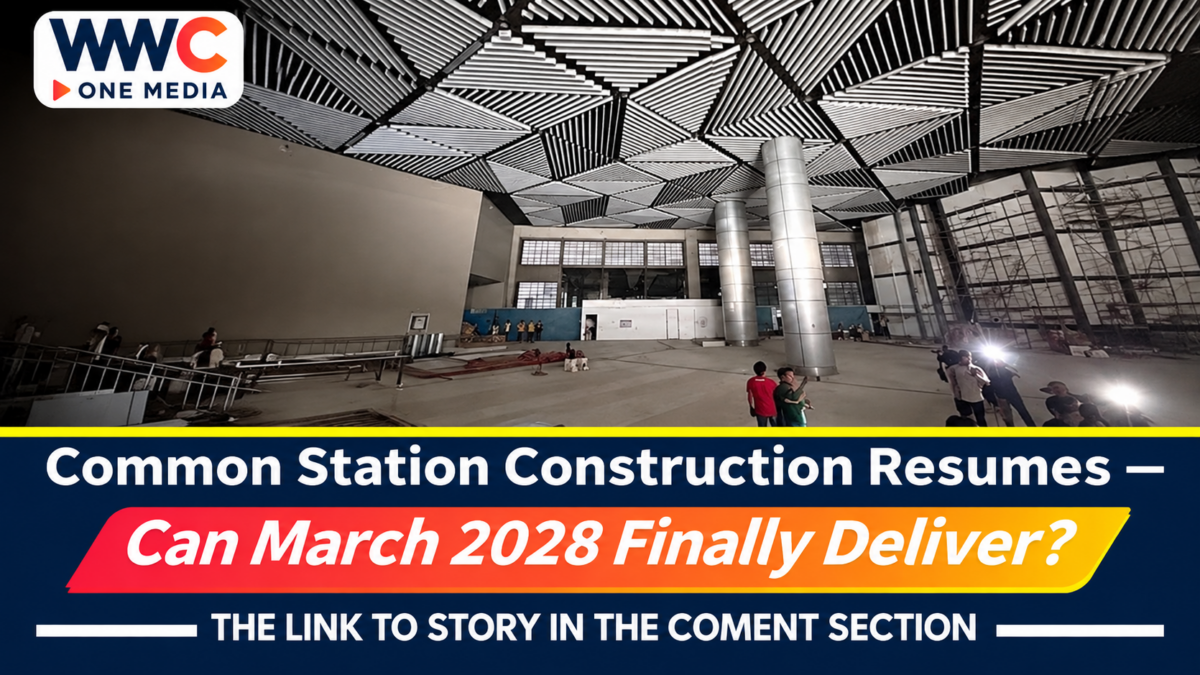
QUEZON CITY, Philippines — The government has restarted work on the long-delayed Unified Grand Central Station at North EDSA, with transport officials targeting interim passenger operations in March 2028. The renewed push follows a presidential directive and a government-approved change to the project’s implementation arrangements.
The crucial test is not simply whether construction proceeds. It is whether passengers can make convenient, safe transfers among Metro Manila’s rail systems while the surrounding network is still being completed.
Common Station Construction: What Has Actually Changed?
The Philippine Information Agency reported on Nov. 13, 2026, that President Ferdinand Marcos Jr. had ordered the immediate resumption of work on the Common Station. Transportation Secretary Vince Dizon said the administration wanted the facility available before the end of the president’s term.
The project is designed to connect Light Rail Transit Line 1 (LRT-1), Metro Rail Transit Line 3 (MRT-3) and the upcoming MRT-7. The Metro Manila Subway is planned for a later connection, rather than being part of the initial interchange service.
That distinction matters to commuters. A building can be open without every train line being ready, and a completed railway platform does not automatically mean passengers can transfer smoothly between separate systems.
The latest announcement confirms a renewed government push. It does not establish that all construction, testing and network integration have already been completed.
Why the ₱2.6-Billion Approval Matters
The government’s Public-Private Partnership Center confirmed that the Economy and Development Council approved a variation for the LRT-1 South Extension Project on July 7, 2026. The arrangement supports the Common Station’s completion and its proposed interim operations.
The variation order amounts to ₱2.6 billion. It covers station completion works, viaduct construction, railway systems, signalling and integration of automatic fare collection.
This is not simply a budget for a station facade. Rail operations depend on technical systems that control train movements, allow trains to use the relevant infrastructure safely and make passenger transfers practical.
The PPP Center also identified Light Rail Manila Corporation (LRMC) as the company implementing the LRT-1 extension’s operations-and-maintenance arrangement. The government’s approval provides a formal route for advancing the interchange work, but it should not be confused with certification that every remaining task has been delivered.
Why March 2028 Means Interim Service, Not Everything at Once
Official planning documents target March 2028 for interim operations of the Common Station. In practical terms, this means a usable stage of the facility may open before the long-term transport network is complete.
The distinction becomes especially important for the Metro Manila Subway. That railway forms part of the hub’s eventual design, but its own construction and commissioning follow a separate schedule.
WWC previously examined how underground utility relocation affects Metro Manila Subway construction. The same broad lesson applies here: supporting works and system interfaces can determine when passengers benefit from major transport investments.
A realistic assessment of March 2028 should therefore ask which entrances, concourses, platforms, connections and payment arrangements will be available on opening day. It should not equate a partial launch with the final integrated vision.
MRT-7 Is Another Piece of the Timeline
The Common Station is also tied to the development of MRT-7, the planned railway linking North Avenue with communities towards Bulacan.
In a 2026 project update, the PPP Center described MRT-7 as a ₱62.6-billion undertaking, with 14 stations over approximately 23 kilometres. It reported construction progress of 86.50% as of March 2026, with operations then targeted for the second quarter of 2027.
A separate transport-agency clarification said the first 12 stations were intended to begin partial service before the full 14-station alignment became available. Those schedules remain plans, not proof that passenger services have begun.
Other large rail projects face the same distinction between physical deliveries and passenger readiness. WWC’s report on new trainsets for the North-South Commuter Railway illustrates why rolling stock, stations, signalling and testing must come together before regular journeys can start.
For Common Station users, progress on MRT-7 will shape how valuable the interchange is during its opening phase.
Elevated Walkways Could Change the Daily Commute
The Nov. 13 government statement said the president had instructed transport officials to include elevated pedestrian walkways. The intended benefit is straightforward: passengers changing services would no longer need to descend to street level and cross busy parts of EDSA.
For commuters, the quality of the transfer can matter as much as the train journey itself. Covered paths, clear directions, manageable walking distances and accessible routes determine whether an interchange makes travel easier or creates another bottleneck.
There is an economic dimension, too. The PPP Center estimated that the fully developed hub could handle approximately 1.28 million passengers daily. That is a projected future capacity or usage figure, not an observed current passenger count.
The government’s wider transport spending choices will also influence how effectively the station connects with other services. WWC’s earlier examination of proposed transport funding and railway priorities provides context for the competing demands on public infrastructure budgets.
What Happens Next
The immediate milestone is sustained construction and completion of the works needed for interim service. The next is integration: stations, safe walkways, rail systems, passenger information and fare arrangements must function together.
The public will need a precise opening-phase plan showing which rail connections are ready, which remain temporary and which will follow later. The promised advantages should then be measured through actual transfer times and passenger experience, rather than projections alone.
What this could mean: The restart and approved funding mechanism improve the project’s path forward. But the decisive achievement will be a working interchange that passengers can reliably use in March 2028 — not simply another revised completion announcement.
Frequently Asked Questions
When is the Common Station expected to open?
Officials target March 2028 for interim operations. This is a planned date, not a guaranteed opening or confirmation that all connected lines will operate by then.
Which train lines will the Common Station connect?
Its main rail interchange is designed to serve LRT-1, MRT-3 and MRT-7, with the Metro Manila Subway intended to connect later.
How much is the approved variation order?
The PPP Center reported ₱2.6 billion, covering completion works, viaducts, railway systems, signalling and fare collection integration.
Will passengers still need to cross EDSA to change trains?
The government plans elevated pedestrian links so passengers can transfer without crossing busy EDSA lanes at street level. The actual routes available will depend on the completed opening-phase design.
Does the 1.28-million-passenger figure describe current ridership?
No. It is a government projection for the fully operational Common Station, not a measured daily count for an interchange that has yet to open.