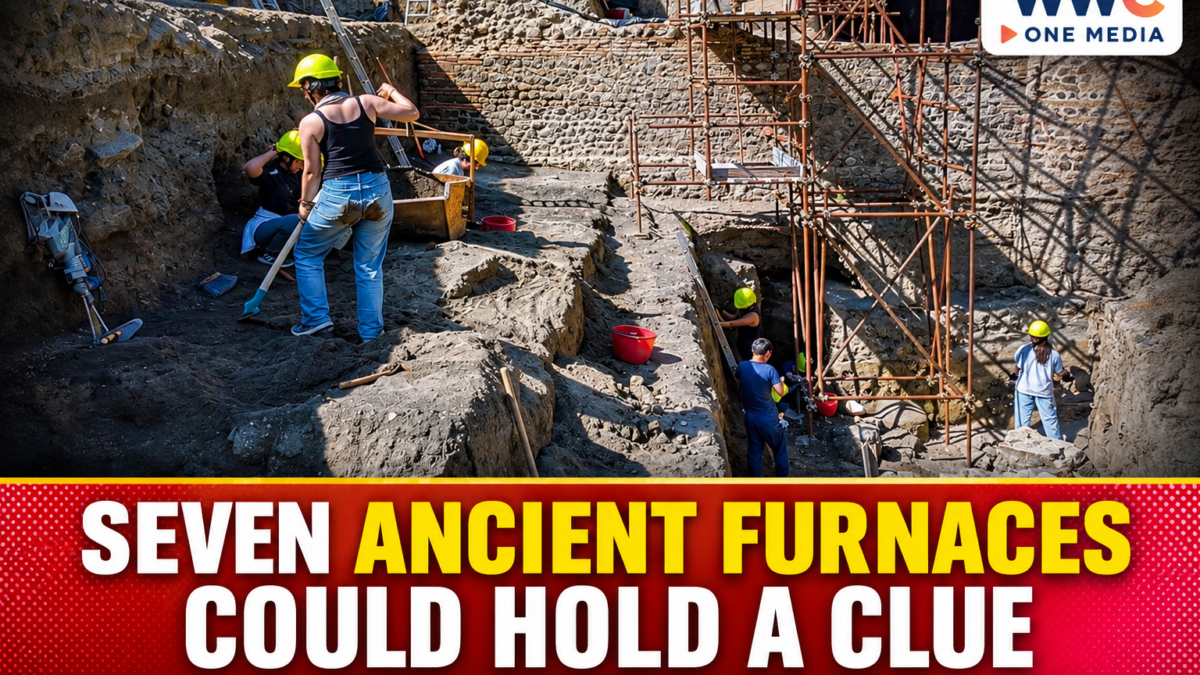
An excavation led by the University of Tokyo in southern Italy has uncovered an unusual room containing at least seven ancient furnaces, adding a significant clue to a Roman site that researchers are investigating for a possible connection to Emperor Augustus.
The discovery is part of the long-running Somma Vesuviana excavation, beneath the northern slopes of Mount Vesuvius. The researchers are examining whether an earlier building buried by volcanic activity could be connected to the place where Augustus, Rome’s first emperor, spent his final days. That possibility remains a hypothesis, not a confirmed identification. 東京大学基金+1
The project has now passed another important milestone. Its 2026 excavation season ended on Oct. 9, but the latest field report also shows that some of the questions researchers hoped to answer will require further work. 東京大学基金
Seven furnaces raise new questions about the Roman building
One of the most unusual findings at the site is a room containing at least seven furnaces, a feature the University of Tokyo project describes as exceptionally rare among comparable archaeological sites from the same period in Italy.
Their exact purpose has not yet been established. Researchers have raised the possibility that the room formed part of a bathing facility, but the discovery alone does not prove that interpretation.
Understanding how the furnaces were used will require examining the surrounding architecture, associated installations and archaeological layers. The arrangement may eventually help researchers determine whether the room served a specialised function within a larger complex.
The finding is important because it adds another piece of evidence to a site whose architecture and history are still being reconstructed. It also gives the research team a more specific target for future excavation. 東京大学基金
The Augustus connection remains a historical possibility
The site is in Somma Vesuviana, in Italy’s Campania region, near the town of Nola and north of Mount Vesuvius.
The University of Tokyo began its interdisciplinary excavation project there in 2002, working with local researchers. The investigation focuses on Roman structures buried by volcanic eruptions and the changes that took place in the surrounding community over time.
The possible connection to Augustus comes from the discovery of an earlier building beneath a much later Roman structure. The university’s 2024 research announcement described evidence suggesting that the earlier villa might have belonged to Augustus, whose final days are associated with the Nola area.
However, the university has not announced a definitive identification of the building as the emperor’s residence. Its researchers are still testing the possibility through archaeological evidence and comparison with historical accounts. The University of Tokyo+1
That distinction is essential. An archaeological site can be consistent with a historical account without conclusively proving that a particular person lived or died there.
Vesuvius buried more than Pompeii
The excavation also contributes to a wider understanding of the impact of Mount Vesuvius.
The eruption of A.D. 79 famously buried Pompeii and affected other settlements around the volcano. But the Somma Vesuviana site, located north of the mountain, provides evidence of destruction and rebuilding beyond the areas most commonly associated with the disaster.
The University of Tokyo’s research has identified an earlier building beneath a large structure constructed in the second century. The earlier remains were buried by volcanic material, while later construction indicates that the area experienced rebuilding after the eruption.
This makes the site valuable not only for Roman architectural history but also for studying how communities responded to major natural disasters.
Researchers are examining the sequence of destruction, burial and reconstruction to understand how the local environment and society changed over time. The University of Tokyo+1
The 2026 excavation ended with important questions unresolved
The project began its 2026 field season on Aug. 31 and completed work at the excavation site on Oct. 9. The researchers involved in the season had returned to Japan by Oct. 16, the project reported on Oct. 20.
The team had planned to investigate the layers between the damage caused by the A.D. 79 eruption and the construction of a later building in the middle of the second century.
However, researchers encountered more gravel deposits than expected. Removing those layers took longer than planned, leaving the investigation of the first-century deposits for a future season.
The team also hoped to identify a wall separating the room containing the seven furnaces from an adjoining room. That wall was not confirmed during the 2026 work.
Instead, the excavation showed that the room containing the furnaces continued farther west than previously established. 東京大学基金+1
These findings do not mean the season failed. They show that archaeological work can change direction when the physical evidence differs from what researchers expected.
They also demonstrate why the Augustus theory cannot yet be treated as a settled conclusion.
Why the excavation needs more than one season
The project is a multidisciplinary effort involving archaeology and other fields, including volcanology, history, architecture, soil science and conservation.
The work requires more than removing soil. Researchers must document the position of structures and objects, study geological deposits, analyse materials and protect exposed remains.
The university’s project information estimates that a larger investigation covering three excavation seasons would require approximately ¥150 million. It has also identified the need for about ¥15 million for repairs and new protective roofing for exposed structures.
Those expenses help explain why archaeological discoveries do not automatically lead to immediate answers. The evidence must be excavated carefully, preserved and studied before researchers can draw reliable conclusions. 東京大学基金
Public support allowed the 2026 work to proceed
The project faced funding difficulties before the 2026 season. Its emergency fundraising campaign ran from May 18 to June 30, with an initial target of ¥15 million.
The first target was reached on June 18. The campaign subsequently pursued a larger goal of ¥30 million, and the project reported total donations of ¥27,873,600 during the campaign period.
The university later reported that the funding needed for the 2026 excavation at its traditional scale had been secured. The field season proceeded as planned, although the project warned that continued work beyond 2026 would still require financial support. 東京大学基金+1
The fundraising outcome highlights a challenge for long-term archaeological research: even when a site produces significant discoveries, continuing the investigation depends on sustained funding for fieldwork, preservation and scientific analysis.
What happens next
The project has said that further excavation and analysis will be needed to address the questions left open in 2026.
Future work is expected to examine the first-century deposits, investigate the area west of the room containing the furnaces and clarify the sequence of construction and rebuilding.
The larger research objective remains to test whether the earlier building could be connected to Augustus and to reconstruct the history of the settlement before and after the eruption.
For now, the seven furnaces are an important archaeological feature, but their precise function and the identity of the building remain under investigation.
The next season may provide more evidence. Until then, the site offers a compelling glimpse into Roman life and the long process of recovery after one of antiquity’s most consequential volcanic disasters.