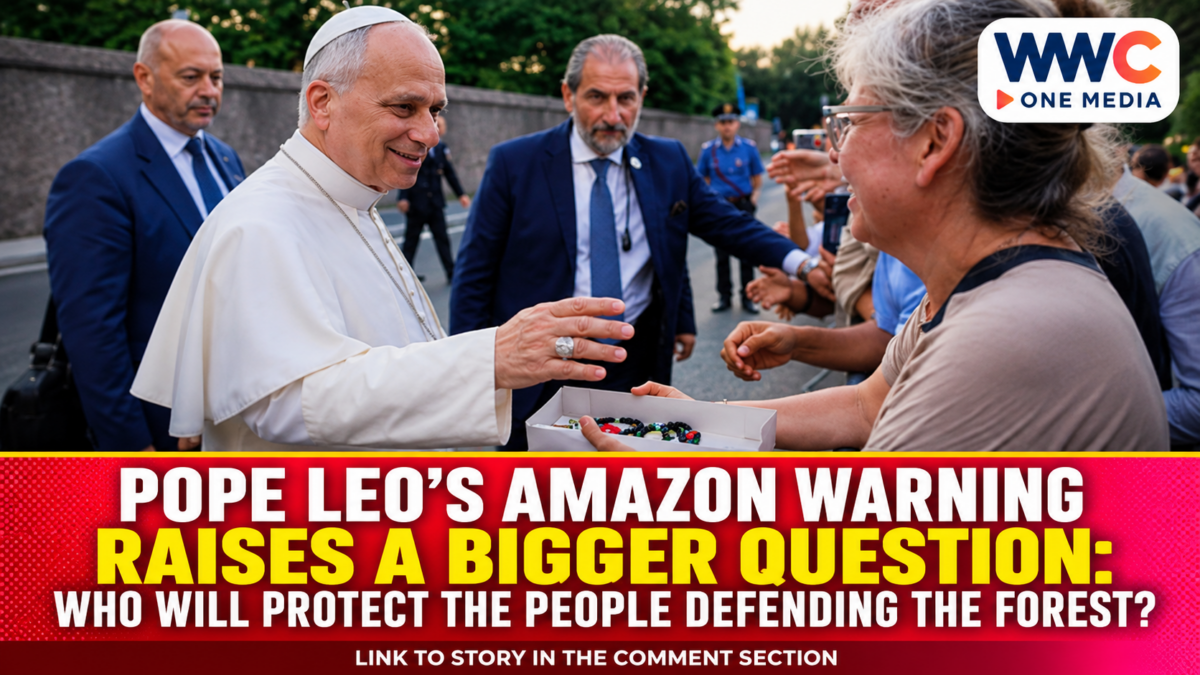
Pope Leo XIV used his Nov. 15 visit to Pucallpa, in Peru’s Amazon region, to connect environmental destruction with the safety, rights and survival of Indigenous communities, calling for justice for leaders murdered while defending their territories.
Speaking to missionaries and representatives of Amazonian peoples, the Pope condemned indiscriminate deforestation, river pollution linked to illegal mining and oil spills, and the exploitation of natural resources that threatens communities. His message placed a central question before governments, businesses and religious institutions: can the Amazon be protected if the people who live there remain exposed to violence, neglect and the loss of their ancestral lands? press.vatican.va+1
The address was not an announcement of a new conservation programme or a specific government policy. It was a public appeal grounded in the experiences described by people from the region and in the Catholic Church’s longstanding position that environmental protection cannot be separated from human dignity and social justice.
Pope Leo links Amazon protection to Indigenous rights
The meeting took place at Malecón Puerto Callao in Pucallpa on Sunday, Nov. 15, during the Pope’s apostolic journey to South America.
Leo told the gathering that protecting the rainforest must go hand in hand with concern for the people who depend on it. He described ecological protection, social justice and spiritual life as connected responsibilities.
The Pope also addressed the risks faced by Indigenous leaders who defend their territories. Referring to testimony presented during the gathering, he said that many Indigenous leaders had been murdered in recent years for protecting their lands.
“The blood of these brothers cries out to God and demands justice,” he said.
The statement gave the meeting a significance beyond environmental advocacy. It placed the protection of Indigenous land defenders within a wider discussion of human rights, accountability and the responsibility of institutions to protect vulnerable communities. press.vatican.va
The Pope did not identify individual victims or name alleged perpetrators in the address. Nor did he announce findings from a criminal investigation. His remarks were a condemnation of the killings and a demand for justice, not a legal determination of responsibility in any particular case.
That distinction matters. Allegations and reports of violence require investigation by competent authorities, while families and communities affected by those crimes need protection and access to justice.
Deforestation and polluted rivers threaten more than trees
Leo also focused on the environmental pressures facing the Amazon.
He referred to indiscriminate deforestation and the pollution of rivers and other waterways through illegal mining and oil spills. He rejected the idea that such damage should be treated as a series of unrelated accidents.
“These are not isolated accidents, but the consequences of the irresponsible exploitation of natural resources, which undermines the very existence of communities,” he said.
The concern is not limited to the loss of forest cover. When rivers are polluted or forests are degraded, communities that rely on local ecosystems can face threats to their livelihoods, access to resources and traditional ways of life.
For Indigenous populations, territory can carry cultural, historical and spiritual meaning as well as economic value. Damage to the environment can therefore affect both material conditions and the continuity of community traditions.
The Pope also criticised an economic approach that treats the region primarily as a reserve of resources to be extracted for immediate gain. He urged a different model that respects the knowledge and rights of the people who have lived in the Amazon for generations. press.vatican.va+1
The Pope raised concerns beyond environmental damage
The address also covered social problems that can leave remote communities particularly vulnerable.
Leo referred to the difficulty some communities face in accessing healthcare and education because of geographical isolation or institutional neglect. He described the denial of those rights as unacceptable.
He also expressed concern about violence and sexual abuse affecting women, girls and adolescents. The Pope said such suffering can be compounded by complicity and impunity, while corruption and arbitrary practices weaken public trust.
These concerns broadened the meaning of environmental protection in the address. Conservation cannot be measured only by the condition of forests and rivers if the people living in those areas are denied basic services or remain exposed to abuse.
The Pope called for quality education that includes Indigenous languages and values ancestral knowledge while preparing younger generations to meet contemporary challenges.
That point is significant because education can help communities preserve their languages and cultural identity while giving young people greater opportunities. It also recognises that traditional knowledge should not automatically be dismissed when decisions are made about land, resources and development.
The Vatican’s account of the meeting also recorded Leo’s appeal for renewed moral and educational commitment, as well as support for the local Church working across the vast Amazonian territory. press.vatican.va+1
Why the warning matters beyond Peru
The Pope’s remarks were delivered in Peru, but the issues he raised are relevant across the wider Amazon region, which extends across several South American countries.
Deforestation, illegal resource extraction, pollution and threats to Indigenous communities are not problems that can be addressed through speeches alone. They involve land governance, environmental enforcement, criminal investigations, public services and the participation of affected communities in decisions about their territories.
The challenge is especially clear when economic activity is presented as development while the environmental and social costs are carried by people living near extraction sites.
That does not mean every mining, energy or infrastructure project is automatically unlawful or harmful. It means projects must be assessed through credible environmental safeguards, transparent permitting and meaningful consultation where Indigenous rights may be affected.
The same questions arise in the Philippines, where disputes over mining and ancestral lands have prompted calls for stronger scrutiny of consultation and environmental safeguards. WWC has previously examined the questions raised by Ayta communities over a mining agreement in Bataan’s Mount Pantingan area.
A separate debate over the proposed Pax Silica development and concerns raised by farmers and Aeta communities has also highlighted the importance of transparency, land rights and environmental review.
These Philippine cases are not the same as the circumstances in the Peruvian Amazon. But they illustrate a common governance question: how can development proceed without sidelining communities whose land, resources and livelihoods may be affected?
The Church’s role—and the limits of a papal appeal
Leo’s address also called attention to the work of the local Church in remote parts of the Amazon.
He noted that the vicariate serving the area had only 25 priests, despite covering a territory he described as comparable in size to entire countries. He thanked religious workers, pastoral leaders and laypeople who serve communities in isolated locations.
The reference underscored the practical difficulty of providing consistent support across a vast region. Religious organisations can contribute through education, community assistance and advocacy, but they cannot replace the responsibilities of public authorities.
Governments remain responsible for enforcing environmental laws, investigating killings, protecting witnesses and ensuring access to healthcare and education. Companies operating in the region also have responsibilities to comply with the law and avoid causing harm.
The Pope’s appeal may strengthen public attention on these duties, but it does not itself establish a new enforcement mechanism or guarantee that conditions will change.
WWC has also reported on concerns about destructive mining and environmental protection in Eastern Samar, reflecting the continuing debate over how natural resources should be managed while protecting communities and ecosystems.
What happens next
The immediate test will be whether the concerns raised in Pucallpa receive sustained attention from the institutions with the authority to act.
That includes investigating the killings of Indigenous leaders, protecting people who face threats for defending their territories, addressing illegal mining and pollution, and improving access to essential services in remote communities.
The Pope’s address did not set deadlines or announce a formal action plan. It did, however, make clear that environmental destruction and the treatment of Indigenous peoples cannot be considered separate issues.
The lasting value of the visit will depend not on the strength of the words alone, but on whether they encourage practical action by governments, businesses, civil society and religious institutions.
For communities in the Amazon, the stakes are immediate: the security of their leaders, the condition of their rivers and forests, and their ability to protect their homes and cultural heritage.
Frequently asked questions
What did Pope Leo XIV say about the Amazon?
During a Nov. 15 meeting in Pucallpa, Peru, he condemned indiscriminate deforestation, pollution associated with illegal mining and oil spills, and the irresponsible exploitation of natural resources.
Why did Pope Leo mention murdered Indigenous leaders?
He referred to Indigenous leaders who had been killed while defending their territories and called for justice. His address did not identify individual victims or determine responsibility for specific killings.
Where did Pope Leo deliver the address?
He spoke at Malecón Puerto Callao in Pucallpa, in Peru’s Amazon region, during his apostolic journey to South America.
Did the Pope announce a new Amazon conservation programme?
No. The address was an appeal for environmental protection, justice and respect for Indigenous communities. It did not announce a specific new conservation programme or government policy.
Why are Indigenous communities central to Amazon protection?
Many Indigenous communities have longstanding cultural, social and livelihood connections to their territories. Environmental damage can affect their access to resources, traditional knowledge, community life and ability to remain on their ancestral lands.