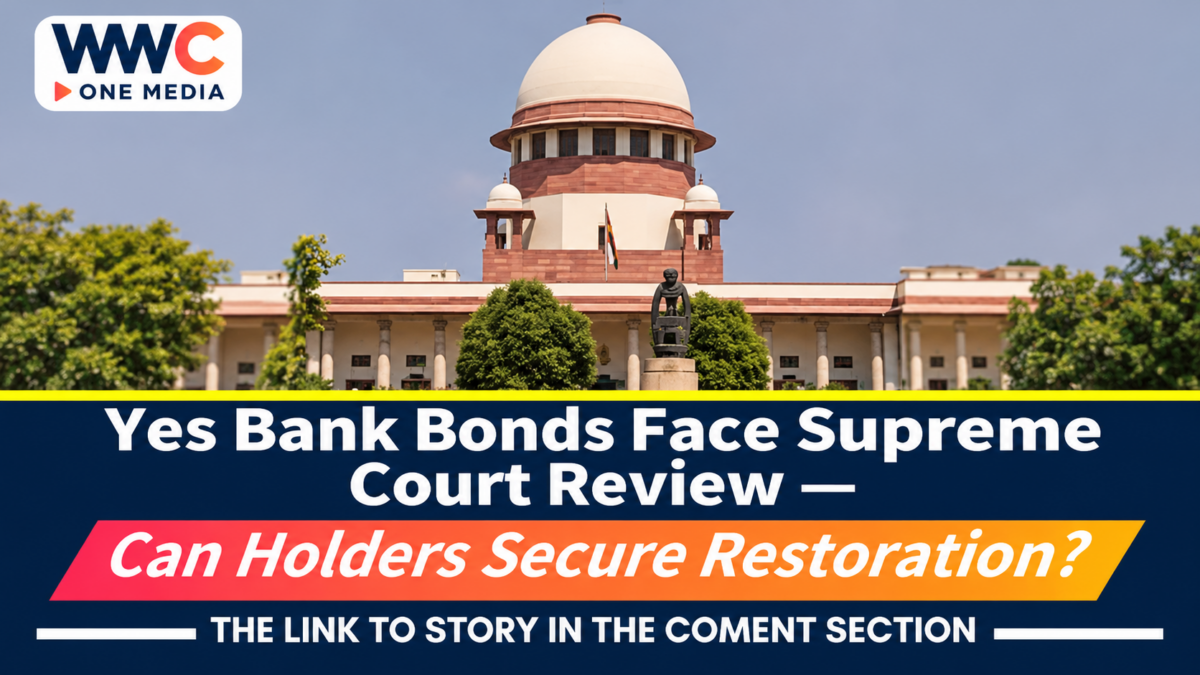
MUMBAI, Nov. 15, 2026 — India’s Yes Bank has asked the Supreme Court to review an Oct. 15 judgment involving the write-down of ₹8,415 crore in Additional Tier-1 bonds, the lender disclosed to stock exchanges on Nov. 13. The petition follows a formal demand by bond trustee Axis Trustee Services for restoration of the securities, leaving bondholders and the bank facing unresolved questions about implementation.
The amount in dispute is the face value of instruments covered by the write-down, not a court-confirmed cash payment already made to investors. The case illustrates why a bank’s capital instruments can pose legal and financial risks quite different from ordinary deposits or conventional bonds.
Yes Bank Bonds: What the November Filing Confirms
Yes Bank’s disclosure, signed by company secretary Sanjay Abhyankar, says the review petition was filed under Article 137 of India’s Constitution. It seeks reconsideration of the Supreme Court’s Oct. 15 judgment and order relating to the AT-1 bond write-down.
The filing puts the total at ₹8,415 crore, equivalent to ₹84.15 billion. Any dollar conversion depends on the exchange rate and date.
The bank cites earlier disclosures and promises updates on material developments.
Analysis: A review petition signals that the bank is challenging a judgment. Filing the petition is not evidence that the court has granted a stay, reversed its earlier ruling or settled what each holder will ultimately receive.
Trustee’s Demand Adds an Implementation Dispute
The bank’s Oct. 30 exchange filing includes the Oct. 28 letter sent by Axis Trustee Services, which acts on behalf of holders of the relevant securities. The trustee called on the bank to reinstate the bonds and complete the necessary corporate actions within three days.
The trustee warned that it might initiate contempt proceedings if the bank did not take the steps it demanded. That warning was a position expressed in the trustee’s letter; it was not itself a judicial finding that the bank or its officers had committed contempt.
In its Oct. 30 reply, Yes Bank acknowledged the judgment and said it was examining the legal implications. It maintained that it would take measures required and permitted by applicable law. The correspondence shows a disagreement about timing and implementation, not a final resolution of that disagreement.
The trustee’s letter identifies two bond-security identification numbers and refers to issuance documents from 2016 and 2017. Each security’s terms and the court’s directions matter for restoration.
Why AT-1 Instruments Are Not Ordinary Bank Deposits
Additional Tier-1 instruments are designed to absorb losses in a bank’s capital structure. Their terms may permit substantial losses to investors in specified circumstances, subject to the applicable contract, regulatory framework and law.
They are not equivalent to money held in a savings account. Nor should every bond issued by a bank be treated as the same type of security: maturity, ranking, coupon provisions and loss-absorption clauses can differ considerably.
For comparison, WWC’s coverage of Bank of Commerce’s recently completed bond fundraising discusses conventional peso-denominated bank funding securities. Those products are not the disputed Yes Bank AT-1 instruments, and the outcome of the Indian lawsuit does not determine their contractual terms.
Similarly, Bank of Commerce’s earlier bond-offering terms highlight the distinction between advertised interest and investor risk. A headline yield cannot explain what happens if a lender runs into serious financial difficulty.
The 2020 Write-Down Remains the Central Legal Question
The litigation concerns an AT-1 write-down associated with Yes Bank’s 2020 restructuring. The bank’s disclosures identify the Supreme Court judgment as the event now under review, while the trustee’s letter refers to the Bombay High Court’s Jan. 20, 2023 judgment and subsequent Supreme Court appeals.
A Supreme Court case record identifies Yes Bank and Axis Trustee Services as parties to Civil Appeal No. 3182 of 2025.
The full text of the Oct. 15 Supreme Court judgment was not independently opened for this article. Consequently, its detailed reasoning, precise directions concerning coupons and any deadlines beyond those stated in filed correspondence should not be presented as independently authenticated judicial findings.
Analysis: Legal validity and practical implementation are distinct. Restoring a security on a register, calculating payments and recognising a financial obligation are potentially different steps.
What the Dispute Means Beyond India
The dispute is directly about Indian instruments and Indian courts. It does not rewrite Philippine banking regulations or decide the treatment of bonds issued by Philippine lenders.
Still, it offers a useful reading lesson for investors. A bank’s name, the word “bond” and a quoted coupon rate do not establish capital protection. The governing documents and regulatory classification are decisive.
WWC’s review of BPI’s planned sustainability bond offering describes another form of bank financing with its own disclosures. The Yes Bank case should prompt closer attention to security-specific conditions, rather than blanket conclusions about all bank-issued debt.
Analysis: For regulators and investors, the larger question is whether the contractual and legal treatment of loss-absorbing instruments is sufficiently clear before a crisis. Litigation years after a resolution can complicate that assessment, even when the original regulatory goal was to preserve banking stability.
What Happens Next
The next decisive evidence will be a Supreme Court order addressing the review petition, any published decision on interim relief, and Yes Bank’s subsequent stock-exchange disclosures. Those records would show whether the earlier judgment remains operative and how the parties are required to proceed.
As of Nov. 15, the verified development is the bank’s filing for review and the previously disclosed trustee demand. Neither repayment to bondholders nor a reversal of the Oct. 15 judgment has been established in the records reviewed.
Frequently Asked Questions
How much is involved in Yes Bank’s AT-1 bond case?
Yes Bank’s Nov. 13 regulatory disclosure identifies AT-1 bonds aggregating to ₹8,415 crore, or ₹84.15 billion. That is the disputed bond amount, not a confirmed cash payout.
Did the Supreme Court reverse its ruling after Yes Bank filed for review?
No reversal was established in the primary records reviewed. The bank disclosed a review petition; filing one does not itself establish a new judgment.
Why did the bond trustee threaten contempt proceedings?
In its Oct. 28 letter, Axis Trustee Services demanded reinstatement and warned of possible contempt action if the bank failed to comply. The bank responded that it was studying the judgment and would follow applicable law.
Are Yes Bank’s AT-1 bonds the same as ordinary bank deposits?
No. AT-1 securities are loss-absorbing bank capital instruments with distinct terms and risks. They should not be treated as insured savings deposits or assumed to carry guaranteed repayments.