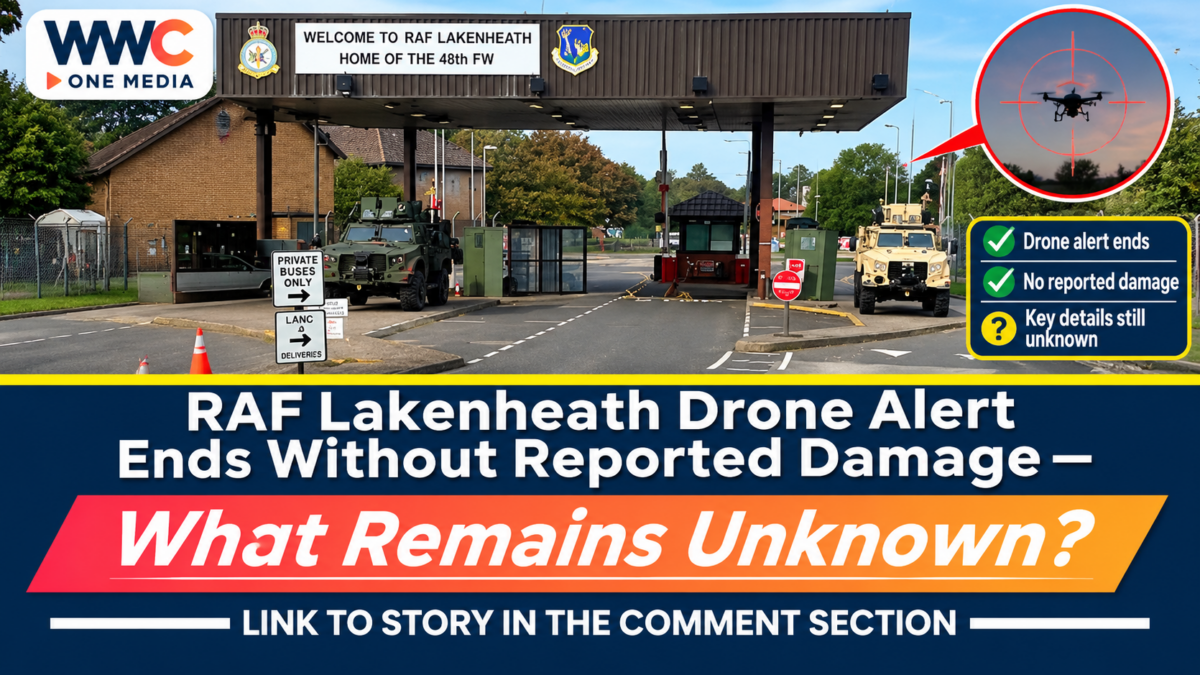
US Air Force security personnel responded to reports of suspected unauthorised drone activity at RAF Lakenheath in Suffolk, England, on Friday, Nov. 13, 2026. The US military’s publicly circulated statement said no personnel, aircraft or infrastructure were affected, while Britain’s Ministry of Defence said the immediate incident was resolved.
The RAF Lakenheath drone alert highlights an important distinction for communities around military installations: a security response confirms that personnel acted on a reported threat, not necessarily that investigators have identified a drone, its operator or its purpose. The public statements did not settle those questions.
RAF Lakenheath Drone Alert: What Officials Confirmed
The Air Force described the activity as suspected, rather than making a final identification of the objects. Its statement described a response by USAF Security Forces at the base and reported no damage or injuries. The UK Ministry of Defence likewise described joint work to establish what happened and said the immediate situation had been resolved.
A later Defence Ministry statement said Ministry of Defence Police and Suffolk Police assisted US security personnel. It also said the base had returned to normal security and force-protection measures. That is an operational update, not a finding that surveillance, an attack attempt or a foreign operation occurred.
An exact drone count, flight path, aircraft type, operator’s identity and method of detection were not established in the accessible official material. Nor was there a confirmed announcement that a drone was recovered, intercepted or destroyed. Reporting any of those possibilities as facts would go beyond what officials have made public.
Why the Airbase Matters to US and UK Security
RAF Lakenheath hosts the US Air Force’s 48th Fighter Wing, a substantial American combat-aircraft presence in Britain. Its official wing history identifies four combat-ready fighter squadrons operating F-15E Strike Eagles and F-35A Lightning II aircraft.
The base’s published organisational information describes a larger support network spanning operational units, security forces, maintenance, logistics and a community of American and British personnel and their families. A security alert at such an installation therefore involves more than the protection of aircraft alone.
This context explains why unusual activity around an airbase can prompt a rapid response before investigators have determined whether an aircraft is hostile, accidental or even present. It does not establish that Lakenheath’s operational readiness was impaired on Nov. 13.
WWC has previously examined security risks facing US military bases overseas, including the different challenges posed by drones, surveillance and potential sabotage. Those general risks should not be treated as proof of the motive behind this particular report.
Britain’s Drone Incidents Have Increased Sharply
Britain’s Ministry of Defence disclosed on Feb. 2, 2026, that there were 266 reported uncrewed-aerial-vehicle incidents near defence sites during 2025, compared with 126 in 2024. The count covers reported incidents near defence locations; it is not a tally of proven hostile drone incursions or successful attacks.
The government used those figures to explain measures in the Armed Forces Bill 2026. Its proposal would give authorised defence personnel expanded powers to detect and defeat threatening uncrewed devices at military sites without depending entirely on a police response.
The policy reflects a practical challenge: suspicious objects can appear close to sensitive installations faster than conventional law-enforcement processes can always respond. Any use of counter-drone equipment still depends on the relevant legal powers and safeguards.
Britain has also put specific flight restrictions around designated defence sites into law. Such restrictions aim to control unauthorised unmanned-aircraft flights; they do not by themselves establish that every reported sighting is criminal or dangerous.
Other Base Cases Require Separate Evidence
Military installations used by American forces in Britain have drawn attention in other investigations. A recent US prosecution relating to RAF Fairford, for example, involves allegations that must be proved through the courts, not assumptions about a separate incident at Lakenheath.
WWC’s report on the RAF Fairford prosecution and the allegations in a US indictment explains how investigators described a different alleged operation. Earlier coverage of arrests near RAF Fairford documented the initial response there. Neither case establishes a link to the suspected drone activity reported at Lakenheath.
Separating incidents is essential to fair reporting. The fact that two locations serve US military operations, or that security warnings appear close together in time, does not demonstrate a common organiser, method or objective.
There is no basis in the verified Lakenheath incident record to attribute the reported activity to Iran, Russia, another government or a particular organisation. Equally, a return to normal security measures does not prove that officials have resolved every factual question.
What This Could Mean for Base Protection
Analysis: The clearest lesson is about decision-making under uncertainty. Airbase commanders must protect people and equipment using the information available at the time, even when that information is incomplete. A precautionary response can be appropriate without proving an attack occurred.
The UK government’s drone-incidence statistics suggest that military installations face a persistent detection and response problem. However, aggregate reports cannot tell readers whether the Nov. 13 Lakenheath incident involved a genuinely unauthorised aircraft, an innocent flight or a mistaken identification.
For nearby residents, transparent public updates can help distinguish an immediate danger from a resolved alert. For military planners, effective coordination between US base security, UK defence police and local police matters because airspace, base access and civilian safety involve overlapping responsibilities.
The unresolved question is therefore not whether officials should have responded, but what their investigation can establish from the available evidence.
What Happens Next
As of Nov. 15, the official position conveyed publicly was that the immediate Lakenheath situation had ended and normal security arrangements had resumed. Officials had not publicly supplied a final identification of the suspected object or an explanation of its origin.
Further meaningful updates would include an official incident summary, confirmation of whether an actual drone was identified, and any police or regulatory action supported by evidence. Until then, the most accurate description remains a security response to suspected unauthorised drone activity, with no reported harm to personnel, aircraft or infrastructure.
Frequently Asked Questions
Where did the suspected drone activity occur?
The alert involved RAF Lakenheath in Suffolk, eastern England, which hosts the US Air Force’s 48th Fighter Wing.
Was RAF Lakenheath damaged?
The US military’s public statement reported no personnel, aircraft or infrastructure affected. No damage was established in the available official accounts.
Did authorities confirm who flew the drone?
No. The publicly circulated official statements did not identify an operator, a country of origin or a motive, and did not confirm a recovered drone.
Has the security alert ended?
The UK Defence Ministry said the immediate situation was resolved and later reported that normal security and force-protection arrangements had resumed.
Why is Britain expanding counter-drone powers?
The Ministry of Defence reported 266 drone-related incidents near UK defence sites in 2025, up from 126 in 2024, and proposed changes to the powers of authorised defence personnel.