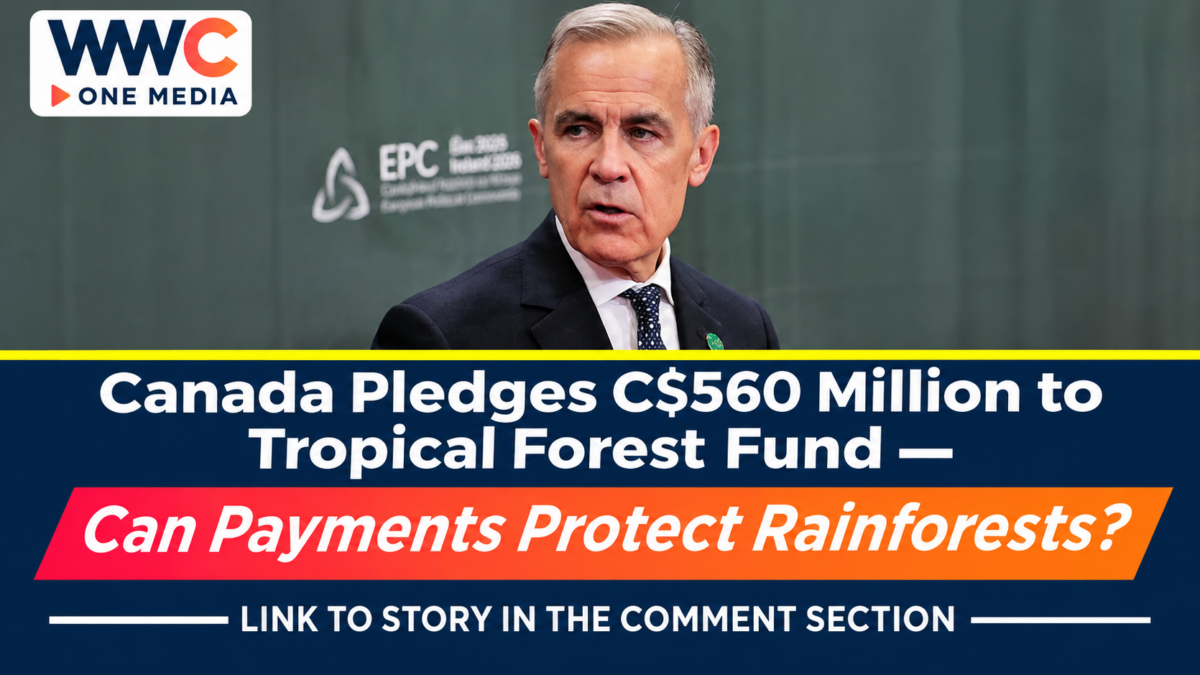
CANADA — Nov. 15, 2026. Canadian Prime Minister Mark Carney announced an initial contribution of up to C$560 million over four years to the Tropical Forest Forever Facility (TFFF) after meeting Brazilian President Luiz Inácio Lula da Silva during the ASEAN Summit in Manila on Sunday. The Brazil- and Norway-led initiative aims to finance tropical forest protection by rewarding participating countries for verified conservation rather than simply funding individual projects.
The tropical forest fund is an ambitious test of environmental finance: sponsors must supply capital, investments must produce sustainable returns, and eligible countries must demonstrate that forests remain standing. Canada’s announcement is a funding commitment, not proof that C$560 million has already been transferred or that forest payments have begun.
What Canada’s tropical forest fund pledge actually covers
Ottawa described the C$560 million as an initial contribution of up to that amount, spread across four years. The wording matters because it specifies a ceiling and period rather than a confirmed one-time cash disbursement.
The pledge sits within Canada’s wider goal of delivering more than C$13 billion in international climate-related support to developing countries by 2031. The government said its financing is intended to help the facility launch operations and attract further investment from public and private sources.
The announcement was made in Manila, not in the Amazon. It came during a bilateral meeting on the sidelines of an ASEAN summit, highlighting how forest protection has become part of broader economic diplomacy between Canada and Brazil.
How investment returns could pay for standing forests
Instead of relying only on recurring grant budgets, the TFFF intends to assemble sponsor capital and private investment in a financing structure. Its investment arm would hold a diversified portfolio of financial assets; the conservation arm would distribute performance-based payments to eligible tropical forest countries.
The World Bank’s description distinguishes the Tropical Forest Investment Fund, a separate financial entity, from the facility’s financial intermediary fund, which channels conservation payments. This separation is important: raising money and paying countries for results are related but different operations.
Canada’s announcement sets out a fundraising ambition of US$35 billion from sponsor countries and organisations, intended to attract up to US$140 billion in private capital. These are targets, not amounts verified as raised or available for distribution.
If investment returns are weaker than expected, the resources available for payments could be constrained. The model therefore carries financing and implementation risks even if governments support its conservation objectives.
How tropical forest protection would be measured
Under the facility’s published design, annual payments depend on verified forest-conservation performance. Remote-sensing and satellite information would help assess eligible forest areas and deforestation conditions, rather than counting the number of trees promised in a press release.
The intended scale is substantial: when fully operational, the facility aims to cover more than one billion hectares of tropical forests in over 70 countries. That is a future programme ambition, not an assertion that those forests are already receiving protection payments.
A credible measurement system will need consistent definitions, reliable monitoring and understandable public reporting. Satellite evidence can document changes in forest cover, but decisions over eligibility and the use of money also require institutional safeguards.
This distinction echoes the Philippine emissions-monitoring challenge: financing claims become more credible when the underlying environmental results can be independently assessed.
Why Indigenous communities are central to the design
The TFFF requires at least 20% of forest payments to be directed to Indigenous Peoples and local communities. It recognises their role in protecting forests and seeks to give them a defined share of the programme’s benefits.
That percentage applies to forest payments, not automatically to 20% of Canada’s headline pledge. Confusing the two would exaggerate what has already been allocated to communities.
The facility’s charter, adopted in July 2026, also provides for a stronger role for Indigenous and local-community representatives in governance. It remains necessary to monitor how national arrangements translate the international commitment into transparent, accessible financing.
As with the Philippines’ emerging climate-finance strategy, announcing access to a funding mechanism is not the same as demonstrating that money has reached vulnerable households.
What this could mean for climate finance
Analysis: The proposition behind the TFFF is that conserving forests provides benefits beyond national borders and should produce a dependable economic reward for countries that preserve them. If effective, this could complement climate grants and carbon-market initiatives with a longer-term source of conservation funding.
Its strongest potential advantage is predictability. Instead of requiring a new project proposal for every payment, the design seeks recurring rewards linked to verifiable national performance. Its biggest test is whether capital can be raised at scale without excessive financing risk or weak oversight.
The existing COP31 climate-finance debate provides context for that challenge: political commitments alone cannot guarantee implementation. The Canadian contribution is significant, but measurable conservation outcomes will ultimately determine its value.
What happens next
The facility’s own development timetable still lists key operational tasks, including establishing its investment arm, mobilising initial capital, conducting performance assessments and making its first forest payments. The World Bank is involved as trustee and interim host of the secretariat.
Canada and its partners must now turn announced support into financing arrangements, while tropical forest countries prepare the data and systems needed to qualify. Until those steps are completed, it would be premature to credit the pledge with preventing a specific amount of deforestation.
The decisive test is simple: can a sophisticated investment vehicle reliably reward countries and communities for keeping forests intact, year after year?
Frequently asked questions
How much did Canada pledge to the Tropical Forest Forever Facility?
Up to C$560 million over four years, announced by Prime Minister Mark Carney on Nov. 15, 2026. The official announcement describes a commitment, not a completed transfer of the full amount.
What is the Tropical Forest Forever Facility?
It is a Brazil-initiated, Norway-co-led financing mechanism designed to generate investment returns and pay eligible tropical forest countries for verified forest conservation.
Does the fund pay communities directly?
Its design requires at least 20% of forest payments to benefit Indigenous Peoples and local communities. The actual payment arrangements and disbursements must still be tracked.
Has the fund already protected one billion hectares?
No. More than one billion hectares across over 70 countries is its stated scale once fully operational, not a verified outcome as of Nov. 15, 2026.
Is this the same as the Amazon Fund?
No. The TFFF is a separate international investment-based facility designed to reward eligible tropical forest countries. It should not be confused with existing forest programmes or specific restoration-project financing.