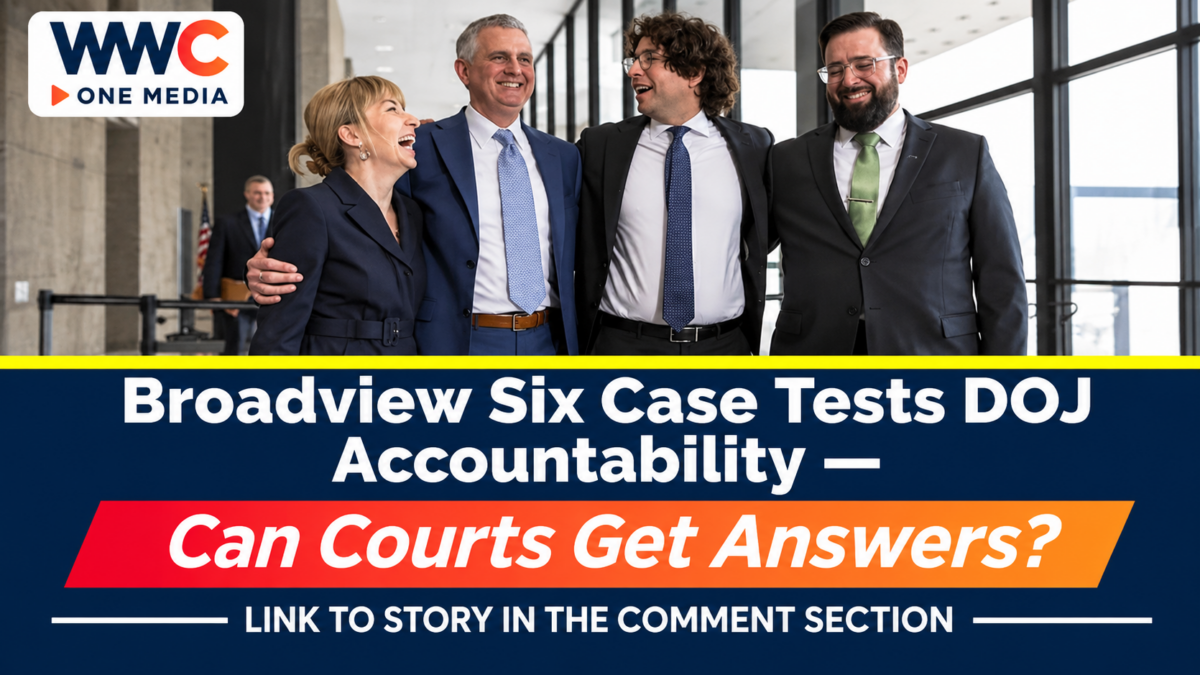
CHICAGO, United States — Nov. 15, 2026. The failed federal prosecution of six people arrested after a September 2025 protest near an immigration detention facility in Broadview, Illinois, continues to raise questions about the handling of grand-jury proceedings. A released federal court transcript records the prosecution’s decision to abandon the remaining charges on May 21, 2026, while an official Justice Department report provides the government’s account of one disputed aspect of the case.
The Broadview Six case matters beyond the individuals involved. Its record exposes an important distinction between a prosecutor’s power to bring charges, a grand jury’s responsibility to evaluate evidence, and a court’s authority to examine possible procedural failings. The collapse of the case is documented; claims of political direction or criminal misconduct require separate proof.
Broadview Six Case: What the Court Record Shows
The federal case, United States v. Rabbitt et al., was assigned number 25 CR 693 in the Northern District of Illinois. The six named defendants were Michael Rabbitt, Katherine Marie Abughazaleh, Andre Martin, Catherine Sharp, Brian Straw and Joselyn Walsh.
The May 21 hearing transcript records proceedings before US District Judge April M. Perry with US Attorney Andrew S. Boutros appearing for the government. The case arose from accusations connected with activity near the Broadview immigration facility, but the underlying accusations were never established through a criminal conviction in this prosecution.
At that hearing, Boutros discussed the decision to dismiss the case and the handling of material from grand-jury proceedings. That is more reliable evidence of the procedural history than speculation about what an untested allegation means.
Dismissal is not the same thing as a jury finding on every disputed fact. It does mean the prosecution ended without a conviction of these six defendants in the matter.
What the Grand-Jury Transcripts Add
Released October 2025 grand-jury transcripts later filed in the case show Assistant US Attorneys Sheri Mecklenburg and Matthew Skiba participating in proceedings. The October 9 transcript includes statements by Mecklenburg about her familiarity with the grand jurors and her confidence in the proposed charges.
Those recorded remarks explain why the presentation became a focus of legal scrutiny. A grand jury is supposed to assess whether the evidence supports a charge, rather than decide a case on a prosecutor’s personal assurance.
But a transcript showing disputed conduct is not automatically a final finding of intentional wrongdoing. Whether an attorney violated a particular rule, what consequences should follow, and whether additional investigation is warranted are separate legal questions.
That distinction also matters when evaluating a federal investigation involving opposition lawmakers: a proposed charge, an indictment and a conviction are three different procedural outcomes.
The Justice Department’s Response Is Part of the Record
The US Attorney’s Office subsequently published a special report about grand-jury appearances. The office characterised the release as a court-authorised disclosure of materials normally protected by grand-jury secrecy, and said it was addressing questions about Boutros’s own participation.
The report offers an official government position. It should be read alongside, not substituted for, the court transcript and other filings. Government statements can explain an agency’s actions without resolving every question the judge or defendants have raised.
The public record therefore supports two simultaneous observations: prosecutors acknowledged the failure of the case, and the parties continued to dispute aspects of the grand-jury process. It does not support the blanket claim that every prosecutor involved was found criminally liable.
In analysis, transparency matters particularly when an agency investigates conduct connected to demonstrations against government policy. The evidentiary standard should remain the same regardless of whether defendants support or oppose the administration.
Why Prosecutorial Accountability Matters
Federal prosecutors exercise substantial discretion, but they are subject to judicial procedures and professional responsibilities. Grand-jury secrecy protects the integrity of investigations; it does not mean the public should assume that every disputed action was lawful or unlawful without examining the record.
A failed prosecution can also have wider institutional consequences. The public may reasonably ask whether safeguards worked, whether errors were detected promptly and whether internal reviews are sufficiently independent.
Those are governance questions, not proof of a particular official’s motive. WWC’s earlier coverage of the wider dispute over Justice Department investigations provides political context, but it cannot establish why individual lawyers acted in the Broadview prosecution.
Likewise, an immigration-related federal assault case involves its own evidence and legal process. Similar subject matter does not justify treating separate defendants or incidents as interchangeable.
A sound measure of institutional accountability is whether documented mistakes receive a clear response, not whether the result satisfies a preferred political narrative.
What the Record Does Not Prove
The case raises questions about communications, decisions to bring charges and possible handling of grand-jury material. But the primary documents reviewed for this article do not establish an instruction from the White House to prosecute the six defendants.
They also do not establish a judicial finding that Boutros, Mecklenburg or other named prosecutors committed a crime. Allegations advanced by participants must be distinguished from rulings actually entered by a court.
The November timetable for further hearings has been described in publicly available reporting, but a contemporaneous signed order setting those dates was not independently obtained for this article. No specific future hearing date is therefore presented here as a verified court order.
What Happens Next
The important next step is the release of any additional court orders, sworn testimony and decisions that clarify the grand-jury record. Those materials could establish whether further inquiry, professional discipline or other remedies are appropriate.
In the meantime, the strongest conclusion is narrow but consequential: the prosecution ended, the grand-jury process became the subject of serious judicial concern, and the government published its own account of disputed proceedings.
Public trust is not restored by treating an allegation as a conviction or by dismissing every concern as politics. It depends on verifiable records, fair opportunities to respond and clear explanations of what courts actually decide.
Frequently Asked Questions
Who were the Broadview Six?
They were Michael Rabbitt, Katherine Marie Abughazaleh, Andre Martin, Catherine Sharp, Brian Straw and Joselyn Walsh, the defendants named in federal case 25 CR 693.
Were the Broadview Six convicted?
No. The federal prosecution ended without convictions of the six in that case. The May 21, 2026, court transcript documents proceedings concerning dismissal.
Why did the grand-jury process come under scrutiny?
Released transcripts recorded disputed statements and interactions during presentation of the proposed charges. The legal significance of those actions must be determined through the appropriate proceedings.
Has the court found that the White House ordered the prosecution?
No such finding was established by the primary records reviewed for this report.
What could happen next in the case?
Further court records may clarify the disputed conduct and whether any judicial, professional or other accountability measures are justified. No particular outcome is guaranteed.