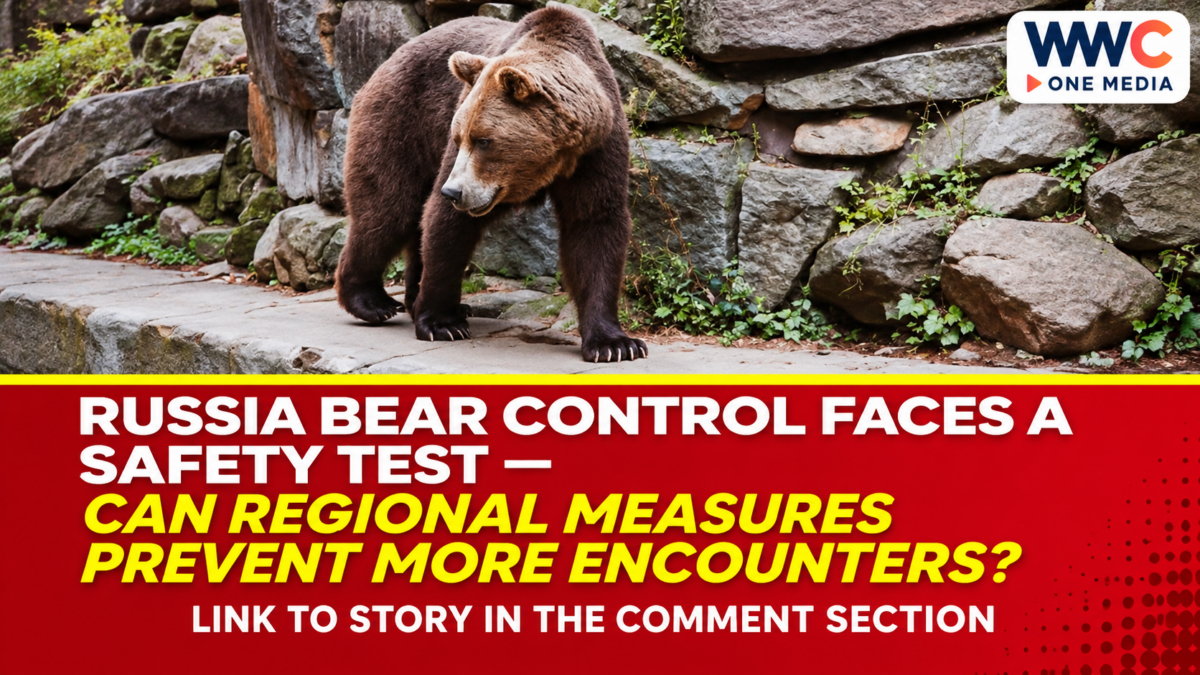
MANILA, Philippines — Nov. 14, 2026. Russian authorities have documented a series of dangerous encounters between people and brown bears this year, prompting regional wildlife-control decisions, restrictions on access to forest areas and prosecutorial scrutiny of public-safety responses. The evidence raises a larger question for Russia bear control: can authorities reduce the risk to people while ensuring that wildlife removals are properly authorised, targeted and monitored?
An announcement reported on Nov. 13 described a nationwide removal ceiling of 30% and 36 bear-attack deaths in 2026. The signed federal amendment and the underlying national fatality dataset were not independently located in the original records examined for this story. Those figures therefore cannot be certified as official statistics here. The available regional records, however, establish that authorities have already been responding to a serious safety problem.
Russia Bear Control: What Regional Orders Actually Establish
The Tomsk regional department responsible for hunting and fishing maintains a public register of 2026 decisions to regulate wildlife numbers. Its entries identify dates, particular districts, named locations and quantities of brown bears authorised for removal. These are individual administrative decisions, not evidence that an entire regional population has been culled.
For example, its Sept. 25 entries include authorisations concerning one bear near Kirzavod in Bakcharsky district and two near Gorelovka in Chainsky district. Other decisions issued in September cover specific settlements and hunting areas. Such records make the geographic scope of a particular intervention more transparent than a nationwide percentage reported without its implementing order.
A decision to remove an animal also does not prove that the operation was completed. For that, readers would need execution reports showing the date, the animals involved and how officials confirmed the result.
The Public-Safety Response Goes Beyond Hunting
In the Republic of Tuva, the regional emergency ministry warned on Sept. 5 that bears were appearing near settlements amid a poor harvest of nuts and berries in Siberia. It advised residents to take precautions during the autumn period, when bears are particularly active before hibernation.
A further Oct. 16 notice stated that heightened restrictions would remain in place until Nov. 30. These included limits on access to tourist trails, restrictions on events near forests and guidance on contacting emergency services after a sighting. The notice demonstrates that authorities were using access controls as well as wildlife management to reduce potential encounters.
The measures can inconvenience tourism operators and local residents. Analysis: Their justification must therefore depend on a credible local risk assessment, clear public communication and regular review of whether conditions still require restrictions. Opening a forest trail too early and keeping it closed unnecessarily carry different costs.
Prosecutors Examine Whether Authorities Acted in Time
A published Krasnoyarsk regional prosecutor’s statement described six deaths linked to incidents involving bears in September, while expressly noting that the circumstances and precise cause of one death were still being established. It is important not to erase that qualification or automatically add the provisional case to a confirmed national total.
The prosecutor’s review found that measures by responsible agencies to regulate bear numbers and prevent animals approaching settlements had been untimely and insufficient to protect residents. Materials were referred to investigators, and a criminal negligence case was opened. The existence of an investigation does not mean that any named individual has been convicted or that negligence has been finally proved in court.
This is a more concrete accountability question than whether a quota sounds large enough. Officials need to show when warnings were received, what action followed and whether the available powers were used appropriately.
Human–Wildlife Conflict Requires Evidence, Not Simple Comparisons
Wildlife management involves both safety and conservation duties. An animal entering a residential area may create an immediate hazard, but an occasional sighting and an aggressive approach are not identical events. Authorities need consistent categories for reports, verified attacks, injuries and fatalities so the public can understand the nature of the threat.
Earlier WWC coverage of wild boar encounters and public-safety litigation in Singapore illustrates why agency action and legal responsibility must be kept distinct. That unrelated case does not establish the cause of Russia’s bear encounters or the effectiveness of Russian controls.
Similarly, the challenge of Philippine eagle protection and wildlife monitoring illustrates a different conservation problem. The species, risks and applicable laws differ sharply, but careful field observations and transparent records matter in both situations.
The availability of food near settlements is also relevant. Tuva’s official warning points to poor natural food conditions as one factor in encounters. It does not establish the exact cause of every incident elsewhere in Russia. A complete response may require safer waste handling and community warnings alongside interventions involving particular animals.
What a National Removal Ceiling Would Need to Prove
Analysis: Even if the reported 30% ceiling is confirmed, a ceiling is not a target and certainly not a record of animals killed. A maximum share of a regional population describes legal room for action; actual permits, removals and ecological effects would need separate accounting.
Wildlife population estimates can also vary by survey methods, season and area. Without published regional baselines, the same national percentage could lead to very different numbers of authorised removals. Policymakers should therefore explain how they measure populations and assess whether interventions focus on repeated danger near communities.
WWC has previously explored the role of wildlife monitoring and conservation technology. Technology cannot replace trained field personnel, but better records could help authorities distinguish persistent high-risk sites from isolated sightings.
Any conclusion that expanded culling has already prevented attacks would require before-and-after data, adjusted for geography, season and reporting differences. Those outcomes have not been demonstrated by the official material examined for this article.
What Happens Next
The next decisive documents are the signed and registered nationwide hunting amendments, regional implementation orders and authoritative attack statistics. They should clarify whether the reported ceiling changes local permissions, when it takes effect and what independent safeguards apply.
The already published regional record demonstrates real safety concerns and active government interventions. Whether a broader policy saves lives will depend on timely action, reliable wildlife information and measurable results rather than the size of a quota alone.
Frequently Asked Questions
Has Russia officially authorised killing 30% of its bears?
A national 30% maximum was reported on Nov. 13, but the signed original federal amendment was not directly authenticated for this review. A maximum allowance would not mean that 30% had already been killed.
Were 36 people killed by bears in Russia in 2026?
That total appears in contemporaneous reporting of a ministry statement, but the original nationwide fatality dataset was not accessible. The article does not certify it as a verified primary-record count.
What has the Russian government already done?
Tomsk published location-specific removal decisions. Tuva’s emergency authorities issued safety warnings and temporary access restrictions. Krasnoyarsk prosecutors examined the adequacy of regional responses.
Does a wildlife-removal permit prove a bear was killed?
No. Permission is different from completion. Execution reports would be needed to verify how many animals were actually removed.