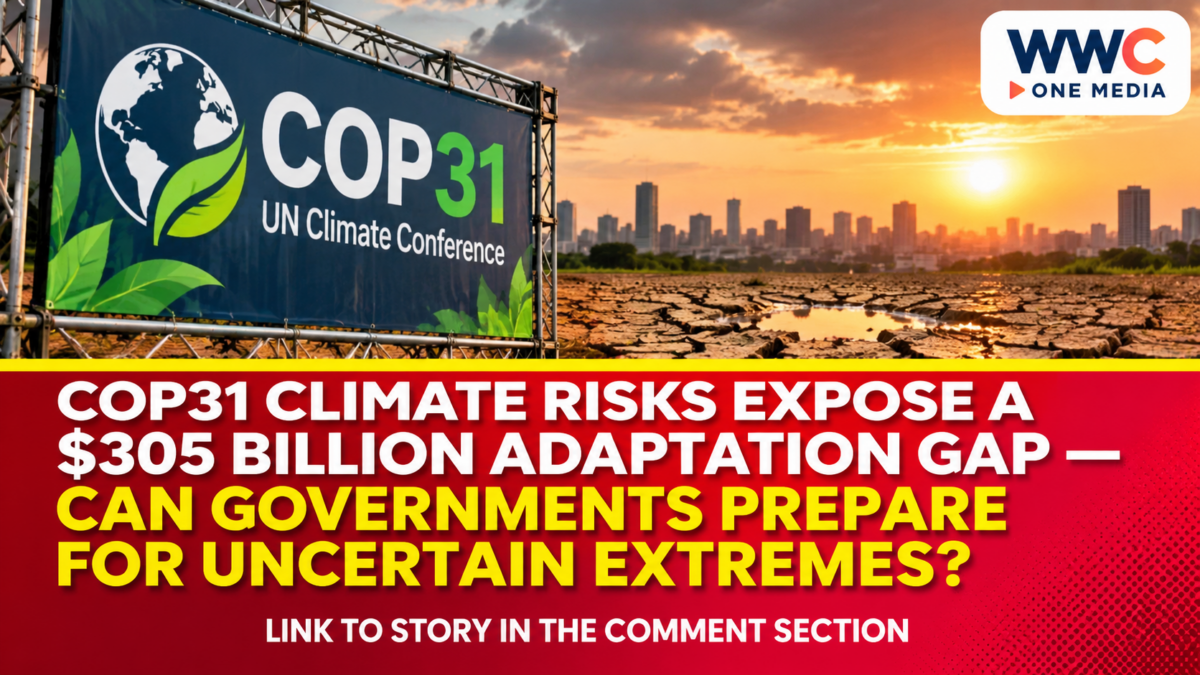
UNITED STATES — Nov. 14, 2026. Negotiators at COP31 in Antalya, Türkiye, are confronting a measurable gap between the growing risks of climate change and the money available to protect vulnerable communities. A new United Nations assessment estimates developing countries will need US$305 billion a year for adaptation by 2035, even as 2026 temperatures, ocean heat and sea levels underscore the difficulty of planning for changing conditions.
The immediate challenge is not evidence that climate models have universally failed. It is that models describe ranges of possible futures, while households, businesses and governments must make expensive decisions today about drainage, water supplies, buildings and insurance.
COP31 Climate Risks: What the Scientific Records Show
The UN climate conference runs from Nov. 9 to 20 at the Antalya Expo Center. Its official agenda includes adaptation, climate finance and the international framework for responding to loss and damage. Discussions are continuing; a final COP31 agreement cannot yet be described as adopted.
The World Meteorological Organization’s Nov. 9 climate update places the global mean temperature for January through September 2026 at approximately 1.47°C above the 1850–1900 average. Its preliminary assessment says 2026 is on course to rank among the four warmest years on record.
This figure describes nine months, not a completed calendar-year average. It also does not mean the Paris Agreement’s long-term 1.5°C temperature threshold has been formally measured as permanently breached by that single period.
The same update reports record-high global mean sea level in the satellite era and preliminary evidence of a tenth successive year of record ocean heat content. The agency says El Niño intensified after August and could add further heat and rainfall variability into 2027.
Are Climate Models Really Being Overtaken?
The phrase “outpacing the models” can describe a planning problem, but it should not be presented as a universal scientific finding. Climate projections typically compare outcomes under different emissions assumptions, while short-term weather, regional extremes and exposure to hazards can differ greatly from a long-term global average.
The Intergovernmental Panel on Climate Change finds that models reproduce important features of observed global warming and temperature extremes, although the agreement varies by region, period and measurement. It also identifies compound risks: events that combine with infrastructure weaknesses, settlement patterns or other pressures to magnify harm.
A city using an outdated flood map may underestimate danger even when the underlying climate science correctly identifies rising risk. Likewise, a more intense rainfall event does not alone demonstrate that an entire generation of climate models has been disproved.
Analysis: The sensible response is to update design assumptions, test a range of plausible outcomes and plan for consequences that would be difficult to reverse. That is more useful than arguing that one surprising disaster makes all predictions worthless.
The Adaptation Gap Is a Budget Problem, Too
The UN Environment Programme’s 2026 Adaptation Gap Report estimates annual adaptation needs in developing countries at US$305 billion by 2035. It calculates international public adaptation-finance flows from developed to developing countries at US$28.2 billion to US$31.7 billion in 2024.
The figures refer to different years and concepts: the first is an estimate of future annual needs; the second measures historical financial flows. They should not be compared as though they were identical budget accounts. Nonetheless, their scale illustrates how far existing funding falls short.
The report also says the initial funding window for the Fund for Responding to Loss and Damage attracted US$2.8 billion in requests, against US$342 million available. This is a separate facility and should not be confused with the total adaptation-finance requirement.
The related Philippine issue is explored in WWC ONE MEDIA’s report on the national climate-related loss-and-damage strategy. A framework may improve access to assistance, but it is not evidence that individual families have already received new funding.
Why Emissions Cuts Still Matter to Adaptation Costs
The 2026 UN emissions assessment examines what is needed to limit the extent and duration of warming above 1.5°C. Under its described lower-overshoot pathway, global greenhouse-gas emissions would need to fall 18% by 2030, 45% by 2035 and 69% by 2040, relative to 2025.
The assessment estimates that full implementation of current national pledges would instead place warming around 2.6°C this century. That is a conditional projection under specified policies, not a precise forecast for any individual country or a prediction of temperatures next year.
Mitigation and adaptation serve different purposes. Cutting emissions limits future warming; adaptation reduces damage from climate impacts that occur. Better warning systems, water planning and resilient infrastructure are useful, but their effectiveness can decline as hazards intensify.
The IPCC warns of limits to adaptation, particularly when financing, institutions or ecological conditions prevent protective measures from keeping pace. It does not imply that protective investments are futile. It supports acting earlier, combining approaches and considering people with fewer resources.
What the Numbers Mean for the Philippines
For Philippine communities, an infrastructure plan must deal with several risks at once: intense rain, coastal flooding, heat, drought and interruptions to power or transport. The relative importance of each hazard differs by location, so national averages cannot replace local assessments.
WWC’s coverage of Cebu’s preparations for El Niño-related water shortages illustrates a related problem: early forecasts matter, but communities also need workable emergency supplies and investment in reliable systems. El Niño changes rainfall probabilities; it does not guarantee drought in every locality.
Meanwhile, WWC’s report on Philippine climate finance and COP31 negotiations provides context on the distance between global commitments and actual national protection.
Analysis: A practical Philippine adaptation budget would examine asset lifetimes, who bears the risk, the credibility of local hazard mapping and how quickly a project can be repaired after an event. Those questions cannot be answered by a single global temperature figure.
What Happens Next
COP31 continues through Nov. 20. Negotiators can discuss funding, reporting and adaptation arrangements, but implementation will depend on the final decisions, national budgets and projects that pass practical and financial tests.
For governments and insurers, a useful benchmark is not whether every future storm can be predicted exactly. It is whether investment decisions remain defensible across a range of scientifically plausible outcomes, especially those that would impose severe losses on vulnerable communities.
Frequently Asked Questions
Where is COP31 being held in 2026?
COP31 is taking place in Antalya, Türkiye, from Nov. 9 to 20, 2026, under the UN climate convention.
Are extreme weather events proving climate models wrong?
Not generally. Models describe ranges and long-term trends; individual events and local damage depend on additional factors. The IPCC documents both strong model performance in key areas and important regional uncertainty.
How much adaptation funding do developing countries need?
UNEP’s 2026 assessment estimates US$305 billion annually by 2035, compared with US$28.2 billion–US$31.7 billion in international public flows during 2024.
Why does COP31 matter to the Philippines?
Climate finance, risk assessment and adaptation commitments can influence access to support for flood resilience, water security and recovery. International pledges do not automatically become funded Philippine projects.