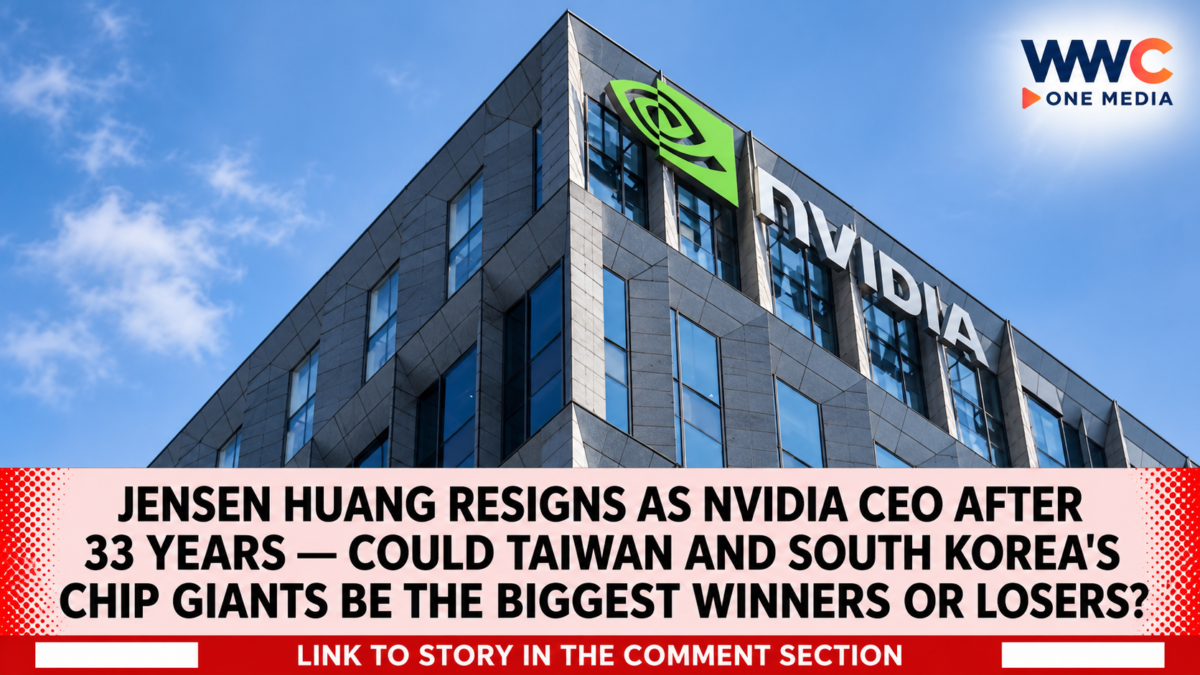
Nvidia’s Asian supply chain is preparing for a major leadership transition after longtime chief executive Jensen Huang resigned, raising questions about whether the world’s most influential artificial intelligence chipmaker can maintain the aggressive partnerships and investment strategy that helped fuel the global AI boom.
The company’s board announced on November 12, 2026, that Huang had resigned as president, chief executive officer and a member of the board, effective immediately. Chief Financial Officer Colette Kress has taken over as interim CEO while directors begin searching for a permanent successor.
The announcement has sent a powerful signal through the technology industry, particularly in Taiwan and South Korea, where some of Nvidia’s most important manufacturing and component suppliers are based.
For years, Huang personally cultivated relationships with semiconductor manufacturers, electronics companies and technology leaders across Asia. His frequent visits, direct negotiations and willingness to commit substantial resources helped Nvidia secure the manufacturing capacity needed to keep pace with surging demand for AI processors.
Now, suppliers are facing a critical question: Will Nvidia’s next leader maintain the same aggressive approach to securing production capacity, investing in technology partnerships and building the wider AI ecosystem?
Colette Kress Takes Over as Interim CEO After Huang’s Resignation
Nvidia confirmed that Kress, who has served as its executive vice-president and chief financial officer since September 2013, will serve as interim chief executive until a permanent replacement is appointed.
The board said it would consider both internal and external candidates.
Harvey C. Jones, a longtime director and technology investor, has also been appointed as the company’s first-ever board chair.
In its announcement, Nvidia said it expected operations, customer commitments and its product roadmap to continue without interruption. The company also highlighted Kress’s knowledge of its business, customers, finances and operations.
The transition is particularly significant because Huang was not simply a chief executive overseeing corporate performance. He was closely involved in Nvidia’s relationships with customers, suppliers, investors and technology partners.
Reuters reported that analysts and industry executives had identified Nvidia engineer Ian Buck and Kress as possible short-term successors before the resignation was announced. The company has not confirmed a permanent replacement.
Taiwan’s TSMC, Foxconn and Wistron Face a New Nvidia Leadership Era
Taiwan is one of the most important parts of Nvidia’s global supply chain.
The company depends on manufacturing partners such as Taiwan Semiconductor Manufacturing Company (TSMC), Foxconn and Wistron to produce and assemble the advanced computing hardware needed by cloud providers and AI companies.
Huang spent years strengthening these relationships through frequent visits and direct engagement with executives.
His personal involvement helped Nvidia secure manufacturing capacity while the AI industry was competing for limited supplies of advanced semiconductors, packaging technology and other critical components.
A Taiwan-based supplier executive told Reuters that the company would continue supporting Nvidia’s requirements but expressed concern that a new CEO might not be as aggressive as Huang in securing production capacity.
That concern is not necessarily a prediction of immediate production cuts. It reflects uncertainty over whether the next leadership team will pursue the same pace of expansion and make equally large commitments to suppliers.
In May 2026, Huang said Nvidia planned to invest approximately US$150 billion annually in Taiwan, underscoring the scale of the company’s relationship with the island’s technology ecosystem.
The leadership change will therefore be closely watched by manufacturers whose investment plans depend partly on Nvidia’s future demand.
South Korea’s Samsung and SK Hynix Are Also Watching Closely
South Korea has another major stake in Nvidia’s future.
Samsung Electronics and SK Hynix are important suppliers of memory components used in advanced AI computing systems, including high-bandwidth memory (HBM).
These memory chips are essential because AI accelerators require extremely fast access to large amounts of data. Their performance and availability can influence the overall capabilities of advanced AI systems.
South Korean news agency Yonhap reported that officials at Samsung and SK Hynix were monitoring Nvidia’s leadership uncertainty.
Some industry insiders warned that Huang’s departure could affect relationships between top executives and potentially slow certain business discussions.
However, other officials said existing supply agreements were unlikely to be immediately disrupted because Nvidia works with multiple executives and technical teams, not just its chief executive.
This distinction is important. The departure of a powerful corporate leader can change strategic relationships over time, but it does not automatically cancel manufacturing contracts or stop production.
Nvidia and SK Group’s Reported US$500 Billion AI Initiative
The relationship between Nvidia and South Korea extends beyond supplying individual chips.
Nvidia and SK Group, the parent company of SK Hynix, are pursuing a major AI initiative involving large-scale data centres and next-generation computing technology.
Reuters has reported that the initiative is valued at approximately US$500 billion.
The scale of the proposed collaboration illustrates how Nvidia’s influence extends beyond semiconductor sales into the construction of the infrastructure needed to support artificial intelligence.
These projects require processors, memory, networking equipment, electricity, cooling systems and large amounts of capital.
A change in Nvidia’s leadership could influence the pace and structure of future partnerships, although there is currently no confirmed announcement that the initiative has been cancelled or reduced.
For South Korea, maintaining stable relationships with Nvidia remains important as the country competes in the global AI hardware market.
Why Huang’s Departure Could Affect More Than Chip Deliveries
Analysts have warned that Huang’s departure could affect Nvidia’s long-term strategy because he played an unusually active role in building the company’s broader AI ecosystem.
Nvidia has used its financial resources to support companies across the AI industry, including cloud-computing providers, technology developers and infrastructure businesses.
These investments help create demand for Nvidia’s processors while encouraging customers to build their systems around the company’s hardware and software platforms.
Neil Shah, vice-president of research at Counterpoint Research, told Reuters that Nvidia could see slower ecosystem-level investments and fewer aggressive bilateral AI infrastructure deals without Huang leading the company.
Omdia chief analyst Lian Jye Su also warned that a leadership change could create uncertainty around Nvidia’s long-term direction.
If execution slows or the product roadmap becomes less clear, competitors could gain opportunities to challenge the company.
However, the potential impact should not be exaggerated.
Some investors and analysts cited by Reuters expect limited disruption to near-term deliveries because chips scheduled for shipment over the next year or two have already been designed and entered production.
Customer spending plans for 2027 are also not necessarily dependent on the identity of Nvidia’s chief executive.
This means the bigger risk may involve future investment decisions and strategic partnerships rather than an immediate collapse in semiconductor orders.
The Allegations Surrounding Huang Add Pressure to the Transition
Huang’s resignation comes amid intense scrutiny following reports about alleged extramarital relationships and questions involving a Chinese businesswoman linked to a Singapore-based technology company.
The controversy has developed into a corporate governance and national-security issue, attracting attention from investors, US officials and technology industry executives.
Reports have raised questions about whether Huang was unknowingly exposed to an alleged Chinese intelligence operation through his relationship with Alice Huang, also known as Huang Le.
There have also been reports of another alleged relationship involving an Nvidia employee.
These claims must be distinguished from established findings. Allegations about possible intelligence activity do not, by themselves, prove that Nvidia’s confidential information or national-security-sensitive technology was compromised.
The Associated Press previously reported that Nvidia’s board had launched its own inquiry and said it had no reason to believe national security or company secrets had been compromised.
Nvidia’s November 12 leadership announcement confirmed Huang’s resignation but did not publicly identify the specific reason for his departure.
The board’s decision to begin a permanent CEO search now places additional attention on the company’s governance, internal controls and ability to maintain confidence among customers and suppliers.
Could Nvidia’s Competitors Benefit From the Leadership Change?
The transition could create opportunities for rivals such as Advanced Micro Devices (AMD) and other companies developing AI processors and custom computing solutions.
Nvidia has built a strong competitive position through its hardware, software ecosystem and close relationships with major technology companies.
Competitors may attempt to attract customers or suppliers if they believe Nvidia’s leadership transition will slow product development or investment decisions.
However, replacing Nvidia’s position in the AI industry will not be easy.
The company has established a broad ecosystem involving processors, networking products, software platforms and developer tools. Customers that have invested heavily in Nvidia-based infrastructure cannot necessarily switch suppliers overnight.
The next CEO will therefore inherit more than a successful chip business. The person will be responsible for maintaining an interconnected technology ecosystem that has become central to the global AI industry.
What Nvidia’s Leadership Change Means for Asia’s Semiconductor Industry
The impact will extend across several Asian economies.
Taiwan is exposed through advanced chip manufacturing and electronics assembly. South Korea is deeply involved through memory chips and other semiconductor technologies. Japan also plays an important role through semiconductor manufacturing equipment, materials and specialised components.
These industries have benefited from the rapid expansion of AI data centres.
But they are also vulnerable to changes in investment plans, product schedules and demand from major customers.
If Nvidia continues its current expansion strategy, suppliers could remain positioned to benefit from strong demand for advanced computing hardware.
If future investment becomes more cautious, some manufacturers may have to reassess capacity expansion plans.
For now, there is no confirmed evidence that Nvidia’s leadership change has caused widespread cancellations of supplier orders or halted production across Asia.
The coming months will reveal whether the new leadership maintains Huang’s aggressive approach or adopts a more measured strategy.
The Next Test Comes With Nvidia’s Earnings and Permanent CEO Search
Nvidia’s next major corporate milestone will be its third-quarter fiscal 2027 financial results, scheduled for November 17, 2026.
Investors will be watching for management comments about customer demand, manufacturing capacity, product delivery schedules and the company’s long-term investment plans.
The board’s search for a permanent CEO will also be closely monitored by suppliers and financial markets.
The challenge for Kress is to provide stability during a period when Nvidia’s customers and manufacturing partners are looking for reassurance.
Her experience as CFO gives her a detailed understanding of the company’s financial position and operations. However, the permanent leadership decision will determine who ultimately guides Nvidia’s next stage of growth.
Huang’s resignation marks the end of a 33-year chapter in the company’s leadership. His influence helped transform Nvidia from a graphics processor manufacturer into a central force behind the global artificial intelligence boom.
The real test now is whether Nvidia’s powerful network of Asian suppliers, technology partners and customers can continue operating at the same pace without the executive who personally helped build many of those relationships.