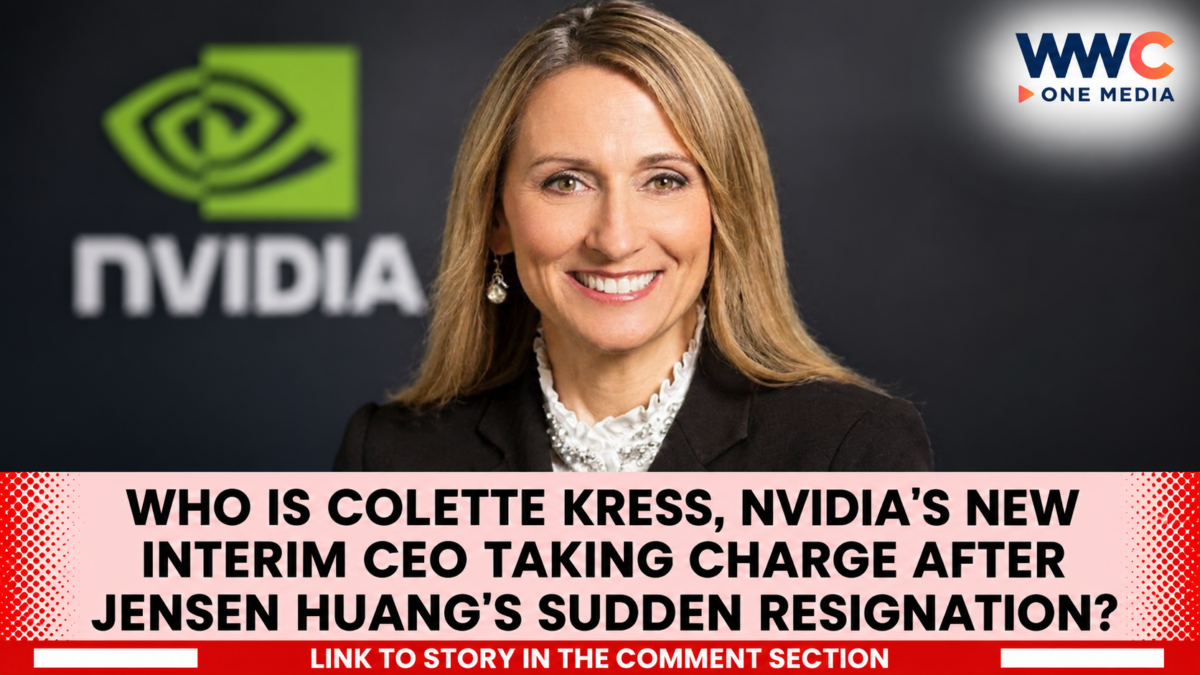
Nvidia has entered an extraordinary new chapter after co-founder Jensen Huang resigned as chief executive, president and board member, ending his 33-year leadership of the artificial intelligence chip giant. Now, the company has turned to one of its longest-serving executives: Chief Financial Officer Colette Kress, who has been appointed interim CEO while the board searches for a permanent successor.
The announcement, made on November 12, 2026, immediately placed Kress at the centre of one of the most consequential leadership transitions in the technology industry. She will continue serving as Nvidia’s executive vice president and CFO while temporarily taking over the chief executive position.
For investors, technology companies and the global AI industry, the decision raises a critical question: Can the executive who helped manage Nvidia’s extraordinary financial expansion also guide the company through a period of leadership uncertainty?
Colette Kress Has Been at the Centre of Nvidia’s Growth Since 2013
Kress is not a newcomer brought in to stabilise an unfamiliar organisation. She joined Nvidia in September 2013 as executive vice president and chief financial officer and has remained in the position ever since.
During her tenure, she became one of the company’s most recognisable executives to investors, regularly appearing alongside Huang during quarterly earnings calls and explaining Nvidia’s financial performance, business strategy and growth prospects.
The scale of the company’s expansion during those years is remarkable.
Nvidia reported revenue of approximately US$4.13 billion in the fiscal year Kress joined. By fiscal 2026, annual revenue had reached US$215.9 billion, reflecting the extraordinary demand for graphics processing units, data-centre infrastructure and technologies powering artificial intelligence.
That growth does not belong to one executive alone. It reflects Nvidia’s engineering teams, customers, partners, management and the broader AI boom. Nevertheless, Kress has been responsible for overseeing the financial organisation during one of the most dramatic expansions in modern technology.
Her experience is particularly relevant as Nvidia faces questions about whether it can maintain investor confidence and operational momentum without Huang at the helm.
WWC ONE MEDIA previously examined the company’s developing leadership uncertainty in its report on Nvidia’s search for Jensen Huang’s replacement and the possibility of a new CEO.
From Texas Instruments to Microsoft and Cisco
Before joining Nvidia, Kress built nearly 25 years of experience in finance and corporate leadership across major technology companies.
She spent eight years in finance positions at Texas Instruments. She subsequently worked at Microsoft from 1997 to 2010, eventually becoming chief financial officer of its Server and Tools division in 2006.
Her responsibilities included financial strategy, planning and reporting for a major part of Microsoft’s business.
In 2010, she moved to Cisco, where she became senior vice president and chief financial officer of its Business Technology and Operations Finance organisation. She was responsible for financial strategy and business development before leaving for Nvidia three years later.
This background gives Kress experience across different areas of the technology industry, including software, networking, semiconductors and corporate finance.
Her academic qualifications include a bachelor’s degree in finance from the University of Arizona and a Master of Business Administration from Southern Methodist University.
Her appointment therefore brings a finance-focused executive with decades of experience into the most powerful operational position at a company whose influence extends across the global technology economy.
Why Nvidia’s Board Chose Kress
Kress was a familiar and visible figure within Nvidia long before the announcement.
She understands the company’s financial position, major customers, internal operations and investor expectations. Her regular participation in earnings calls also means that institutional investors have had years to assess her communication and financial leadership.
Nvidia’s board said Kress had helped guide the company through a period of extraordinary growth and possessed a deep understanding of its business, customers, operations and financial position.
Harvey C. Jones, appointed as the company’s first-ever board chair, also expressed confidence in Kress and the wider leadership team.
The board said it expected Nvidia’s operations, customer commitments and technology roadmap to continue without interruption.
However, interim leadership is not the same as a permanent appointment. Nvidia has confirmed that it will consider both internal and external candidates as it begins the search for a permanent CEO.
That leaves open the possibility that Kress could eventually receive the position on a permanent basis—or that the board could select another executive.
WWC ONE MEDIA has also examined the wider corporate investigation surrounding Huang in its report on Nvidia hiring a major corporate law firm to investigate the controversy.
Jensen Huang’s Departure Comes Amid a Wider Corporate Controversy
Huang’s resignation follows a turbulent period involving reports about his personal relationships and allegations concerning a businesswoman suspected by US intelligence officials of having links to Chinese intelligence.
Those allegations have attracted attention because of Nvidia’s position in the global semiconductor industry and the sensitivity surrounding advanced AI chip exports.
Huang acknowledged being unfaithful to his wife and apologised to his family and Nvidia employees. However, that admission does not establish that he knowingly participated in espionage, illegal chip transfers or any other criminal activity.
Nvidia’s board has been examining the controversy, while reports have also raised questions about corporate governance, business relationships and potential national-security implications.
It is important to distinguish reported allegations from established findings. The existence of an investigation does not prove wrongdoing by Huang or Nvidia.
The leadership change has nevertheless intensified questions about how the company will manage its reputation, regulatory relationships and business strategy.
WWC ONE MEDIA has followed the controversy in its coverage of the allegations involving Jensen Huang and the questions surrounding Nvidia’s business relationships.
Could Colette Kress Become Nvidia’s Permanent CEO?
Kress is widely viewed as a credible candidate because of her long experience inside the company and familiarity with its financial and operational structure.
But leading Nvidia will require more than managing revenue, expenses and shareholder expectations.
The company operates at the centre of an intensely competitive global AI industry. Its future depends on continued innovation, manufacturing capacity, customer relationships, software development and the ability to respond to changing export restrictions and international competition.
Huang’s influence extended well beyond financial performance. He was closely associated with Nvidia’s product direction, engineering culture and long-term AI strategy.
Kress will therefore need to demonstrate that the company’s leadership team can maintain its direction while the board evaluates potential permanent successors.
Other names have also appeared in media discussions about possible leadership candidates. These include experienced Nvidia technology executives and leaders from other semiconductor companies. Such speculation should not be mistaken for confirmed appointments or formal board decisions.
For further context, WWC ONE MEDIA has reported on the potential market consequences of Nvidia’s leadership crisis and the pressure facing its AI business.
Nvidia’s November 17 Earnings Report Will Be an Early Test
Kress is taking over at a particularly important moment.
Nvidia is scheduled to release its third-quarter fiscal 2027 financial results on November 17, as previously planned. The announcement will give investors an early opportunity to assess whether the leadership transition has affected the company’s financial outlook or communications with the market.
The board has said it expects business operations, customer commitments and the technology roadmap to continue without interruption.
Investors will nevertheless be watching closely for signs of stability, particularly regarding AI chip demand, data-centre spending, competition and the company’s future guidance.
Nvidia remains a major supplier of the processors and computing platforms used by leading AI developers and cloud companies. Its performance therefore has implications well beyond its own shareholders.
The company’s next earnings announcement could become one of Kress’s first major public tests as interim CEO.
A New Era for the Company Behind the AI Boom
For more than three decades, Nvidia’s identity has been closely associated with Jensen Huang. His departure marks a historic change for a company that grew from a graphics-chip developer into one of the most influential businesses in the artificial intelligence economy.
Kress now faces the challenge of maintaining that momentum while the board determines who will lead Nvidia permanently.
Her long tenure, financial expertise and familiarity with the company’s operations give her a strong starting position. But the transition will test whether Nvidia’s leadership structure can function effectively without the founder who shaped its strategy and culture.
The company has said its business and technology plans will continue. The market, however, will want evidence that the transition can be managed without undermining confidence in its future.
Colette Kress has spent more than a decade helping manage Nvidia’s rise. Now she must prove that she can help lead the AI giant through one of the most consequential turning points in its history.