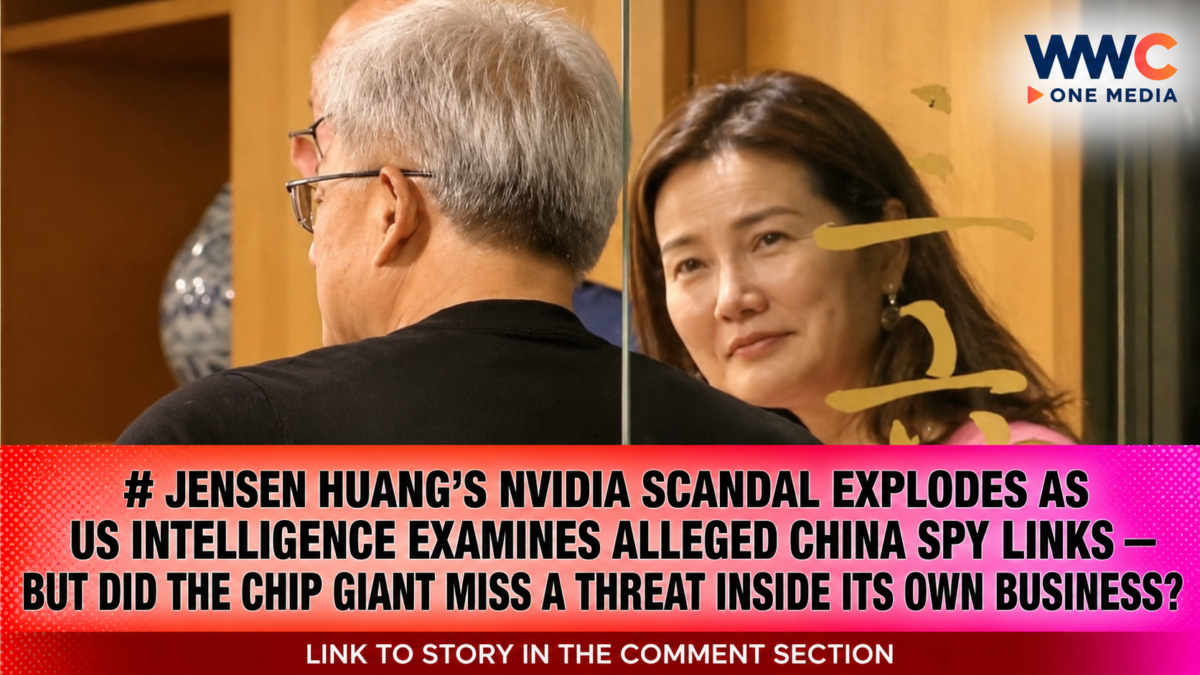
SANTA CLARA, CALIFORNIA / WASHINGTON — Nvidia chief executive Jensen Huang is facing one of the most serious controversies of his career after an acknowledged extramarital affair became entangled in allegations of Chinese intelligence activity, questions about restricted artificial intelligence chip shipments and growing scrutiny from US lawmakers.
What initially appeared to be a deeply personal revelation has developed into a national-security and corporate-governance issue involving one of the world’s most influential technology companies.
Nvidia’s board has launched an independent investigation into reports that Huang may have been targeted by a foreign intelligence operation. The FBI is also reportedly examining the matter, while US lawmakers are demanding answers about the company’s relationships with overseas technology partners.
At the centre of the controversy is Alice Huang, a Chinese businesswoman formerly associated with Singapore-based cloud-computing company Megaspeed International. US intelligence officials reportedly suspect that she worked for Chinese intelligence, although those allegations have not been independently verified by Reuters or established through a public criminal finding.
Jensen Huang, 63, has acknowledged being unfaithful to his wife, apologising to his family and Nvidia employees. However, the admission does not establish that he knowingly assisted a foreign intelligence operation or participated in illegal semiconductor transfers.
The distinction is critical.
The investigation now raises questions about whether sensitive information was exposed, how Nvidia monitored its overseas business relationships and whether advanced American AI processors reached Chinese customers through companies operating outside mainland China.
And with Congress preparing to question Huang, the controversy could have consequences extending far beyond his personal life.
HOW JENSEN HUANG BECAME LINKED TO THE ALLEGED CHINESE INTELLIGENCE OPERATION
The controversy centres on Alice Huang, also known as Huang Le, a Chinese businesswoman who developed a career in finance before becoming involved in the artificial intelligence infrastructure industry.
According to Reuters’ investigation, which reviewed more than 30 publicly available corporate records, financial documents and company materials, Alice Huang held senior positions at Shanghai-based investment firm Hexi before becoming associated with Megaspeed International.
Megaspeed, originally incorporated in Singapore as 7Road International in 2015, operates in cloud computing and AI infrastructure. It has described itself as an Nvidia business partner in the Asia-Pacific region.
Alice Huang became Megaspeed’s controlling shareholder in March 2023, according to research group C4ADS, which reviewed corporate records.
She also served as a director and managing director of the company’s Indonesian subsidiary during 2023.
Her business connection to Nvidia became a central focus of scrutiny after reports emerged that US authorities were investigating whether Megaspeed had helped Chinese customers obtain advanced AI processors subject to American export restrictions.
The New York Times subsequently reported that US intelligence officials believed Alice Huang was a Chinese intelligence asset who had gathered information for Beijing.
Reuters, however, said it could not independently verify that intelligence allegation.
Alice Huang and Jensen Huang are not related, despite sharing the same surname.
The distinction matters because the controversy involves two separate questions: whether Alice Huang had intelligence links and whether her relationship with Nvidia’s chief executive created any security or corporate risk.
Neither question has been conclusively resolved in public.
JENSEN HUANG ACKNOWLEDGES AN AFFAIR AS NVIDIA OPENS AN INVESTIGATION
The scandal escalated after Jensen Huang acknowledged being unfaithful to his wife in a message to Nvidia employees.
In the message, he apologised to his family, colleagues and the company’s board, acknowledging that his actions had fallen short of the responsibilities expected of him.
He did not publicly provide a detailed account of the relationship.
The admission followed reports connecting him to Alice Huang and allegations that she may have been involved in a foreign intelligence operation.
Nvidia subsequently announced an independent investigation led by independent directors, supported by external legal counsel.
The company said it had no reason to believe that its trade secrets or US national-security information had been compromised.
It also said Huang supported the review and would cooperate.
The board’s decision is significant because the allegations concern not only the chief executive’s private conduct but also the potential exposure of corporate information and the integrity of Nvidia’s relationships with customers and business partners.
The investigation is expected to examine what information may have been accessible, whether internal safeguards were adequate and whether any company policies were breached.
As the controversy unfolded, WWC ONE MEDIA examined the initial market and corporate fallout in Nvidia CEO Jensen Huang’s Alleged Chinese Spy Scandal Wipes $190 Billion Off Stock as FBI Gets Involved — But Could the AI King Lose His $4 Trillion Empire?.
THE MEGASPEED CONNECTION: WHY NVIDIA’S CHINA BUSINESS IS UNDER SCRUTINY
The investigation has become particularly sensitive because of Megaspeed’s business relationships and its reported purchases of Nvidia hardware.
Washington has imposed restrictions on the export of certain advanced AI processors to China, citing concerns that the technology could strengthen China’s military and strategic capabilities.
The restrictions have created a difficult environment for companies supplying AI infrastructure across international markets.
A company operating in Singapore, Malaysia or Indonesia may legally purchase and deploy technology for authorised customers. However, using overseas intermediaries to transfer restricted processors to prohibited end users could violate US export-control rules.
That is why investigators are examining Megaspeed’s operations and the movement of Nvidia equipment through regional business networks.
Reuters reviewed shipping records showing that Megaspeed’s Indonesian subsidiary imported Nvidia hardware between 2024 and 2026, including H100 processors and related components.
Those shipments, however, do not by themselves establish an export-control violation. The equipment was shipped to Indonesia, and the records alone do not prove that it was subsequently transferred to prohibited customers in China.
Reuters also reported that Megaspeed’s ownership structure changed after Alice Huang’s involvement, with Singapore-based SwiftData becoming its registered shareholder.
C4ADS said it could not determine who ultimately controlled SwiftData, although it assessed that Alice Huang may have continued to exercise influence over Megaspeed.
The company did not respond to Reuters’ request for comment.
These details have increased pressure on Nvidia to explain how it verifies customers, monitors deployments and responds to concerns about potential diversion.
THE REPORTED US$7.5 BILLION CHIP NETWORK: WHAT THE REPORT ACTUALLY CLAIMS
One of the most consequential allegations emerged in a November 10 report by The Information, subsequently reported by Reuters.
The report alleged that Alice Huang, together with her husband and sister, built a network of companies across China and Singapore to obtain Nvidia processors.
According to the report, a Chinese company called Shanghai Century Litong became a preferred cloud partner of Nvidia by October 2023, giving it priority access to processors.
The Information, citing two people familiar with Alice Huang, reported that the network facilitated the movement of approximately 240,000 H100, H200 and some A100 processors into China.
It estimated that at least US$7.5 billion worth of Nvidia chips were involved.
The report further alleged that Alice Huang used business relationships with Nvidia and its distributors to secure supplies when orders for chips subject to US restrictions encountered difficulties.
These claims are serious, but they must be treated as reported allegations rather than established findings.
Nvidia has not been publicly found to have knowingly facilitated an illegal transfer through this alleged network.
The companies named in the reporting have not all provided public responses, and the alleged shipments require further verification by investigators.
A separate report by Le Monde discussed Megaspeed’s Malaysian subsidiary and purchases reportedly exceeding US$4.8 billion in Nvidia chips and servers.
These figures describe different reported aspects of the wider business network. They should not simply be added together or treated as independently confirmed totals.
The central question is whether restricted processors were transferred to prohibited Chinese customers, who arranged those transactions and what Nvidia knew about their ultimate destination.
WHY THE STRAIT OF SOUTHEAST ASIA AND OVERSEAS DATA CENTRES MATTER
The controversy also highlights the importance of Southeast Asia in the global AI infrastructure industry.
Singapore and Malaysia have attracted major investments in data centres, cloud computing and advanced technology infrastructure.
Companies use these locations to provide computing services to regional and international customers.
That business model is legitimate when it complies with applicable export-control rules.
However, it can create enforcement challenges when regulators need to determine who ultimately uses the computing power, where the equipment is physically located and whether restricted customers are receiving access through intermediaries.
A chip does not necessarily have to be physically shipped into China for Chinese customers to benefit from computing capacity hosted elsewhere.
That distinction has become increasingly important as cloud computing allows customers to access powerful processors remotely.
The controversy could therefore increase scrutiny of regional data-centre operators, cloud providers, equipment distributors and companies purchasing large quantities of advanced processors.
WWC ONE MEDIA previously examined the regional implications in US Intelligence Investigates Alleged Chinese Spy With Links to Nvidia’s CEO — Could Singapore’s AI Data-Centre Industry Face Tougher Scrutiny Next?.
CHINA REJECTS THE ESPIONAGE ALLEGATIONS
The allegations have also triggered a diplomatic response from Beijing.
China’s Foreign Ministry has rejected claims that Alice Huang was working for Chinese intelligence, describing the accusations as baseless and politically motivated.
That denial is important because the central intelligence claims have not been independently verified by Reuters.
The United States and China have been locked in a prolonged technology rivalry over advanced semiconductors, artificial intelligence and access to critical computing infrastructure.
Washington argues that restrictions are necessary to prevent sensitive technology from supporting China’s military modernisation.
Beijing has repeatedly criticised American restrictions and accused Washington of using national-security arguments to contain China’s technological development.
The Jensen Huang controversy has added another layer to that dispute.
Nvidia’s business is global, but its access to the Chinese market remains a politically sensitive issue.
The company must balance commercial opportunities against American export-control requirements and the risk of technology reaching prohibited end users.
US LAWMAKERS WANT ANSWERS FROM JENSEN HUANG
The controversy has attracted attention from both political parties in Washington.
Reuters reported that senior Republican lawmakers requested a closed-door briefing from Huang on November 18.
The request concerns the allegations involving Alice Huang, Megaspeed and Nvidia’s security protocols against foreign intelligence operations.
Lawmakers are particularly interested in whether Nvidia’s relationships with overseas customers created vulnerabilities that could expose sensitive technology or information.
The controversy has also strengthened calls for additional legislation governing advanced AI chip exports.
Reuters reported that several proposed measures could be considered as part of the annual US defence authorisation process.
These include the AI Overwatch Act, which would give Congress greater authority over certain advanced-chip export decisions, and the Chip Security Act, which would require stronger tracking measures to combat smuggling.
Another proposal, the MATCH Act, seeks to encourage US allies to impose tighter restrictions on semiconductor manufacturing equipment supplied to China.
These proposals are not the same as enacted laws. Their eventual passage and final provisions remain subject to the legislative process.
Nevertheless, the allegations have given lawmakers another reason to examine whether existing controls are sufficient.
WWC ONE MEDIA also explored the broader political implications in Nvidia Short Seller Warned of China Chip Risks Six Months Before Jensen Huang Scandal — But Was Wall Street Ignoring a Bigger Threat?.
SHAREHOLDER LAWSUIT ADDS ANOTHER THREAT TO NVIDIA
The controversy is no longer limited to intelligence and export-control questions.
Nvidia and Jensen Huang have also been named in a proposed shareholder class-action lawsuit alleging that investors were misled because material information about the controversy was not adequately disclosed.
The lawsuit follows a sharp decline in Nvidia’s share price as the allegations gained attention.
Reuters reported that the company and its chief executive could face additional legal and regulatory scrutiny depending on what investigators uncover.
However, a lawsuit is an allegation, not a judgment.
Shareholders would still need to establish the necessary legal elements, including whether relevant statements or omissions were materially misleading and whether the defendants were legally responsible.
The company’s board investigation could also become important if it identifies failures in oversight, internal controls or disclosure procedures.
At this stage, Jensen Huang has not been publicly charged with a crime in connection with the alleged intelligence operation.
The distinction between a civil shareholder claim, a corporate investigation and a criminal prosecution must remain clear.
COULD NVIDIA LOSE INVESTOR CONFIDENCE?
The controversy comes at a particularly sensitive time for the AI industry.
Nvidia’s processors are central to the infrastructure powering generative AI, cloud computing and large-scale machine-learning systems.
The company has become one of the world’s most valuable businesses, and Jensen Huang is closely associated with its technological direction and commercial strategy.
A prolonged investigation could create uncertainty for investors, customers and business partners.
Potential risks include tighter export restrictions, increased compliance costs, reduced access to Chinese customers and reputational damage.
There is also the question of leadership continuity.
Huang has led Nvidia for decades and remains a defining figure in the company’s public identity.
The Associated Press has noted that his central role raises questions about succession planning if the controversy were ever to threaten his position.
However, there is no confirmed announcement that Huang is stepping down.
Nvidia has expressed confidence in its leadership while the independent review proceeds.
The wider semiconductor supply chain could also be affected if new restrictions complicate access to advanced processors.
That does not mean Nvidia’s AI business is automatically collapsing. Demand for advanced computing remains a major driver of the semiconductor industry, and analysts have pointed out that the broader AI infrastructure market is larger than any one executive.
WHAT HAPPENS NEXT?
Several developments could determine the direction of the controversy:
1. Nvidia’s independent investigation: The board’s findings may clarify whether sensitive company information was exposed or whether internal controls were breached.
2. FBI and government inquiries: Investigators may establish whether a foreign intelligence operation targeted Huang and whether any laws were violated.
3. Congressional scrutiny: Huang’s requested November 18 briefing could provide lawmakers with additional information about Nvidia’s security procedures and overseas business relationships.
4. Export-control enforcement: US authorities may examine whether Megaspeed or other intermediaries transferred restricted technology to prohibited customers.
5. Shareholder litigation: The proposed lawsuit could develop into a separate legal battle over corporate disclosure and investor protection.
Each process has a different purpose and standard of proof. None should be treated as confirmation of the others.
THE BIGGER QUESTION: WAS NVIDIA TARGETED, OR DID ITS BUSINESS CONTROLS FAIL?
Jensen Huang’s admission of infidelity has placed his private life under an extraordinary spotlight.
But the more consequential issue is whether a relationship involving a business executive connected to Nvidia’s overseas chip ecosystem created a security vulnerability that the company or US authorities failed to identify.
The intelligence allegations remain contested. The reported chip movements require further investigation. Nvidia says it has no reason to believe company secrets or US national-security information were compromised.
For Washington, the controversy could become another turning point in the battle over who gets access to the world’s most powerful AI processors.
For Nvidia, the stakes include corporate governance, investor confidence, international business and the future of its China strategy.
And for Jensen Huang, the challenge is no longer simply responding to questions about his personal conduct.
He must also help answer a much larger question: Did one of the world’s most powerful technology companies have sufficient safeguards to protect its business, its information and the advanced chips at the centre of the global AI race?