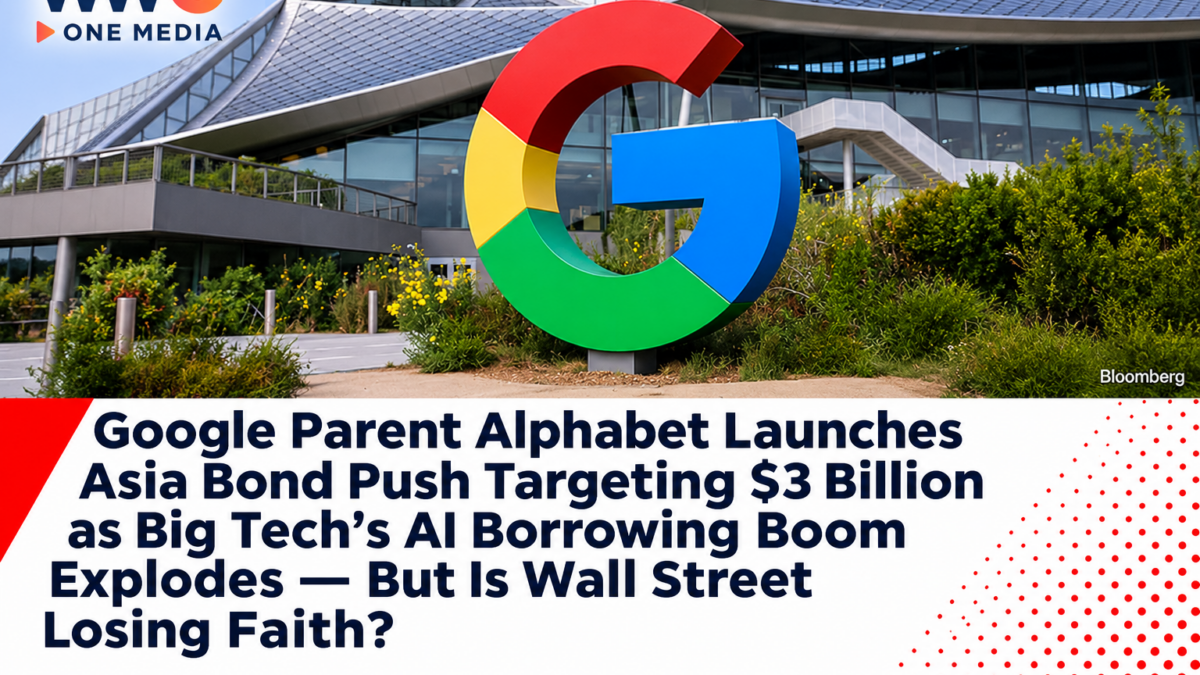
HONG KONG / SINGAPORE / MANILA, Philippines — November 12, 2026 — Google parent Alphabet is moving into two of Asia’s major corporate bond markets as it seeks approximately US$3 billion in fresh financing, testing whether investors remain willing to fund the artificial intelligence revolution after a wave of selling rattled global technology stocks and debt.
According to Bloomberg’s November 12 report, Alphabet has kicked off its Asian bond offering, marking another step in the technology giant’s rapid expansion into international debt markets.
Reuters separately reported that the company was targeting approximately US$3 billion through its first bond offerings denominated in Hong Kong and Singapore dollars.
The proposed transactions include at least HK$8 billion in Hong Kong dollar bonds and S$1.5 billion in Singapore dollar bonds, equivalent to approximately US$2.2 billion combined.
The final amount could be larger, depending on investor demand and pricing.
The fundraising comes after Alphabet disclosed US$80.8 billion in US-dollar and foreign-currency bond issuance during the first nine months of 2026, underscoring how dramatically the financing requirements of the world’s largest technology companies have changed.
Alphabet is not alone.
Microsoft, Meta Platforms, Oracle and other technology companies have tapped debt markets as artificial intelligence drives enormous spending on data centers, advanced processors, networking equipment and electricity infrastructure.
But investors are beginning to question whether the future profits from AI will justify the unprecedented financial commitments being made today.
The central question is whether Alphabet’s Asian bond sale will demonstrate continued confidence in Big Tech’s AI expansion—or reveal that even the strongest technology companies must pay increasingly expensive borrowing costs to keep the boom alive.
Alphabet Enters Hong Kong and Singapore Bond Markets
The proposed offering would mark Alphabet’s first bond issuance in Hong Kong and Singapore dollars.
The two currencies offer access to established Asian institutional investor markets, including banks, insurance companies, investment funds and other fixed-income buyers.
Reuters reported that Alphabet was considering a Hong Kong dollar transaction worth at least HK$8 billion.
Its Singapore dollar offering could raise at least S$1.5 billion.
Together, those minimum amounts would equal approximately US$2.2 billion.
Sources familiar with the transaction said the overall offering was targeting around US$3 billion.
However, the target should not be confused with proceeds already secured.
Final issuance size, yields and allocations depend on market conditions and demand.
The preliminary transaction also represents an opportunity for Asian bond investors to assess the creditworthiness of one of the world’s most influential technology companies.
HSBC and JPMorgan Lead the Proposed Offering
Alphabet has appointed HSBC and JPMorgan as joint global coordinators, according to a term sheet reviewed by Reuters.
Several other financial institutions are participating.
For the Hong Kong dollar transaction, Bank of China (Hong Kong), ICBC Asia and Standard Chartered are among the participating banks.
For the Singapore dollar offering, DBS, OCBC and UOB are involved.
The banks’ participation reflects the importance of local institutional relationships in distributing corporate debt.
The proposed Hong Kong dollar bonds could have maturities of two, five and 10 years.
The Singapore dollar offering could include two-, five-, 10- and 30-year notes.
These different maturities would allow Alphabet to borrow money over several time horizons.
Shorter-term bonds could provide financing flexibility, while longer-term debt may help match borrowing obligations with investments expected to generate revenue over many years.
But longer maturities also create exposure to changing investor expectations about inflation, interest rates and credit risk.
The transaction’s precise borrowing costs will depend on final market pricing.
Why Google Is Borrowing So Aggressively
Alphabet owns Google Search, YouTube, Google Cloud and several other technology businesses.
For years, its digital advertising operations generated substantial cash that could help finance new investments.
But the AI revolution has dramatically increased the scale of infrastructure spending.
Advanced AI systems require powerful processors, extensive data center facilities, specialized networking equipment and reliable electricity.
These expenses can be incurred years before investments generate their expected returns.
Borrowing allows companies to spread the financing burden across longer periods instead of funding every project entirely from current operating cash flow.
Alphabet’s increasing use of corporate debt therefore reflects the capital-intensive nature of AI infrastructure.
It does not automatically mean the company is experiencing financial distress.
However, greater borrowing can increase interest expenses and create pressure to produce sufficient returns from new investments.
Alphabet Issued $80.8 Billion in Notes Through September
One of the most striking figures comes from Alphabet’s own financial disclosure.
According to Reuters, Alphabet stated in an October 29 filing that it issued US$45 billion in US-dollar-denominated notes and US$35.8 billion in foreign-currency notes during the nine months ending September 2026.
Together, those transactions amounted to approximately US$80.8 billion.
The figure represents debt issuance during that period.
It should not automatically be described as the company’s total outstanding debt, because issuance, repayments and debt balances are different measures.
The company has also continued raising funds through international bond offerings.
In early November, Alphabet sold another €6 billion in euro-denominated debt.
That transaction followed substantial financing activity in the United States and Australia.
For investors, the key issue is no longer whether Alphabet can raise capital.
It is whether the financial returns from its AI expansion will ultimately justify the cost of raising and deploying that capital.
Alphabet’s Australian Bond Sale Shows How Global the AI Financing Race Has Become
Alphabet’s Asian expansion follows its entry into Australia’s corporate bond market.
In August, the company raised A$5.5 billion through its first Australian dollar bond offering.
The transaction provided another source of financing beyond its established US and European investor markets.
As WWC ONE MEDIA reported in its coverage of Alphabet’s A$5.5-billion Australian bond deal, the company offered debt with maturities extending as far as 20 years.
The Australian issue demonstrated Alphabet’s willingness to reach investors across different currencies and regions.
The proposed Hong Kong and Singapore transactions extend that strategy.
Borrowing internationally can help diversify funding sources, but it also creates currency-management considerations.
A company borrowing in foreign currencies must assess how exchange-rate changes affect its financing obligations.
Foreign-exchange hedging can mitigate certain risks, although it may involve additional costs.
Why Investors Are Becoming More Cautious About AI Debt
The enormous cost of artificial intelligence has begun changing sentiment in corporate bond markets.
Investors initially welcomed large technology companies’ expansion plans, expecting demand for AI infrastructure and services to increase rapidly.
But the scale of borrowing has raised concerns about whether investment returns will arrive quickly enough.
Bloomberg reported that credit spreads for certain technology issuers have widened.
A credit spread represents the additional yield investors demand above a benchmark to compensate for issuer-specific risk and other market factors.
Wider spreads generally make borrowing more expensive.
Alphabet’s November euro offering reportedly carried materially higher borrowing costs than its earlier euro transaction in May.
That difference illustrates how quickly financing conditions can change, even for financially strong borrowers.
As WWC ONE MEDIA reported in its analysis of Asian bond markets facing pressure from America’s AI debt boom, rising yields can influence borrowing decisions far beyond the United States.
The effects can reach banks, infrastructure developers and other companies competing for investment capital.
Meta and Oracle Add Billions to the Borrowing Wave
Alphabet’s financing plans are part of a broader corporate borrowing trend.
Reuters reported that Meta completed a US$15-billion US bond sale in early November.
Oracle also sold US$10 billion in bonds during the same period.
These transactions followed other large technology-related offerings as companies sought capital for infrastructure expansion.
As WWC ONE MEDIA examined in its coverage of Meta’s nearly US$25-billion multi-market bond fundraising, major technology borrowers are increasingly testing investors’ capacity to absorb large amounts of corporate debt.
Another WWC ONE MEDIA report on Oracle’s US$10-billion financing and a 17-company bond rush highlighted how issuers moved to secure financing amid market and political uncertainty.
But the financial position of each company is different.
Alphabet has substantial advertising revenue and an established cloud business.
Meta generates considerable revenue through its digital platforms.
Oracle is pursuing a large cloud infrastructure expansion with a different debt and earnings profile.
Investors must examine these businesses individually rather than treating every AI-related bond offering as carrying the same level of risk.
The US Midterm Elections Add Another Layer of Uncertainty
The November 2026 US midterm elections have added a political dimension to the technology financing debate.
Democratic electoral gains have increased expectations of greater congressional scrutiny of major technology companies.
Potential areas of attention include AI infrastructure financing, electricity demand, competition, data protection and corporate disclosure practices.
Bloomberg has reported that investors are considering the possibility of increased oversight as they reassess AI-related investments.
However, a change in congressional control does not automatically introduce new financial restrictions or alter existing bond agreements.
Specific regulatory changes would require legislative or administrative action.
The immediate effect is greater uncertainty over the policy environment surrounding the AI industry.
For bond investors, that uncertainty may influence the yield they require when lending money to technology companies.
Google’s Next Challenge May Be Electricity, Not Computing Chips
AI infrastructure development is also becoming an energy challenge.
Large data centers require substantial electricity for computing equipment and cooling systems.
Power availability can determine where new facilities are built and how quickly they become operational.
Google has pursued long-term energy partnerships to support its operations.
As WWC ONE MEDIA reported in its coverage of Google’s approximately 3.6-gigawatt power arrangements with Constellation Energy, the company has committed to agreements involving additional nuclear generating capacity and existing electricity supply.
The arrangement includes 890 megawatts of planned new nuclear generation capacity through upgrades to operating reactors, alongside a separate agreement covering approximately 2,700 megawatts.
These are distinct components of the electricity partnership.
They demonstrate why AI infrastructure financing increasingly extends beyond servers and chips.
Technology companies also need to secure power supplies capable of supporting their facilities over long periods.
The cost of electricity and network infrastructure may therefore become an increasingly important part of the economics of artificial intelligence.
Why Hong Kong and Singapore Matter
Hong Kong and Singapore are among Asia’s most important international financial centers.
Both have established banking systems and substantial institutional investor communities.
Hong Kong provides access to investors involved in Chinese and international financial markets.
Singapore serves as a major regional hub for asset management, banking, insurance and corporate financing.
Issuing bonds in both markets can help Alphabet broaden its investor base.
It may also provide useful benchmarks for future foreign-currency borrowing by other major technology companies.
However, local-currency corporate bond markets differ in liquidity, investor preferences and pricing.
Successful demand for one currency’s bonds does not necessarily guarantee equally strong demand in another.
That is one reason Alphabet’s dual-currency offering represents an important test of Asian investor appetite.
The Credit Ratings Give Alphabet an Advantage
The proposed bonds are expected to carry strong investment-grade credit ratings.
According to the preliminary term sheet reviewed by Reuters, Moody’s is expected to assign an Aa2 rating, while S&P is expected to assign an AA+ rating.
These ratings indicate that the issuer is viewed as having a strong capacity to meet its financial obligations.
But ratings are assessments, not guarantees.
They do not eliminate the possibility of bond-price declines or future changes in credit conditions.
Bond investors face interest-rate risk even when the issuer remains financially sound.
For example, the market value of an existing fixed-rate bond generally falls when comparable yields rise.
That relationship is particularly important for longer-maturity securities.
Alphabet’s proposed 30-year Singapore dollar bond would therefore carry different interest-rate sensitivity from a two-year note.
Could the AI Debt Boom Become a Financial Bubble?
The sharp rise in technology borrowing has revived concerns about speculative excess.
Companies are committing enormous amounts of capital based on expectations of future demand for AI computing.
If those expectations prove accurate, infrastructure investment could support substantial business growth.
But if revenue growth disappoints, some companies may struggle to earn sufficient returns on their investments.
That could lead to reduced spending, weaker profitability or pressure on highly leveraged businesses.
However, large debt issuance alone does not prove that a bubble exists.
Companies with strong recurring cash flow and manageable debt may be able to finance large investments responsibly.
The more important warning signs would include deteriorating credit quality, persistently negative returns on new investments and rising debt-service burdens.
Alphabet’s Asian offering will provide one indication of how investors are assessing those risks.
What Does This Mean for Southeast Asia?
The transaction is relevant to financial markets across the Asia-Pacific region.
Asian investors are being offered exposure to the debt of a major American technology company through local currencies.
At the same time, regional businesses are competing for capital to support their own infrastructure and technology investments.
The Philippines is also seeking to attract more digital infrastructure, cloud and AI-related investment.
But the implications of Alphabet’s bond sale for Philippine financing conditions are indirect.
The offering does not establish that Philippine banks, companies or households will immediately face higher borrowing costs.
Broader effects would depend on regional interest rates, investor portfolio decisions, currency movements and overall credit-market conditions.
For policymakers and businesses, the development illustrates how closely technology investment has become connected to global financing markets.
What Happens Next for Alphabet’s Bond Sale?
The most important next development is the final pricing of the Hong Kong and Singapore dollar notes.
Investors will be watching the total amount raised, the yields offered and the demand for each maturity.
The reported transaction terms include an expected November 19 settlement date.
However, settlement remains conditional on the transaction proceeding as planned.
Strong demand could demonstrate that institutional investors continue to view Alphabet as an attractive borrower despite the wider uncertainty surrounding AI spending.
Weaker demand or higher-than-expected yields could reinforce concerns about investor fatigue.
The final outcome will provide a clearer signal than preliminary fundraising targets alone.
The Bottom Line: Alphabet’s Asian Bond Sale Is a Test of the AI Economy
Alphabet’s planned US$3-billion Asian bond offering is more than another corporate financing transaction.
It reflects a major shift in how the world’s largest technology companies fund their expansion.
Artificial intelligence requires investment on a scale that is transforming corporate borrowing strategies.
Alphabet has already issued substantial amounts of debt in multiple currencies during 2026.
Its move into Hong Kong and Singapore offers access to additional investors but comes at a time when bond markets are becoming more cautious about the AI spending boom.
The critical issue is whether future demand for AI services can support the enormous infrastructure costs being incurred today.
Alphabet’s strong credit profile may help it attract buyers, but the price investors demand for lending to Big Tech could reveal growing concern about the financial sustainability of the AI race.
As Alphabet targets US$3 billion from Hong Kong and Singapore investors, will Asia provide another powerful source of financing for the artificial intelligence revolution—or could widening bond spreads signal that the market is finally questioning the price of Big Tech’s ambitions?