SINGAPORE — A 37-year-old woman has died after her bicycle was involved in a collision with a tipper truck at a busy junction in Katong, prompting renewed concerns about the safety of cyclists sharing Singapore’s roads with heavy vehicles.
The fatal accident happened at approximately 3.15pm on Wednesday, November 11, 2026, at the junction of Amber Road and Amber Gardens.
The Singapore Police Force and Singapore Civil Defence Force (SCDF) confirmed that they were alerted to an accident involving a bicycle and a tipper truck.
An SCDF paramedic pronounced the female cyclist dead at the scene.
Police arrested the 47-year-old male tipper truck driver for driving without reasonable consideration causing death. Investigations are ongoing, and no finding of guilt has been announced.
The incident left part of Amber Gardens closed while Traffic Police officers investigated the scene.
But the tragedy is raising a much wider question: Are Singapore’s roads becoming increasingly dangerous for cyclists, particularly when they have to share space with large commercial vehicles?
The latest available figures suggest the concern deserves attention.
Fatal Crash at Amber Road and Amber Gardens
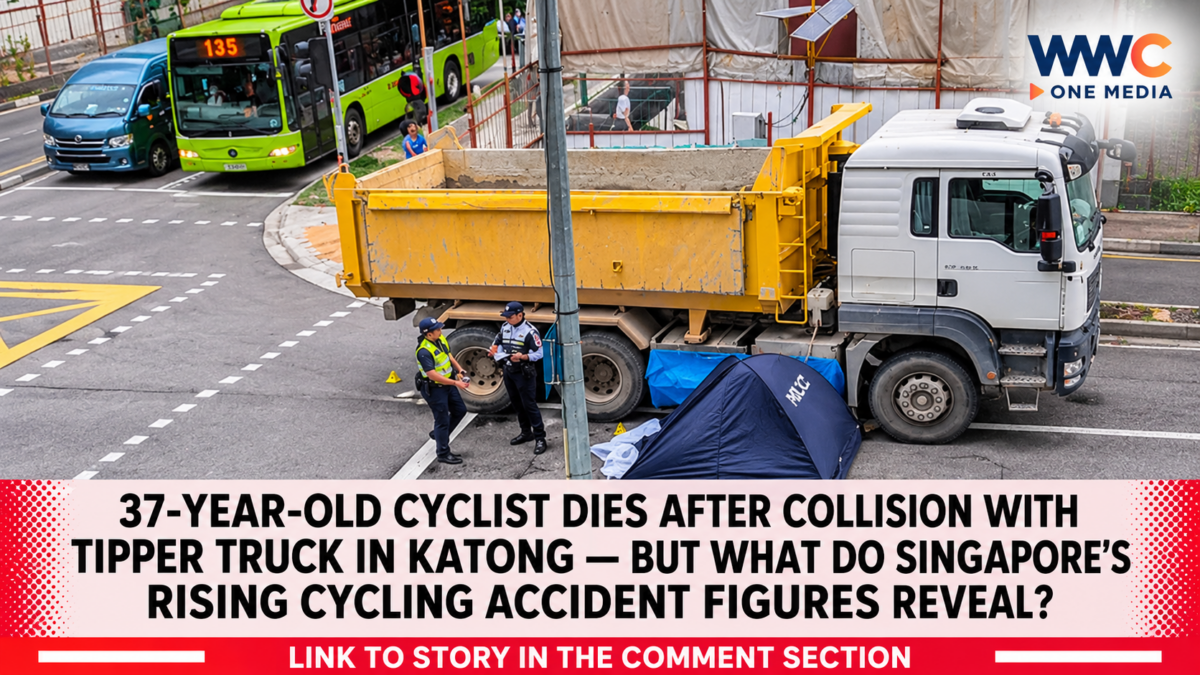
The collision occurred at the junction of Amber Road and Amber Gardens, near a condominium construction site in the Katong area.
According to reports by AsiaOne and The Straits Times, police and SCDF received the alert at about 3.15pm.
When AsiaOne visited the location at around 5pm, a section of Amber Gardens had been closed to vehicles as Traffic Police officers carried out investigations.
A blue tent was placed over the cyclist’s body near the tipper truck involved in the accident.
Photographs and footage from the aftermath circulated online, showing police personnel and emergency vehicles at the scene.
The available reports have not established precisely how the collision happened, which road user had the right of way or whether any specific manoeuvre contributed to the crash.
Those details remain matters for investigators to determine.
The arrest of the truck driver is part of the investigation and should not be treated as proof of criminal guilt.
Driver Arrested for Driving Without Reasonable Consideration Causing Death
Police confirmed that the 47-year-old male driver was arrested on suspicion of driving without reasonable consideration causing death.
This is a serious alleged traffic offence, but the investigation remains ongoing.
Authorities have not publicly disclosed a detailed account of the moments leading up to the collision.
They have also not announced whether the driver has been charged in court.
The distinction is important: an arrest allows investigators to examine a suspected offence, but it does not establish liability or determine the final circumstances of a fatal accident.
Investigators will need to establish how the truck and bicycle came into contact and whether any traffic rules were breached.
For now, the confirmed facts remain that a 37-year-old cyclist died at the scene and a 47-year-old truck driver was arrested.
A Second Cyclist Accident Happened in Eastern Singapore on the Same Day
The Katong tragedy was not the only reported accident involving a cyclist in eastern Singapore on November 11.
Earlier that morning, at approximately 8.30am, a 52-year-old male cyclist was involved in an accident with a taxi at the junction of Kaki Bukit Avenue 2 and Eunos Link.
The cyclist was taken to Changi General Hospital while conscious, according to the police and SCDF.
A 64-year-old male taxi driver was assisting police with investigations.
The two accidents happened at different locations and involved different vehicles. There is no reported evidence connecting them.
Nevertheless, the incidents brought attention to the risks cyclists face when travelling on roads shared with motor vehicles.
They also illustrate why road safety cannot be considered solely from the perspective of drivers or cyclists. Both groups must be able to anticipate one another’s movements and follow traffic rules.
Singapore Recorded 772 Accidents Involving Cyclists in 2025
The Katong fatality comes amid a rise in reported accidents involving cyclists.
According to figures cited by The Straits Times and AsiaOne from police statistics, Singapore recorded 772 accidents involving cyclists in 2025.
That represented an increase from:
- 620 accidents in 2024
- 581 accidents in 2023
The number of fatal accidents involving cyclists also increased.
Singapore recorded 17 fatal accidents involving cyclists in 2025, compared with 13 in 2024.
<escape> </escape>
<escape> </escape>
These figures point to a worrying upward trend, although they do not establish the cause of any individual collision.
Police statistics also indicated that more than half of cyclist accidents involved cyclists riding in a disorderly manner or failing to keep a proper lookout.
That finding highlights the importance of responsible cycling, but it does not mean cyclists are automatically at fault in collisions involving motor vehicles.
Road safety depends on the conduct of everyone using the road, including motorists, commercial vehicle operators, motorcyclists and cyclists.
Singapore’s Overall Road Fatalities Also Reached a 10-Year High
The broader road-safety picture is also concerning.
The Straits Times reported that Singapore recorded 149 traffic deaths in 2025, the highest annual figure in a decade.
That was higher than the 141 traffic deaths recorded in 2016.
The increase in overall road fatalities, alongside the rise in cyclist accidents, has intensified questions about whether existing road-safety measures are sufficient.
However, the figures cover different categories of road users and accidents. They should not be interpreted as evidence that all road fatalities are caused by the same factors.
The challenge is to understand where collisions are occurring, which road users are most vulnerable and what targeted measures could prevent future deaths.
Why Collisions With Heavy Vehicles Are Especially Dangerous for Cyclists
Cyclists have considerably less physical protection than people travelling inside cars, buses or trucks.
A collision involving a heavy vehicle can therefore have devastating consequences, even when the vehicle is travelling at a relatively low speed.
Large trucks also have substantial blind spots, particularly around their sides and immediately in front of or behind the vehicle.
Depending on the vehicle’s design and turning movement, a cyclist may be difficult for a driver to see.
This does not establish that a blind spot or turning manoeuvre contributed to the Amber Gardens collision. Investigators have not publicly confirmed the precise cause.
However, the risks associated with interactions between cyclists and heavy vehicles make awareness and careful manoeuvring particularly important.
Drivers of large vehicles should remain alert to cyclists approaching from either side, especially near junctions and when preparing to turn.
Cyclists, meanwhile, should avoid lingering in areas where drivers may have limited visibility and should remain alert to the movement of large vehicles.
Earlier Fatal Cyclist Crashes Have Raised Similar Questions
The Amber Gardens accident is not the first fatal collision involving a cyclist and a large vehicle in Singapore this year.
In October, a 62-year-old female cyclist died after an accident involving a trailer at the junction of Defu Avenue 1 and Defu Lane 7.
A 43-year-old trailer driver was subsequently arrested after allegedly leaving the scene.
WWC ONE MEDIA covered that case in Trailer Driver Arrested After Fleeing Fatal Crash Involving Cyclist in Singapore.
The two accidents happened at different locations and involved different circumstances. There is no evidence that they are connected.
However, both tragedies demonstrate the potentially severe consequences of collisions involving cyclists and larger commercial vehicles.
They also underline the importance of determining exactly what happened in each case rather than assuming that every fatal collision has the same cause.
Dangerous Cycling Behaviour Is Also Part of Singapore’s Road-Safety Debate
While motorists must exercise care around vulnerable road users, cyclists also have responsibilities under Singapore’s traffic regulations.
Cyclists are required to obey traffic signals, travel in the correct direction and use appropriate safety equipment.
They must also follow rules governing group riding and positioning on roads.
Recent incidents involving large groups of cyclists have renewed debate about whether some riders are taking unnecessary risks.
In November, footage showing nearly 50 teenage cyclists and e-bike riders occupying multiple lanes in Singapore’s Central Business District triggered public criticism.
WWC ONE MEDIA reported on the incident in Nearly 50 Teen Cyclists and E-Bike Riders Take Over Singapore CBD Roads in Viral Video.
Another incident in September showed teenagers cycling along Somerset Road without helmets and apparently without the required lights or rear reflectors.
The footage raised concerns about compliance with active mobility rules.
Read: Teen Cyclists Spotted Riding Across Somerset Road Without Helmets or Lights.
These cases involve different circumstances from the Katong fatal accident and should not be used to suggest that the woman who died was riding dangerously.
Rather, they illustrate the broader need for responsible behaviour from all road users.
Singapore Has Also Seen Serious Accidents Involving Other Vulnerable Road Users
The dangers of sharing busy roads extend beyond cycling.
Pedestrians and motorcyclists are also exposed to significant risks when vehicles lose control, make unsafe manoeuvres or enter areas intended for other road users.
In September, a motorist spotted an elderly man walking dangerously close to fast-moving traffic along the Ayer Rajah Expressway and turned back to help him.
The incident highlighted the vulnerability of pedestrians in areas designed primarily for motor vehicles.
WWC ONE MEDIA reported on the incident in Driver Spots Elderly Man Walking on Singapore’s AYE — Then Makes a Split-Second Decision to Get Him to Safety.
Although the incident did not involve a collision, it raised a similar question about how quickly vulnerable road users can be exposed to danger.
Safer roads require more than enforcement after an accident. They also depend on road design, awareness, visibility and responsible decisions before a collision occurs.
What Happens Next in the Amber Gardens Investigation?
For now, police investigations into the fatal Katong accident are continuing.
Authorities have not released a complete account of the collision or announced a final determination of responsibility.
The investigation will need to establish the circumstances surrounding the crash, including the movements of the tipper truck and bicycle before impact.
The driver’s arrest for driving without reasonable consideration causing death does not mean that a court has found him guilty.
Further details may emerge as investigators establish what happened.
For the cyclist’s family and loved ones, however, the consequences are already irreversible.
The tragedy also leaves Singapore with a difficult road-safety question. With cyclist accidents rising from 581 in 2023 to 772 in 2025, and fatal cyclist accidents increasing over the same period, what more can be done to protect people who have little physical protection when sharing roads with heavy vehicles?
A 37-year-old woman has lost her life at a Katong junction. But as investigations continue, could her death become another turning point in Singapore’s efforts to make its roads safer for cyclists?