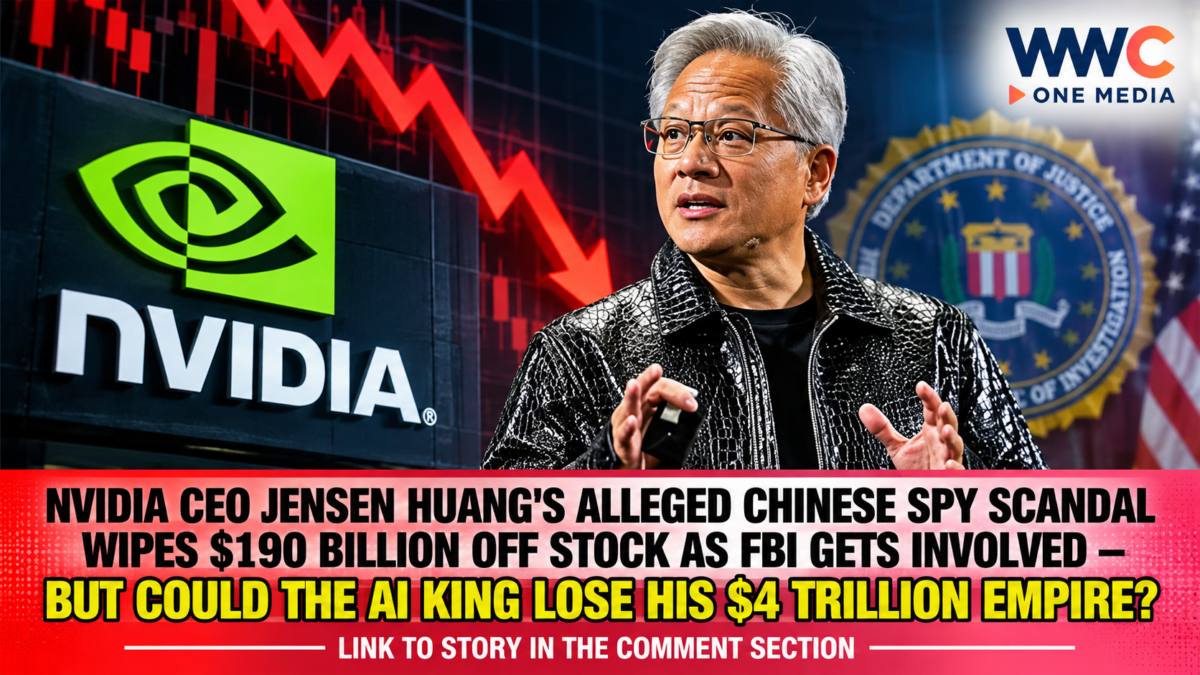
SANTA CLARA, CALIFORNIA / WASHINGTON — November 10, 2026 — What began as a deeply personal admission by Nvidia chief executive Jensen Huang has escalated into an extraordinary corporate and geopolitical controversy, triggering an independent board investigation, federal scrutiny, a shareholder lawsuit and a devastating selloff in one of the world’s most valuable technology companies.
At the center of the unfolding scandal is Huang’s acknowledged extramarital affair and reports that the woman involved, identified as Alice Huang, may have been associated with a Chinese intelligence operation.
The allegations have not been established as fact. China has rejected the espionage claims, while Nvidia’s board says it currently has no reason to believe that company secrets or national security were compromised.
Nevertheless, the controversy has raised serious questions about corporate governance, access to sensitive technology, succession planning and the growing intersection of artificial intelligence and national security.
Nvidia shares plunged as much as 8.8% during trading on November 9 before recovering some losses to close approximately 4.3% lower at $178.67.
The closing decline erased roughly $190 billion from the semiconductor giant’s market capitalization, even as major US stock indexes rallied.
For a company valued at approximately $4.3 trillion and central to the global AI economy, the repercussions could extend far beyond its chief executive’s personal conduct.
Jensen Huang Admits Affair as Nvidia Launches Independent Investigation
The controversy erupted publicly on November 8 when Nvidia announced that its board would investigate whether Huang had been targeted by a foreign intelligence operation.
According to Bloomberg and other news organizations, Huang acknowledged that he had been unfaithful to his wife in a message to company employees.
The 63-year-old executive apologized for his actions and pledged to cooperate fully with the investigation.
Nvidia’s board established plans for a committee of independent directors, assisted by outside legal counsel, to examine the circumstances surrounding the allegations.
The company’s leadership has expressed confidence in Huang, who remains chief executive while the investigation proceeds.
The disclosure quickly intensified concerns because the alleged intelligence connection involves a country at the center of Washington’s efforts to control access to advanced artificial intelligence technology.
As previously reported by WWC ONE MEDIA in its coverage of Nvidia’s board investigation and leadership crisis, the controversy has forced investors to reconsider risks surrounding a company whose strategy is closely associated with one individual.
Who Is Alice Huang, the Woman Linked to the Espionage Allegations?
Alice Huang has been identified in news reports as a Chinese businesswoman and former executive associated with Singapore-based Megaspeed International.
According to reporting by The New York Times and other outlets, US intelligence officials suspected that she may have been recruited to collect information for Beijing.
Those claims remain allegations.
No publicly disclosed finding establishes that Alice Huang acted as a Chinese intelligence operative or that Jensen Huang knowingly participated in espionage.
Megaspeed has also faced scrutiny involving the movement of advanced computer chips and whether restricted Nvidia technology may have reached Chinese customers through intermediaries.
The company has denied wrongdoing.
The allegations have drawn attention because high-performance Nvidia processors are essential to developing advanced AI systems, training large language models and supporting computationally demanding applications.
Washington restricts exports of certain advanced chips to China because of concerns about military applications and other national-security implications.
Any credible evidence that a foreign intelligence operation obtained confidential commercial or government information through an executive relationship could therefore carry consequences well beyond the technology sector.
But at this stage, the existence of an investigation should not be confused with proof that sensitive information was obtained.
Trump Confirms FBI Interest and Defends Nvidia Chief
The scandal reached the White House on November 9 when President Donald Trump confirmed that the FBI was examining aspects of the situation.
Speaking to reporters, Trump said he had personally contacted Huang and expressed confidence in the Nvidia executive.
The president described Huang as an honorable businessman who had built a successful American company.
Trump also suggested he was unlikely to raise the controversy during his forthcoming meeting with Chinese President Xi Jinping.
The White House response adds another political dimension to an already sensitive case.
Huang has developed a prominent relationship with the Trump administration while advocating policies that would allow Nvidia to compete in the Chinese market under revised export rules.
His influence on discussions about AI processors, semiconductor exports and the United States’ technological competitiveness has become increasingly significant.
The possibility that an intelligence-related controversy could intersect with those policy discussions is one reason the matter is attracting attention in Washington.
Related coverage: WWC ONE MEDIA examines Trump’s relationship with Jensen Huang and the implications for US-China AI chip policy.
However, Trump’s confirmation of FBI interest does not establish that Huang committed a crime, knowingly assisted a foreign government or improperly influenced American export policy.
Nvidia Investors File Lawsuit Over Alleged Disclosure Failures
The controversy has also moved into the American legal system.
Reuters reported on November 9 that Nvidia and Huang were named in a proposed shareholder class-action lawsuit filed in federal court in San Jose, California.
The complaint alleges that investors were misled because the company failed to disclose information concerning Huang’s reported relationship with Alice Huang and the potential business and national-security risks surrounding it.
The shareholders are seeking unspecified damages.
The legal action raises questions about whether Nvidia had disclosure obligations concerning circumstances that could materially affect investors.
However, the filing contains allegations rather than judicial findings.
A court will have to determine whether the plaintiffs can establish legally actionable omissions or misleading statements, as well as any resulting damages.
The lawsuit nevertheless introduces an additional challenge for a company already facing an investigation and investor uncertainty.
Nvidia Loses $190 Billion While Wall Street Rallies
Perhaps the most immediate financial consequence was the sharp decline in Nvidia’s share price.
On November 9, the company’s stock fell approximately 4.3% to $178.67, wiping roughly $190 billion from its market value.
At one point during the session, Nvidia shares were down as much as 8.8%, temporarily erasing close to $400 billion in valuation before the stock recovered part of its losses.
The decline was particularly striking because the broader US equity market moved in the opposite direction.
The S&P 500 gained approximately 2.35%, while the Nasdaq Composite advanced roughly 2.74%.
The divergence highlighted how investors were reassessing risks specific to Nvidia’s leadership and governance rather than simply reacting to a general technology-sector downturn.
For shareholders, the immediate concern is not whether demand for AI chips disappears overnight.
It is whether leadership instability, additional regulatory scrutiny or tighter export restrictions could disrupt Nvidia’s ability to capitalize on that demand.
Further reading: WWC ONE MEDIA’s analysis of Nvidia’s $190 billion market-value loss and the sharp divergence from Wall Street’s rally.
Why the Allegations Could Affect the US-China AI Chip War
Nvidia’s importance extends far beyond ordinary consumer electronics.
Its advanced processors power much of the infrastructure used for artificial intelligence research, cloud computing and sophisticated data analysis.
The company’s technology is used by major American technology companies and research organizations worldwide.
That makes access to Nvidia products a central issue in the strategic rivalry between Washington and Beijing.
The United States has restricted exports of advanced semiconductor technology to China, arguing that certain processors could support military modernization and other activities that threaten national security.
China, meanwhile, has invested heavily in developing domestic semiconductor capabilities and reducing its dependence on American technology.
Huang has argued that carefully managed commercial engagement with China can benefit American technological leadership.
Critics of loosening export restrictions contend that wider access to advanced chips could strengthen Chinese AI capabilities.
The controversy surrounding Huang could intensify that policy debate, especially if congressional investigators demand additional information about Nvidia’s customer relationships and its dealings with federal agencies.
Yet tougher controls are not inevitable.
Any regulatory changes would depend on evidence, legal authorities, national-security assessments and broader trade-policy decisions.
China Rejects Espionage Accusations
Beijing has rejected claims that the reported relationship involved a Chinese intelligence operation.
Chinese officials have criticized the allegations as unsubstantiated and politically motivated.
The denial is significant because the controversy arrives amid heightened geopolitical competition over semiconductors, export controls and AI infrastructure.
The United States and China have competing economic and national-security interests, and allegations involving intelligence operations can become politically explosive even before investigations are completed.
For Nvidia, maintaining credibility with American regulators while navigating international business relationships will be essential.
For policymakers, the challenge is to distinguish independently verified evidence from suspicion, speculation and political pressure.
Could Jensen Huang Be Removed as Nvidia CEO?
Another major question now confronting investors is whether Huang can remain in charge of the company he co-founded in 1993.
For more than three decades, he has shaped Nvidia’s strategy, helped transform it from a graphics-chip company into an AI computing powerhouse and become one of the technology industry’s most recognizable executives.
That unusually strong association between the company and its founder creates substantial leadership-concentration risk.
Unlike some other major technology founders, Huang does not control Nvidia through a dual-class voting structure that would give him outsized voting rights.
Bloomberg reported that he holds approximately 3.4% of Nvidia shares.
As a result, his long-term position ultimately depends on the board and the company’s governance arrangements.
The board has publicly supported him, and there has been no announcement that he will resign or be removed.
Nevertheless, investors are asking whether Nvidia has a sufficiently developed succession strategy if its chief executive becomes unavailable or unable to continue in his position.
A change in leadership could create uncertainty about relationships with major customers, government officials and business partners.
But it would not automatically mean that Nvidia’s technology, employees or market position would disappear.
The company’s long-term performance will continue to depend on product development, competition, customer demand and execution.
The AI Industry Faces a Wider Confidence Test
The timing of the Nvidia controversy is especially sensitive because investors have already been questioning the enormous capital expenditure required to build artificial intelligence infrastructure.
Technology companies have committed substantial resources to data centers, advanced computing equipment and electricity networks.
Those investments are based on expectations that AI demand will continue expanding and eventually generate attractive commercial returns.
Any new uncertainty involving the sector’s dominant semiconductor supplier could add pressure to those assumptions.
Financial markets have already experienced significant volatility as investors reassess technology valuations and the economic sustainability of large-scale AI spending.
Related analysis: WWC ONE MEDIA’s report on the $3.2 trillion AI stock selloff and mounting Wall Street concerns.
However, the risks should not be overstated.
A corporate leadership controversy does not automatically invalidate demand for artificial intelligence or the commercial importance of high-performance computing.
Rival chipmakers, cloud providers and technology companies could adjust their strategies depending on how the situation develops.
The ultimate impact will depend on whether investigators uncover substantive wrongdoing or security failures, and whether the controversy leads to meaningful changes in regulation or corporate governance.
What Happens Next?
The investigation now creates several critical questions for Nvidia, its investors and US policymakers.
First, the independent board committee must determine the relevant facts surrounding Huang’s admitted relationship and the reported foreign-intelligence concerns.
Second, investigators will need to establish whether any confidential company information or sensitive government-related material was exposed.
Third, Nvidia must address questions concerning its internal controls, potential conflicts of interest and disclosures to investors.
Fourth, the shareholder lawsuit could generate additional scrutiny of what company officials knew and whether any information should have been disclosed earlier.
Finally, lawmakers and federal agencies may reconsider whether existing safeguards adequately protect advanced American semiconductor technology.
The answers could determine whether the controversy remains a damaging but manageable episode or develops into a more serious challenge for Nvidia.
The Bigger Picture: A Personal Scandal With Global Implications
Jensen Huang’s admitted affair has become a major governance and geopolitical controversy because of Nvidia’s exceptional role in the global technology economy.
The company sits at the intersection of Wall Street, artificial intelligence, international commerce and national security.
That position makes allegations involving its leadership particularly consequential.
Yet the central factual distinction remains essential: reports of a suspected intelligence operation are not proof of espionage.
Nvidia has said it currently has no reason to believe its confidential information or national security was compromised.
China disputes the spying allegations, and Huang remains in charge while the investigation proceeds.
The shareholder lawsuit is also unresolved.
For investors, regulators and the global AI industry, the most important questions are therefore still unanswered.
Did the reported relationship create an actual security vulnerability, or will the investigation find that no sensitive information was compromised?
And if the controversy continues to intensify, will Nvidia’s board be able to protect investor confidence in the company without losing the executive who helped build its extraordinary AI empire?