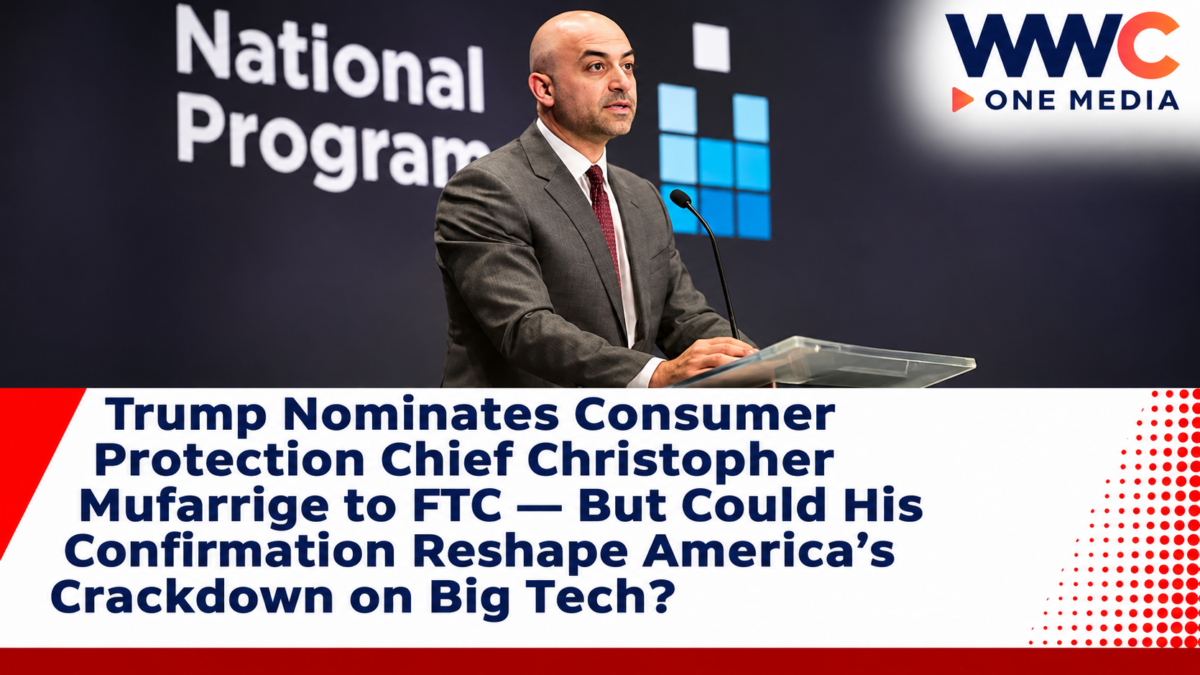
WASHINGTON, D.C. — November 10, 2026 — President Donald Trump has formally nominated consumer protection official Christopher Mufarrige to the Federal Trade Commission, a move that could strengthen Republican control of one of America’s most influential business regulators and reshape how Washington investigates corporate misconduct, digital fraud and competition in the technology industry.
The White House announced the nomination on November 9, confirming earlier Bloomberg reporting that Mufarrige was being considered for a promotion from director of the FTC’s Bureau of Consumer Protection to a voting commissioner.
If confirmed by the US Senate, Mufarrige would join FTC Chairman Andrew Ferguson and Commissioner Mark Meador at an agency responsible for enforcing consumer protection and competition laws.
But the appointment comes amid a contentious debate over the independence of federal regulators, the Trump administration’s approach to corporate oversight and the future of investigations involving powerful technology companies.
Could Mufarrige’s promotion strengthen Washington’s efforts to fight online scams and deceptive business practices—or give the Trump administration greater influence over how aggressively the FTC challenges corporate America?
White House Officially Nominates Christopher Mufarrige
According to the White House’s official November 9 announcement, Christopher Mufarrige of Texas has been nominated to serve as a Federal Trade Commissioner for a seven-year statutory term beginning September 26, 2026.
The nomination identifies the position previously held by Alvaro M. Bedoya, whose term has expired.
The announcement follows Bloomberg’s October 30 report that the administration was preparing to nominate Mufarrige for a Republican vacancy.
Reuters confirmed the formal nomination on November 9, noting that Mufarrige previously served as an adviser at the Consumer Financial Protection Bureau.
However, the nomination does not make him a commissioner immediately.
He must first receive confirmation from the US Senate.
Until that occurs, Mufarrige continues serving as director of the FTC’s Bureau of Consumer Protection.
The development is politically significant because the commission currently has only two sitting members, both Republicans.
Adding another commissioner could change the balance of votes on major enforcement and policy decisions.
Who Is Christopher Mufarrige?
Mufarrige is a lawyer and consumer protection official with experience in financial regulation, federal enforcement and commercial law.
In February 2025, FTC Chairman Andrew Ferguson appointed him director of the Bureau of Consumer Protection.
Before that appointment, Mufarrige served as chief of staff and attorney adviser to former FTC Commissioner Melissa Holyoak.
He also worked during Trump’s first administration as a senior adviser at the Consumer Financial Protection Bureau, where his responsibilities involved enforcement, rulemaking and examinations concerning major banks and nonbank financial institutions.
His professional background includes private law practice, in-house legal work and teaching financial services and consumer protection at George Mason University’s Antonin Scalia Law School.
According to his official FTC biography, Mufarrige holds a law degree and a master’s degree in economics from George Mason University, along with an undergraduate economics degree from Texas Christian University.
His experience places him at the intersection of consumer protection, financial regulation and corporate oversight.
Those areas have become increasingly important as digital financial services, artificial intelligence and online commerce transform how companies interact with consumers.
Trump’s FTC Leadership Overhaul Continues
Mufarrige’s nomination comes during a period of significant institutional change at the Federal Trade Commission.
The FTC is structured as a five-member commission, with no more than three commissioners belonging to the same political party.
Traditionally, that structure has allowed members with different political perspectives to participate in enforcement and policy decisions.
But the agency’s leadership has become increasingly controversial.
President Trump removed two Democratic commissioners in March 2025, triggering litigation and debate over the president’s authority to dismiss officials from independent regulatory bodies.
The commission has subsequently operated with Chairman Ferguson and Commissioner Meador as its two sitting members.
Mufarrige’s confirmation would give it a third Republican commissioner.
That could reduce the risk of deadlocks when existing commissioners disagree.
However, it would not restore the commission to its full five-member complement or reinstate its traditional bipartisan balance.
For supporters of the administration, additional leadership capacity could make the agency more effective.
Critics may see the appointment as another step toward concentrating regulatory authority among officials aligned with the president.
The outcome will depend partly on Mufarrige’s approach to enforcement and his willingness to exercise independent judgment.
White House Withdraws David MacNeil’s FTC Nomination
The November 9 announcement also confirmed a separate personnel decision.
The administration withdrew the nomination of WeatherTech chief executive David MacNeil.
MacNeil had been nominated in January 2026 for a commission seat associated with former Commissioner Melissa Holyoak.
He never received the Senate confirmation necessary to assume the position.
The White House’s latest announcement formally withdraws that nomination.
Importantly, the official record identifies Mufarrige as the nominee for the Bedoya seat rather than the Holyoak seat previously associated with MacNeil.
The distinction clarifies the legal status of both appointments.
The combined announcement highlights the administration’s ongoing effort to fill vacancies at the commission.
Why the FTC Matters to America’s Biggest Technology Companies
The Federal Trade Commission is one of the US government’s principal agencies responsible for protecting consumers and promoting competition.
Its work can affect industries ranging from retail and banking to healthcare, technology and digital advertising.
The agency investigates conduct that may violate federal consumer protection or antitrust laws.
It can challenge certain mergers, pursue enforcement proceedings and seek remedies through appropriate legal processes.
For major technology companies, FTC oversight can affect business models, advertising practices, data handling and competition.
The growing influence of artificial intelligence has added another dimension.
Companies developing advanced AI products face questions about safety, deceptive claims, consumer privacy and the responsibilities associated with increasingly autonomous software.
WWC ONE MEDIA previously reported on these concerns in FTC Investigates OpenAI, Anthropic Over Potential Risks to Consumers.
The investigation illustrates how the agency’s work is extending into emerging AI technologies.
However, an investigation does not establish that a company has violated the law.
Likewise, Mufarrige’s nomination does not automatically determine the outcome of any ongoing FTC inquiry.
Online Scams and Consumer Fraud Could Remain Major Priorities
Mufarrige has emphasized consumer fraud as an important enforcement concern.
Under his leadership, the Bureau of Consumer Protection has addressed matters involving misleading advertising, online scams, billing practices and commercial deception.
In a July 2026 interview with The Guardian, Mufarrige defended the agency’s enforcement record despite concerns about staffing reductions and changes in regulatory priorities.
He highlighted consumer protection matters involving companies such as Amazon, StubHub and Instacart.
He also identified impersonation scams and children’s online privacy as important areas of concern.
Digital fraud has become more sophisticated as criminals exploit social media, search advertising and other online services.
Impersonation schemes can involve fake customer-service accounts, fraudulent advertisements and messages pretending to originate from trusted companies or government agencies.
The FTC has emphasized that consumers need protection from deceptive commercial practices regardless of whether fraud occurs through traditional channels or emerging technologies.
For digital platforms, the growing scrutiny could increase attention on advertising verification and the handling of fraudulent commercial activity.
But companies must still be evaluated under applicable legal standards.
The existence of a fraudulent advertisement on a platform does not automatically prove that the platform itself violated federal law.
Big Tech Regulation Could Become a Major Test
A commissioner with Mufarrige’s background could influence how the FTC approaches investigations involving technology platforms.
The agency must balance the protection of consumers with the enforcement of competition law.
Those responsibilities can intersect when large companies control important digital marketplaces, advertising networks or commercial infrastructure.
The nomination also raises questions about how the FTC will approach artificial intelligence partnerships, acquisitions and other arrangements involving major technology businesses.
However, Mufarrige has not announced a comprehensive new antitrust agenda as a confirmed commissioner.
His previous leadership of the consumer protection bureau provides some insight into his enforcement priorities, but it does not establish how he would vote on every future merger or competition case.
WWC ONE MEDIA previously examined the nomination when it was still under consideration in Trump Moves to Elevate FTC Consumer Protection Chief Christopher Mufarrige — But Could His Appointment Reshape Big Tech Regulation?.
The November 9 announcement is the decisive update: the White House has now formally acted.
Healthcare and Consumer Pricing Are Also Under Scrutiny
The FTC’s responsibilities extend well beyond Silicon Valley.
Healthcare providers, retailers and other businesses can face federal scrutiny when commercial practices are alleged to mislead consumers or restrict competition.
Pricing transparency is one recurring issue.
Consumers may struggle to compare healthcare costs because billing arrangements, insurance contracts and service prices are complicated.
The FTC has increasingly emphasized the importance of accurate and accessible information in certain healthcare markets.
WWC ONE MEDIA examined these concerns in America’s Healthcare Economy Is Booming — But Patients Are Paying the Price.
That report explored how healthcare pricing and competition issues affect patients.
Mufarrige’s financial-regulation background could be relevant to similar questions involving financial products, fees and consumer disclosures.
Nevertheless, any future commission action would depend on the facts of a particular case and the FTC’s statutory authority.
The Fight Over Algorithmic Pricing Is Growing
Technology-driven pricing has become another increasingly important issue for regulators.
Businesses are using algorithms to analyze demand, manage inventory and determine prices.
These systems can improve operational efficiency.
But they can also raise questions when consumers cannot easily determine how prices are calculated or when companies use sensitive information in ways that may be unfair or deceptive.
State and local regulators are developing their own approaches to these issues.
For example, New York City’s consumer protection authorities have been building a specialized research operation to examine technology-driven commercial practices.
WWC ONE MEDIA covered the initiative in Mamdani Administration Builds Data-Driven Consumer Watchdog to Scrutinize Tech Companies.
The New York City initiative is separate from the federal FTC.
However, it illustrates the growing regulatory attention being paid to algorithmic pricing, consumer data and digital commerce.
For the FTC, the legal challenge is determining when the use of new technology crosses the line into an unlawful business practice.
Mufarrige’s Background Could Face Senate Scrutiny
The nomination is also likely to attract examination of Mufarrige’s previous work in consumer finance.
The American Prospect reported on November 9 that Mufarrige previously operated a used-car financing business serving borrowers with poor credit histories.
The publication also revisited criticism concerning his work at the Consumer Financial Protection Bureau.
Those concerns involve allegations and interpretations of his earlier professional activities, not established findings that he committed unlawful conduct.
The distinction matters because Senate confirmation hearings are intended to assess a nominee’s qualifications, judgment and policy approach.
Senators could question him about consumer lending, financial regulation and how he would address potentially abusive practices.
They may also examine his views on the agency’s independence and enforcement priorities.
No outcome of that scrutiny should be assumed.
What Happens Next in the Senate?
The nomination will proceed through the federal confirmation process.
The Senate may examine Mufarrige’s background, financial disclosures and regulatory views.
The Senate Commerce, Science, and Transportation Committee could hold a hearing and consider whether to advance his nomination.
Final confirmation requires Senate approval.
Until that happens, Mufarrige has not become a voting commissioner.
The timing is particularly sensitive because Washington is entering the final weeks of the current congressional session following the November midterm elections.
Lawmakers face a crowded legislative and nominations agenda.
That could influence how quickly the Senate considers the appointment.
However, no confirmed Senate vote date was established in the sources reviewed.
The administration’s decision to submit the nomination demonstrates its intention to move forward, but confirmation remains uncertain.
The Bigger Picture: A Regulatory Turning Point for Corporate America?
The nomination of Christopher Mufarrige could influence the future direction of American consumer protection and competition enforcement.
If confirmed, he would move from directing a major enforcement bureau to participating directly in commission-level decisions.
His experience in financial regulation and consumer law could give him a substantial role in debates over digital fraud, deceptive business practices and emerging technologies.
The appointment could also strengthen the Trump administration’s influence over the FTC at a time when the agency’s independence remains politically contested.
For major corporations, the key question will be whether the commission pursues a narrower regulatory philosophy or adopts aggressive enforcement in selected areas.
For consumers, the more important measure will be whether the agency successfully prevents fraud, protects competition and holds companies accountable under existing law.
As President Trump moves to promote Christopher Mufarrige to one of America’s most powerful regulatory posts, the question is whether the appointment will strengthen the FTC’s fight against online deception—or reshape the watchdog’s priorities in ways that could benefit some of the country’s biggest corporations.