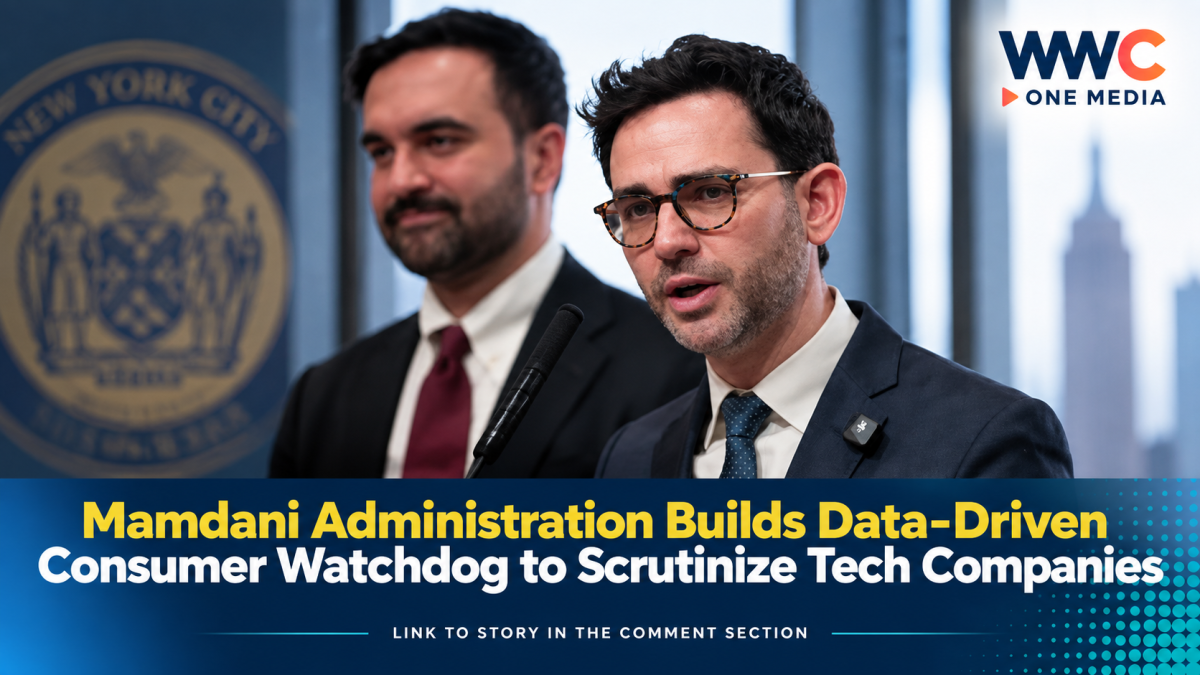
NEW YORK — New York City is building a new data-driven consumer protection operation that will use data scientists, technologists and economists to examine how companies use algorithms to set prices, determine worker pay and interact with consumers.
The initiative is being developed inside the New York City Department of Consumer and Worker Protection (DCWP) under Commissioner Samuel A.A. Levine, who said the agency expects to move quickly on investigations and rulemaking involving technology-driven business practices.
The new Research and Analytics Division (RAD) is planned to grow to 36 employees, including data scientists, technologists and economists. City officials say the unit will analyze large datasets and work directly with DCWP attorneys to identify potential consumer and worker violations.
Levine told Bloomberg that some members of the team are already working while additional specialists are being recruited, with significant rulemaking and enforcement activity expected in the coming weeks.
Algorithms move into the crosshairs
One of the most significant areas of interest is how technology affects prices and wages.
Levine has pointed to situations in which ride-hailing customers could receive different prices for what appears to be the same trip, as well as circumstances in which workers may receive different earnings for comparable work.
The division will examine company data to determine whether such practices comply with New York City’s existing consumer and labor laws.
The city is also interested in surveillance-based pricing, algorithmic decision-making and other technology-enabled practices that can be difficult for consumers or regulators to understand without access to underlying company data.
That does not mean every use of dynamic pricing or an algorithm is illegal. The stated purpose of the new division is to investigate whether particular practices violate laws or regulations that DCWP can enforce.
A 36-person team with billions of records in sight
According to the city, the Research and Analytics Division will eventually include 36 specialists.
The team will combine data analysis with legal investigations rather than operating solely as a research office. Its members will work with DCWP attorneys to identify patterns that could support enforcement actions or new policy proposals.
Bloomberg reported that Levine expects the unit to examine what he described as billions of records, giving investigators a way to analyze corporate practices at a scale that would be difficult through traditional consumer complaints alone.
The city says the approach is intended to allow investigators to identify systemic problems rather than treating each consumer complaint as an isolated incident.
Why the Mamdani administration is emphasizing technology
Mayor Zohran Mamdani’s administration has made consumer and worker protection a prominent part of its economic policy agenda.
The DCWP has already pursued measures involving hidden fees, subscription cancellations, delivery-worker protections and other areas affecting consumers and workers.
In July, the administration announced a citywide proposed rule requiring businesses to disclose mandatory charges in advertised prices, alongside a final “Click-to-Cancel” rule that requires qualifying subscriptions to provide a straightforward cancellation process. The cancellation rule is scheduled to take effect Oct. 1, 2026.
The administration estimates that the Click-to-Cancel rule could save New Yorkers between $21.5 million and $162.5 million annually, citing Roosevelt Institute estimates.
The new analytics division extends that approach into an area where traditional consumer-protection investigations can be particularly complicated: technology.
Levine brings federal experience to City Hall
Levine previously served as director of the Federal Trade Commission’s Bureau of Consumer Protection from 2021 through 2025, during the tenure of former FTC Chair Lina Khan.
The FTC work included investigations involving privacy, artificial intelligence, gig workers, subscription practices and other consumer-protection issues.
The city says Levine’s experience with technology-intensive investigations is relevant to the new municipal operation.
Khan has also advised the Mamdani administration and praised the decision to expand the use of technologists and data analysts in consumer enforcement.
However, the city’s new strategy is not simply an attempt to recreate the FTC at the municipal level. DCWP’s authority remains tied to New York City’s laws and regulations.
AI oversight is already being debated at City Hall
The new division is arriving as New York lawmakers separately examine whether the city needs a dedicated framework for artificial-intelligence oversight.
A New York City Council bill introduced in 2026 would establish an Office of Artificial Intelligence Oversight within DCWP.
Under the proposal, the office would receive and review complaints involving AI-related consumer-protection violations, recommend enforcement actions, issue consumer advisories and propose rules concerning AI-related consumer harms.
The measure is currently listed as being in committee rather than as enacted law.
Separately, the City Council announced a September hearing focused on AI risks and whether additional protections for New Yorkers may be necessary.
That means the city’s technology oversight effort is developing on two tracks: enforcement using data that already falls within existing laws, and potential legislation specifically addressing artificial intelligence.
The city has already tested data-heavy enforcement
The new division is not starting entirely from scratch.
Some of the personnel being incorporated into the operation have previously worked on data analysis related to New York City’s delivery-worker minimum-pay rules.
Bloomberg reported that city data scientists helped develop the methodology behind the city’s delivery-worker pay requirement and defended the approach using evidence from the companies themselves.
The DCWP says it has secured $13.2 million in restitution for workers, consumers and small businesses since January as part of its broader enforcement work.
Tech companies face a changing regulatory landscape
Technology companies operating in New York City could therefore face increased scrutiny of practices that previously depended heavily on proprietary algorithms and internal datasets.
Potential areas of examination include:
- Algorithmic pricing
- Differences in prices offered to consumers
- Algorithmic worker compensation
- Surveillance-based pricing
- Automated decision-making
- Subscription practices
- Hidden and mandatory fees
- Compliance with city wage and scheduling requirements
But the existence of an investigation or regulatory review would not itself mean a company has violated the law.
The key question for regulators will be whether the evidence demonstrates a violation of an enforceable city requirement.
Business groups have raised concerns
The administration’s approach has also drawn criticism from parts of New York’s business community.
The city’s five chambers of commerce jointly criticized the administration’s proposed all-in pricing rule, while a Gibson Dunn legal analysis argued that DCWP was moving toward a broader regulatory role more commonly associated with federal agencies.
Those concerns illustrate the broader debate surrounding the initiative: supporters see stronger data-driven enforcement as necessary to address increasingly sophisticated corporate practices, while critics have questioned the scope of municipal regulatory authority and the potential compliance burden on businesses.
The next phase could arrive within weeks
Levine has indicated that the new operation is intended to move quickly.
The division is being built to examine company data, identify patterns and coordinate with attorneys who can determine whether enforcement is warranted.
The city says the full division is expected to reach 36 positions by fiscal year 2028, while Bloomberg reporting indicates that the unit is already recruiting and deploying personnel.
The administration’s immediate challenge will be translating the enormous volume of corporate data into legally actionable cases.
For New Yorkers, that could mean a new level of scrutiny of the technology behind everyday transactions — from the price displayed on a ride-hailing app to the fees added at checkout and the way digital platforms calculate worker compensation.
The technology may be changing rapidly, but New York City’s regulators are signaling that the rules governing consumer and worker protection will be applied to the digital economy as well.