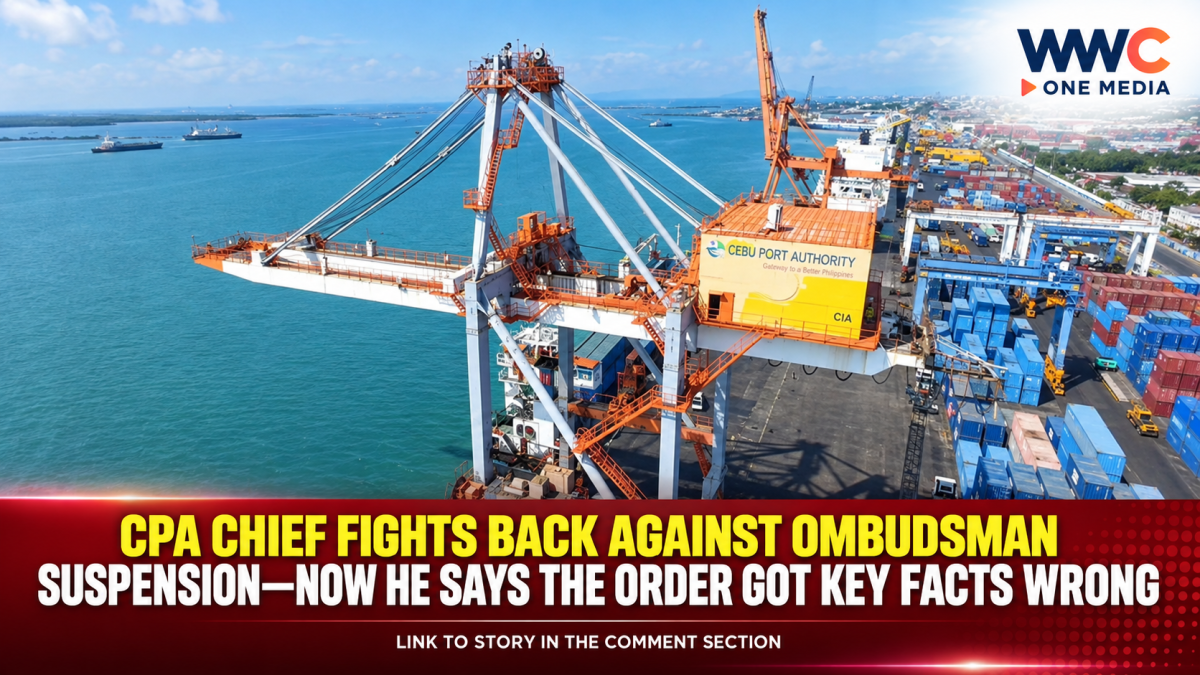
CEBU CITY, Philippines — Cebu Port Authority (CPA) General Manager Francisco C. Comendador III is asking the Office of the Ombudsman to reconsider the six-month preventive suspension imposed on him, arguing that the order allegedly misapprehended key facts and failed to consider documentary evidence that, he says, contradicts the accusations against him.
Comendador filed a 21-page motion for reconsideration challenging the Ombudsman’s Aug. 20, 2026 order that placed him under preventive suspension over allegations of grave misconduct and gross neglect of duty.
The case arose from a complaint filed by Oriental Port and Allied Services Corp. (OPASCOR), a cargo-handling company operating at Cebu International Port (CIP). OPASCOR accused Comendador of allowing vessels to use Cebu South Harbor and Container Terminal Corp. (CSHCTC), a private commercial port, despite restrictions under CPA Administrative Order No. 02-2010.
But in his motion, Comendador disputes the central premise of the complaint.
He maintains that the movement of shipping operations from CIP to CSHCTC was driven by independent commercial and technical decisions made by shipping companies, rather than preferential treatment by the CPA.
Comendador points to Maersk, CMA CGM statements
A major part of Comendador’s defense involves statements from shipping companies themselves.
According to his motion, Maersk Filipinas Inc. said in a Jan. 12, 2026 letter that its decision to transfer operations to CSHCTC was an independent business decision influenced by market conditions, operational efficiency, costs and customer requirements.
He also cited a Feb. 3, 2026 letter from CMA CGM Philippines Inc., which reportedly identified technical and operational factors—including water depth, vessel optimization and cost efficiencies—as considerations in its port preference.
Comendador argues that these statements weaken OPASCOR’s claim that the CPA chief influenced shipping companies to favor CSHCTC.
He further contends that vessel draft, terminal capacity, efficiency and operating costs were among the factors affecting shipping lines’ decisions.
The dispute centers on CPA port rules
At the heart of the controversy is CPA Administrative Order No. 02-2010, which OPASCOR says restricts private commercial ports from accommodating vessels and cargoes except in circumstances such as spill-over demand, emergency, necessity or congestion at CPA-operated ports.
OPASCOR alleged that Comendador’s actions contributed to shipping services moving from CIP to CSHCTC, resulting in declines in cargo throughput, vessel calls and yard utilization at the government-operated port.
Comendador, however, argues that the rules do not establish the kind of exclusivity OPASCOR claims for CIP and that the CPA’s regulatory framework recognizes the role of private commercial ports.
He also disputed the interpretation of a June 4, 2024 letter that OPASCOR had cited as evidence of a policy shift benefiting CSHCTC.
According to Comendador’s motion, the letter reflected existing operational rules and did not amount to an order directing shipping companies to transfer their operations.
Ombudsman says suspension is not a finding of guilt
The Ombudsman previously said the evidence against Comendador was strong at that stage of the proceedings, but emphasized that the preventive suspension order did not resolve the merits of the administrative complaint.
The suspension is a precautionary measure intended to prevent a respondent from potentially influencing witnesses or interfering with evidence while an investigation is ongoing.
Under the Ombudsman’s rules, preventive suspension may be imposed when the evidence of guilt is considered strong and the allegations involve offenses such as grave misconduct or gross neglect of duty. The suspension may last for a maximum of six months without pay, subject to the applicable rules.
The order against Comendador was immediately executory. Glenn Castillo, CPA acting deputy general manager, was designated to oversee the agency during Comendador’s suspension.
Comendador says the order overlooked critical evidence
In his motion, Comendador argues that the Ombudsman relied too heavily on OPASCOR’s interpretation of the port dispute while allegedly failing to give sufficient weight to records and third-party statements.
He says the evidence does not establish that he deliberately gave CSHCTC preferential treatment or caused shipping companies to abandon CIP.
He is therefore asking the Ombudsman to reverse or set aside the preventive suspension order.
Importantly, the filing is an assertion by Comendador and his legal team—not a final determination that the Ombudsman committed an error or that the allegations against him are unfounded.
The Ombudsman’s own rules allow a motion for reconsideration when there is newly discovered evidence or when the movant alleges grave errors of fact or law or serious irregularities prejudicial to their interests.
What happens next could determine the direction of the Cebu port dispute
The case now moves into another significant stage: the Ombudsman must consider Comendador’s arguments alongside the evidence already submitted in the administrative proceedings.
For the Cebu port sector, the dispute goes beyond one official’s suspension. It also raises questions about how government and private ports should share cargo and vessel operations, how CPA regulations should be interpreted, and what factors should govern shipping lines’ choice of terminals.
For now, Comendador remains under the preventive suspension order unless the Ombudsman or a competent court takes action to change its implementation. His motion for reconsideration does not automatically stop the execution of an administrative order under the Ombudsman’s rules.
The underlying administrative complaint also remains unresolved, meaning the allegations against Comendador—and his defenses against them—have yet to receive a final determination on the merits.
The next move by the Ombudsman could therefore become a crucial turning point in the escalating dispute over Cebu’s port operations.