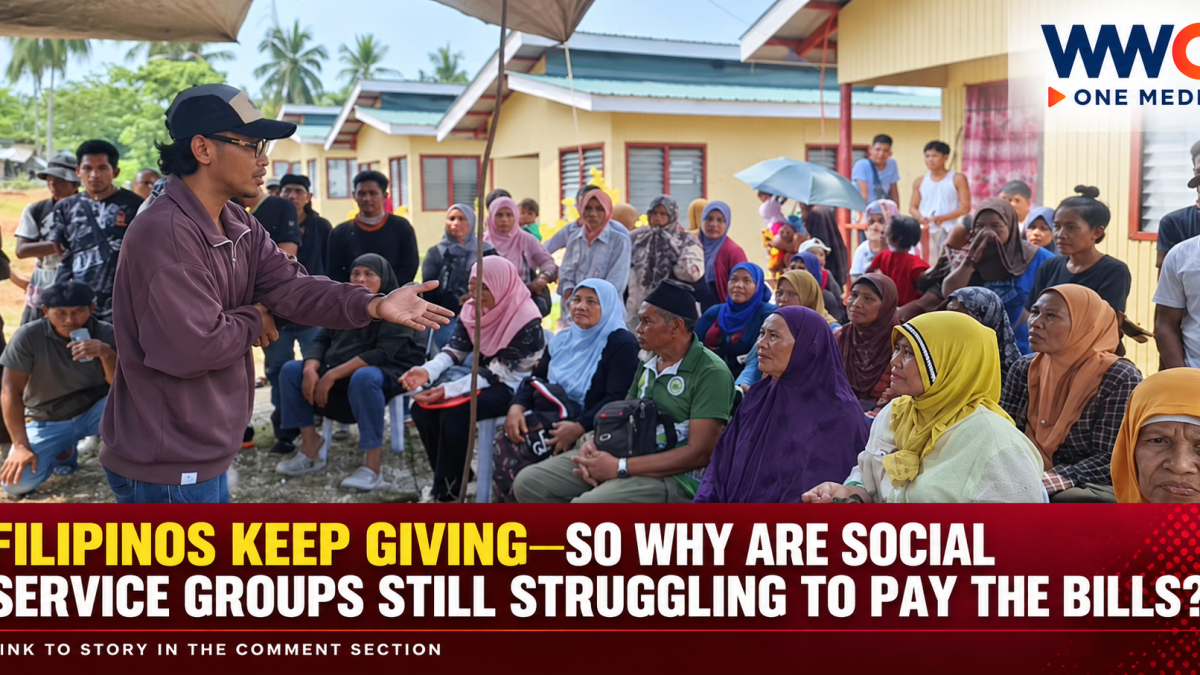
MANILA, Philippines — Filipinos continue to show a strong culture of generosity, but new data reveal a troubling gap: high public trust and widespread giving do not automatically translate into enough sustainable funding for organizations delivering social services.
The issue is highlighted by recent findings from the 2026 Doing Good Index (DGI) and the World Giving Report 2026, which paint a picture of a country where people remain highly willing to help—but nonprofit and social-service organizations still face challenges turning that goodwill into dependable resources.
The Philippines remains in the “Doing Better” category of the Doing Good Index, a regional assessment by the Center for Asian Philanthropy and Society examining whether government policies, regulations, tax systems and the broader environment support philanthropy and social-sector organizations. The Philippines has remained in that category since the index was launched in 2018.
Filipinos are giving—but not always directly to NGOs
The World Giving Report 2026, released by the Charities Aid Foundation, found that 78% of Filipinos reported donating money in 2025, up from 75% in 2024.
That figure was substantially higher than the 61% global average and the 65% Asian average reported in the study, which surveyed 60,443 people across 105 countries.
But another finding exposes the challenge facing organized charities.
According to analysis of the 2026 philanthropy data, only 34% of Filipinos gave money directly to NGOs, while 80% of Philippine social organizations said domestic funding could be strengthened.
In other words, Filipinos are giving—but a significant portion of that generosity may go directly to individuals, communities, religious groups or other causes rather than toward the long-term operating costs of nonprofit organizations.
And that distinction matters.
Trust is not the same as financial sustainability
The 2026 Doing Good Index found that Philippine social delivery organizations enjoy relatively high levels of public confidence.
About 66% of surveyed Philippine social delivery organizations said they were trusted by society, compared with an Asian average of 43%.
Trust in government was also higher than the regional average, at 55% versus 36%, while 70% of organizations reported trust in corporations, nearly twice the Asian average of 38%.
Corporate support is another important source of funding.
Businesses accounted for about 34% of the budgets of Philippine social delivery organizations, compared with 19% across Asia. Meanwhile, 79% of surveyed organizations received corporate funding and 68% benefited from corporate volunteers.
Yet strong trust and corporate participation have not eliminated the sector’s financial pressures.
The problem is simple: organizations need predictable funding to pay employees, maintain facilities, comply with regulations, run programs and continue serving communities—not simply public confidence.
The government is trying to make giving easier
One significant policy change came in May 2026, when President Ferdinand Marcos Jr. issued Executive Order No. 117, streamlining the accreditation system for social welfare and development agencies.
Under the order, the Department of Social Welfare and Development (DSWD) became the sole accrediting entity for social welfare and development agencies. DSWD registration and accreditation are recognized by the Bureau of Internal Revenue for purposes of granting donee-institution status.
That matters because qualified donee institutions can receive tax-deductible contributions under the National Internal Revenue Code, potentially making charitable giving more attractive to donors.
The government said the reform was intended to simplify procedures and reduce unnecessary requirements for organizations involved in social welfare and development work.
Government spending is also increasing—but needs remain enormous
The funding challenge exists alongside a substantial expansion in government social-protection spending.
For 2026, the DSWD received a P264.45-billion budget, a 22.5% increase from the previous year’s P215.8 billion allocation.
The department said P113 billion was allocated to the Pantawid Pamilyang Pilipino Program (4Ps), while P63.9 billion was allotted for protective services, including assistance to individuals and families experiencing crises.
Those figures demonstrate the scale of government involvement in social protection—but they also illustrate how extensive the country’s social needs are.
Civil society organizations continue to fill important gaps in areas such as disaster response, poverty reduction, health, education, child protection and community development.
Red tape remains another obstacle
Despite improvements in the country’s philanthropic environment, nonprofit groups still face difficulties when working with government.
An Inquirer analysis of the 2026 Doing Good Index found that procurement-related barriers continue to make it difficult for nonprofits to partner with government in delivering public services. The Philippines ranked second in Southeast Asia in the index’s assessment of the enabling environment for philanthropy, behind Singapore.
This creates a paradox.
The Philippines has a strong culture of giving, relatively high levels of trust in social organizations and significant corporate involvement. But organizations can still struggle with funding stability, administrative requirements and access to domestic resources.
The bigger question: Can generosity become sustainable support?
The data suggest that the Philippines does not have a shortage of people willing to help.
The bigger challenge is turning that willingness into reliable, long-term support for the organizations that deliver services year-round.
For social-service groups, a one-time donation can help pay for immediate assistance. But sustained operations require recurring funding for salaries, training, equipment, transportation, facilities, technology, compliance and program delivery.
That is why the latest philanthropy figures carry a message beyond the headline numbers: a generous population can create enormous social impact, but generosity alone does not guarantee financially sustainable social services.
The Philippines may have the trust, the culture of giving and increasingly supportive policies.
The question now is whether those strengths can be converted into stable funding that keeps social-service organizations operating long after the donation drive ends.