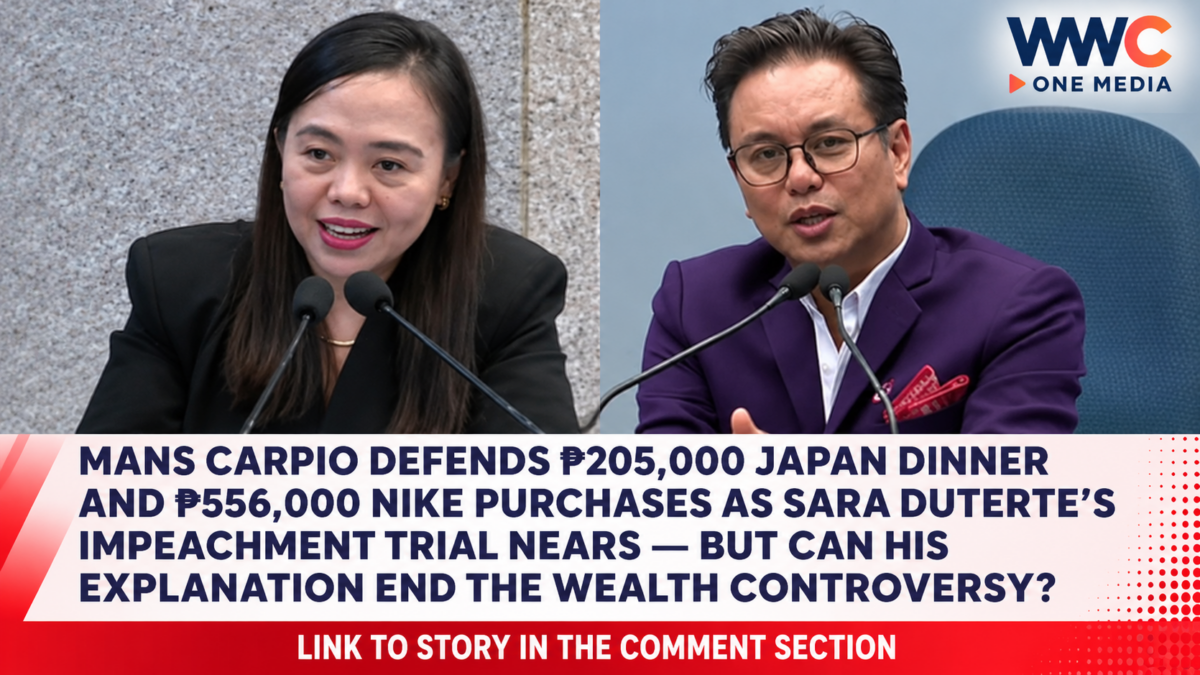
MANILA, PHILIPPINES — The controversy surrounding the credit-card spending of lawyer Manases “Mans” Carpio, husband of Vice President Sara Duterte, has taken another political turn after his spokesperson defended hundreds of thousands of pesos in questioned purchases and challenged lawmakers to examine what he described as extravagant spending among their own ranks.
Lawyer Neil Abayon, speaking for Carpio, said the transactions involving Nike stores in the Philippines and Malaysia, as well as an expensive restaurant in Japan, were legitimate personal or group-related expenses.
He insisted that Vice President Duterte had no involvement in the purchases.
In an interview on Bilyonaryo News Channel’s The Spokes, aired November 6, Abayon explained that Carpio had purchased sporting goods for basketball players and used his credit card to settle a group restaurant bill in Japan.
The explanation comes as Duterte prepares to begin presenting her defense before the Senate impeachment court on November 9.
But the controversy is no longer simply about expensive shoes, a restaurant bill or the lifestyle of a prominent political family.
It has become part of a larger dispute over financial transparency, the interpretation of bank records and allegations of unexplained wealth involving the Vice President.
The prosecution wants answers about the transactions.
Carpio insists that his personal expenses have been unfairly connected to his wife.
And Abayon is now asking why certain House members’ alleged luxury spending is not receiving similar scrutiny.
Carpio’s Spokesperson Defends Credit-Card Transactions
Abayon addressed the controversy during the November 6 episode of The Spokes, hosted by lawyer Trixie Cruz-Angeles.
The discussion focused on credit-card transactions previously examined during Duterte’s impeachment proceedings.
According to Abayon, the purchases were made by Carpio and involved his own activities and companions.
He rejected suggestions that Duterte participated in the transactions.
The spokesperson said Carpio had provided financial support to a university-affiliated basketball team and a youth team associated with his child.
He also explained that a costly restaurant transaction in Japan represented expenses for several people, not a meal consumed by Carpio alone.
These statements are the defense’s explanation of the transactions.
They do not constitute an independent audit of the money used or proof of what every purchase contained.
But the prosecution’s questions likewise do not establish that any of the spending was illegal.
More Than ₱760,000 in Purchases Under Scrutiny
The credit-card transactions attracted attention during testimony by financial forensic analyst Alexander Cabrera in October.
According to Daily Tribune’s reporting on the proceedings, the questioned charges included approximately ₱300,000 in combined Nike purchases at SM Davao.
Another transaction involved ₱256,882.50 at Nike Pavilion in Kuala Lumpur, Malaysia.
A restaurant charge at Ginza Inakaya in Tokyo amounted to approximately ₱205,000.
Together, these transactions total approximately ₱761,882.50.
The amounts have featured in questions about the financial activities of Duterte and Carpio.
However, they should not be represented as money proven to have been stolen, misused or paid from government funds.
The existence of a large credit-card transaction does not establish criminal wrongdoing.
The relevant questions concern the source of the funds, the circumstances of the purchases and whether the transactions have legal significance in the impeachment case.
Why Carpio Says the Nike Purchases Were Legitimate
Abayon said the purchases at Nike stores were intended to support basketball teams.
The Davao transactions were associated with a university-level basketball group, while purchases in Malaysia were linked to a younger team.
Carpio had previously made a similar explanation in October.
He said the Kuala Lumpur expenses concerned junior basketball players who had won a championship in Malaysia.
His defense also maintained that some sporting-goods expenses were shared among participants.
During the October 12 impeachment proceedings, defense counsel Kristine Ferrer questioned Cabrera about whether he knew that the Kuala Lumpur purchase was intended for Carpio’s son’s basketball team.
Cabrera said he was unaware of that explanation.
That exchange highlights an important distinction.
A financial analyst may identify an unusual transaction, but determining its purpose can require receipts, invoices, witness testimony and other supporting records.
Likewise, an explanation offered by a cardholder should be evaluated against available evidence.
The ₱205,000 Japan Restaurant Bill Explained
The expensive restaurant bill in Tokyo has become one of the most discussed details of the controversy.
Prosecutors questioned the roughly ₱205,000 charge at Ginza Inakaya.
Carpio previously explained that he was traveling with a large group when the expense was incurred.
According to his account, some companions lacked sufficient Japanese yen, so he temporarily used his credit card to settle the bill.
The participants subsequently shared the cost, he said.
Abayon repeated that explanation during the November 6 television interview.
Cruz-Angeles argued that public discussion had presented the charge in a misleading way by making it appear to be one unusually large individual expense.
However, the source material does not independently establish the number of diners or contain verified reimbursement records.
The proper description is that Carpio says the expense was shared.
That claim remains distinct from a completed forensic finding.
Abayon Turns Attention to Allegedly Extravagant House Members
The most politically provocative part of Abayon’s interview involved his criticism of certain lawmakers.
He argued that if large personal purchases were considered grounds for scrutiny, similar attention should be given to House members who spend heavily on luxury goods.
The comment shifted the debate from Carpio’s transactions to the personal spending of public officials.
But Abayon did not identify specific lawmakers or present a detailed list of transactions in the Politiko report.
His statement should therefore be treated as political criticism rather than a substantiated finding of misconduct.
Expensive personal purchases are not automatically unlawful.
That principle applies equally to Carpio, lawmakers and other private individuals.
Questions of public accountability arise when spending is connected to possible misuse of government resources, unlawful enrichment, inaccurate financial disclosures or other legally relevant circumstances.
The amount spent alone is insufficient to establish wrongdoing.
Sara Duterte’s Camp Denies Any Use of Public Funds
Carpio previously issued a statement rejecting allegations that his credit-card spending was connected to public money.
He maintained that the transactions were personal and paid from his own resources.
He also said his wife was not present when the purchases were made.
The statement was reported in October by ABS-CBN News, NewsWatch Plus, SunStar and Daily Tribune.
His position is that personal spending should not be misrepresented as expenditure undertaken by the Vice President in her official capacity.
He has also criticized the disclosure of his private financial records during impeachment proceedings.
However, those denials do not resolve every issue raised by the prosecution.
The impeachment court must determine what evidence is relevant and whether the records establish any alleged violation by Duterte.
Why the Prosecution Is Examining Carpio’s Finances
The credit-card controversy forms part of a broader financial inquiry.
The House prosecution has been examining bank records, tax information, property transactions and Statements of Assets, Liabilities and Net Worth involving Duterte and Carpio.
Article II of the impeachment case concerns allegations of unexplained wealth and inaccurate financial disclosures.
Prosecutors argue that some of the financial information requires further explanation.
They have questioned whether the Vice President’s declared assets accurately reflect her financial circumstances and applicable disclosure obligations.
The defense disputes the allegations and challenges how the prosecution interprets the records.
As WWC ONE MEDIA reported in its investigation of the alleged unexplained wealth, the dispute involves more than isolated purchases.
It concerns how financial evidence should be evaluated when a public official is accused of failing to properly disclose wealth or interests.
The allegations remain unproven.
Prosecutors Have Raised an ₱817.87-Million Wealth Allegation
The House prosecution’s forensic financial analysis has also identified an alleged ₱817.87-million discrepancy involving assets and income during the relevant period.
The figure is substantially larger than the credit-card purchases currently attracting attention.
But the ₱817.87 million must be understood correctly.
It represents a prosecution allegation based on financial analysis.
It has not been established by a final impeachment judgment as illegally acquired or concealed wealth.
As WWC ONE MEDIA explained in its coverage of the prosecution’s formal evidence submission, filing documents and presenting calculations does not automatically prove the conclusions drawn from them.
The defense has the opportunity to challenge the methodology, documents and assumptions used in the analysis.
The Senate impeachment court must evaluate the admissible evidence before determining whether the remaining charge has been proven.
Financial Records and Property Transactions Also Under Examination
The broader impeachment proceedings have included testimony concerning bank accounts and property records connected to Duterte and Carpio.
Land registry officials have presented information about properties in Davao City and the Island Garden City of Samal.
The prosecution has questioned how relevant property interests correspond to the Vice President’s financial declarations.
As WWC ONE MEDIA reported when the impeachment court subpoenaed 14 financial-sector representatives, financial institutions were called upon to provide information relevant to the investigation.
Those records can help establish ownership, transaction history and the authenticity of documents.
But the presence of a person’s name in a bank record or property transaction does not automatically establish illegal conduct.
Financial evidence must be examined in context.
The defense may present alternative explanations involving legitimate business activities, personal income, jointly held assets or accounting treatment.
The Prosecution Says the Records Deserve Explanation
House prosecutors have defended their examination of financial records.
In an October 8 statement, prosecution adviser and spokesperson Ace Barbers said the financial questions were based on official tax returns, financial statements and asset declarations.
The House has argued that the relevant evidence should be compared against Duterte’s lawful income and reported assets.
However, the prosecution has also acknowledged that the existence of financial transactions does not automatically prove a crime.
That distinction is essential.
Money entering or leaving a bank account may represent business revenue, transfers, loans, investments or other legitimate transactions.
A large total of aggregate banking activity is not necessarily equivalent to personal wealth.
The court must determine which transactions are relevant to the allegations and what they actually establish.
Prosecutor Terry Ridon Demands Further Explanation
The dispute over Carpio’s spending has not disappeared following his spokesperson’s clarification.
House prosecutor Terry Ridon has continued questioning the transactions.
In a November 8 statement reported by Manila Bulletin, Ridon pressed Duterte’s defense lawyers to explain the credit-card expenses when the impeachment trial resumes.
He referred to the Japan restaurant bill and purchases involving sporting goods.
Ridon questioned whether the spending was consistent with the ordinary financial circumstances of Filipino households.
But the significance of that comparison is contested.
A costly purchase may attract public attention without demonstrating that the funds came from an unlawful source.
For the prosecution, the transactions form part of its broader examination of wealth and financial disclosures.
For the defense, they represent legitimate private expenses that should not be linked to Duterte without supporting evidence.
The dispute may become part of the defense’s presentation.
Could Carpio Be Called to Testify?
The possibility of calling Carpio as a witness has previously been raised.
In September, Ridon said prosecutors were considering whether the lawyer might be asked to explain financial records associated with him.
However, the House clarified at the time that the possibility was still under discussion.
Carpio had not been formally identified as a hostile witness through that announcement.
His possible testimony should therefore not be described as confirmed.
Whether he ultimately appears would depend on subsequent procedural decisions and the court’s applicable rules.
The impeachment court must also consider the relevance of proposed testimony and the legal rights of those involved.
Sara Duterte’s Defense Begins November 9
The political stakes are especially high because the next phase of the impeachment trial is approaching.
As WWC ONE MEDIA reported in its November 8 preview of the trial, proceedings are scheduled to resume on November 9.
Duterte’s legal team has identified 24 prospective witnesses, including representatives of banks, companies and local government offices.
The defense is expected to challenge the prosecution’s financial case.
It may seek to explain transactions, clarify ownership records and dispute allegations involving financial disclosures.
The court has also narrowed the proceedings to the remaining impeachment article concerning unexplained wealth.
No final verdict has been issued.
Duterte remains in office and retains the right to defend herself against the allegations.
The Real Question Is Financial Evidence, Not Lifestyle Alone
The controversy illustrates why high-profile financial investigations require careful reporting.
Large personal purchases can generate political outrage.
But the legal significance of those purchases depends on evidence.
For example, a ₱205,000 restaurant bill paid by one person for a large group has different implications from a ₱205,000 meal purchased for one person.
Likewise, sporting goods bought for an entire basketball team should not automatically be characterized as personal luxury purchases.
Those explanations, however, must be tested against supporting records when legally relevant.
The prosecution must establish the significance of the evidence it presents.
The defense must be given an opportunity to challenge it.
Public officials should also face consistent standards of accountability, irrespective of political affiliation.
What Happens Next?
The immediate focus will be the resumption of Duterte’s impeachment trial on November 9.
Her lawyers are expected to present witnesses and documents addressing the remaining financial allegations.
The prosecution may challenge those explanations.
Questions concerning Carpio’s credit-card transactions could resurface if they are considered relevant to the remaining impeachment article.
Meanwhile, his spokesperson’s criticism of allegedly extravagant lawmakers may continue to generate political debate.
But political arguments about other people’s spending do not determine whether the allegations involving Duterte have been proven or disproven.
That assessment belongs to the impeachment court.
The Bottom Line: Mans Carpio Has Offered an Explanation, but the Financial Dispute Is Far From Over
Lawyer Neil Abayon has defended the credit-card spending of Manases Carpio, insisting that transactions involving Nike stores and a Japanese restaurant were connected to basketball teams and a group outing.
He also maintained that Vice President Sara Duterte was not involved.
Abayon criticized what he described as extravagant luxury spending by some House members, although he did not identify specific lawmakers or present detailed supporting evidence.
The House prosecution continues to examine financial records associated with Duterte and Carpio as part of the remaining impeachment charge.
Carpio denies using public funds for the purchases.
The prosecution has not obtained a final ruling establishing that the transactions were illegal.
With Duterte’s defense scheduled to begin on November 9, both sides are preparing for another critical stage of the proceedings.
And as Mans Carpio’s camp explains more than ₱760,000 in questioned credit-card purchases while challenging lawmakers to examine their own spending, one question remains: Will the defense’s explanations and financial records finally settle the controversy—or will the Senate impeachment court find that the transactions raise questions the couple has yet to answer?