
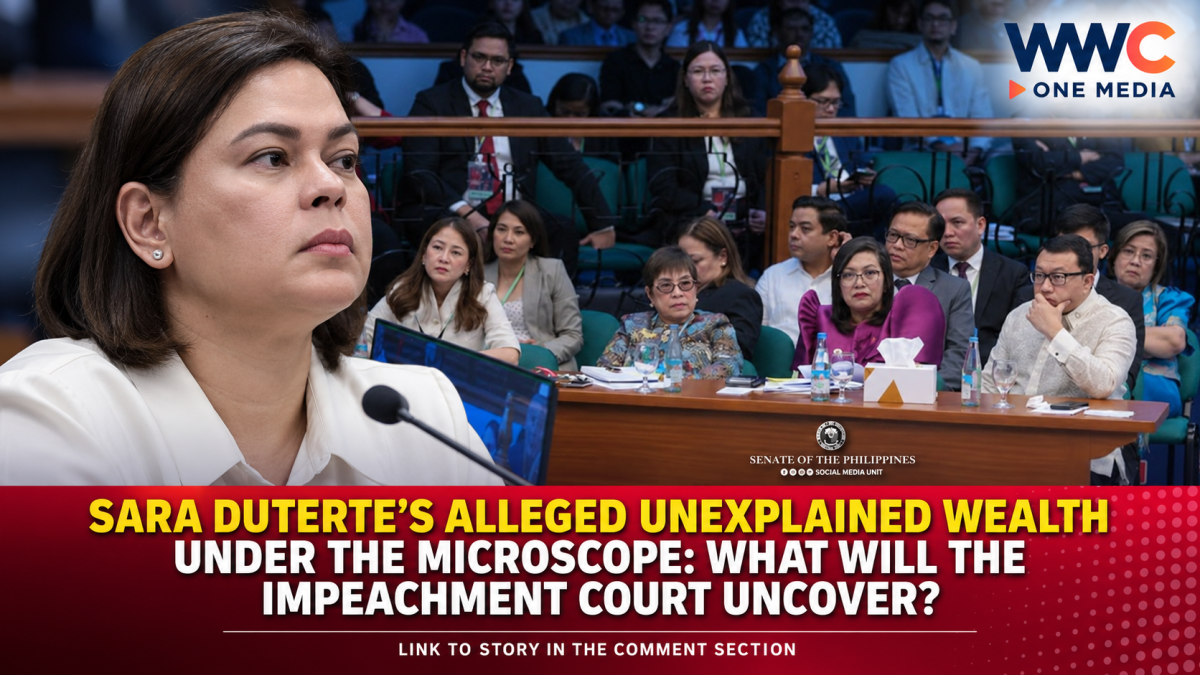
MANILA, Philippines — The impeachment trial of Vice President Sara Duterte is set to enter one of its most closely watched phases on Monday, September 14, as the Senate sitting as an impeachment court begins hearing the House prosecution’s evidence on allegations of unexplained wealth.
The proceedings will focus on Article II of the impeachment case, which accuses Duterte of allegedly accumulating wealth disproportionate to her lawful income, failing to fully and truthfully disclose assets, liabilities and net worth in her Statement of Assets, Liabilities and Net Worth (SALN), and allegedly continuing business interests while serving as vice president.
The House prosecution originally scheduled the unexplained-wealth allegations later in its presentation, but prosecutors moved to advance Article II after completing their presentation of evidence on the confidential-fund allegations under Article I.
More than 1,800 financial documents to be examined
The financial phase of the trial is expected to center on a large volume of documents obtained through subpoenas issued by the impeachment court.
The prosecution has prepared more than 1,800 bank, tax and other financial documents involving Duterte, her husband, lawyer Manases “Mans” Carpio, and companies linked to them. The records are expected to be compared with Duterte’s declared assets, income and business interests.
Six banks have submitted financial records involving Duterte and Carpio, while the Bureau of Internal Revenue provided tax-related documents requested by the court. Prosecutors said the records would be examined to determine whether they support the allegations contained in Article II.
One of the major issues prosecutors are expected to pursue is whether certain bank accounts identified in the records belong to Duterte individually or jointly with other people.
The prosecution has asked Duterte to authenticate the bank records and confirm ownership of accounts identified in the documents. Prosecutor Chel Diokno submitted 104 requests for admission covering the authenticity of records and ownership of accounts.
The billions of pesos at the center of the allegations
Prosecutors have cited an Anti-Money Laundering Council report involving hundreds of transactions associated with Duterte and Carpio.
According to the House prosecution, the AMLC material covers 663 transactions with an aggregate value of about ₱6.77 billion — approximately ₱3.77 billion associated with Duterte and ₱2.99 billion associated with Carpio.
The prosecution intends to use the financial records to examine whether the transactions are consistent with the income and assets declared by the couple.
However, these figures do not by themselves establish that the money was illegally obtained or that Duterte committed an impeachable offense. The allegations remain contested and must be evaluated by the Senate impeachment court.
Duterte camp disputes the allegations
Duterte’s defense has rejected the prosecution’s allegations and has challenged the use and admissibility of some of the financial information.
In its response to the impeachment allegations, the defense questioned evidence attributed to former senator Antonio Trillanes IV and raised concerns over the confidentiality of bank information and the use of AMLC-related records.
The defense has maintained that the allegations concerning Duterte’s wealth are unsupported and has reserved the right to challenge the evidence before the impeachment court.
The defense has also been given 15 days to respond to the prosecution’s 104 requests for admission. Presiding Officer Francis “Chiz” Escudero emphasized that the response period would not stop the trial from proceeding.
Possible witnesses could widen the financial inquiry
The prosecution is preparing a substantial lineup of witnesses for Article II.
House prosecutors have said they could call officials and individuals who can explain bank records, tax documents and other financial evidence. They have also sought subpoenas for retired Sandiganbayan Presiding Justice Amparo Cabotaje-Tang and other potential witnesses connected to their case.
Prosecutors have also discussed the possibility of calling Carpio as a hostile witness if they determine that his testimony would help explain financial records associated with him. However, this remains only a possibility and he was not then included in the prosecution’s witness list.
Why Monday’s proceedings matter
The unexplained-wealth allegations could become one of the most document-heavy portions of Duterte’s impeachment trial.
Rather than relying solely on testimony, prosecutors are expected to build their case through bank records, tax information, SALNs, business records and other financial documents.
The central question for the impeachment court will ultimately be whether the evidence establishes the allegations contained in Article II — not simply whether Duterte or her husband had large financial transactions.
The defense, meanwhile, is expected to challenge the authenticity, relevance, admissibility and interpretation of the prosecution’s evidence while protecting Duterte’s constitutional rights.
With the Senate impeachment court now turning its attention to Duterte’s alleged unexplained wealth, the proceedings could provide the clearest public examination yet of the vice president’s declared assets, financial transactions and business interests.
For now, however, the allegations remain allegations. The Senate impeachment court has yet to determine whether the prosecution’s evidence is sufficient to establish an impeachable offense.




Leave a Reply