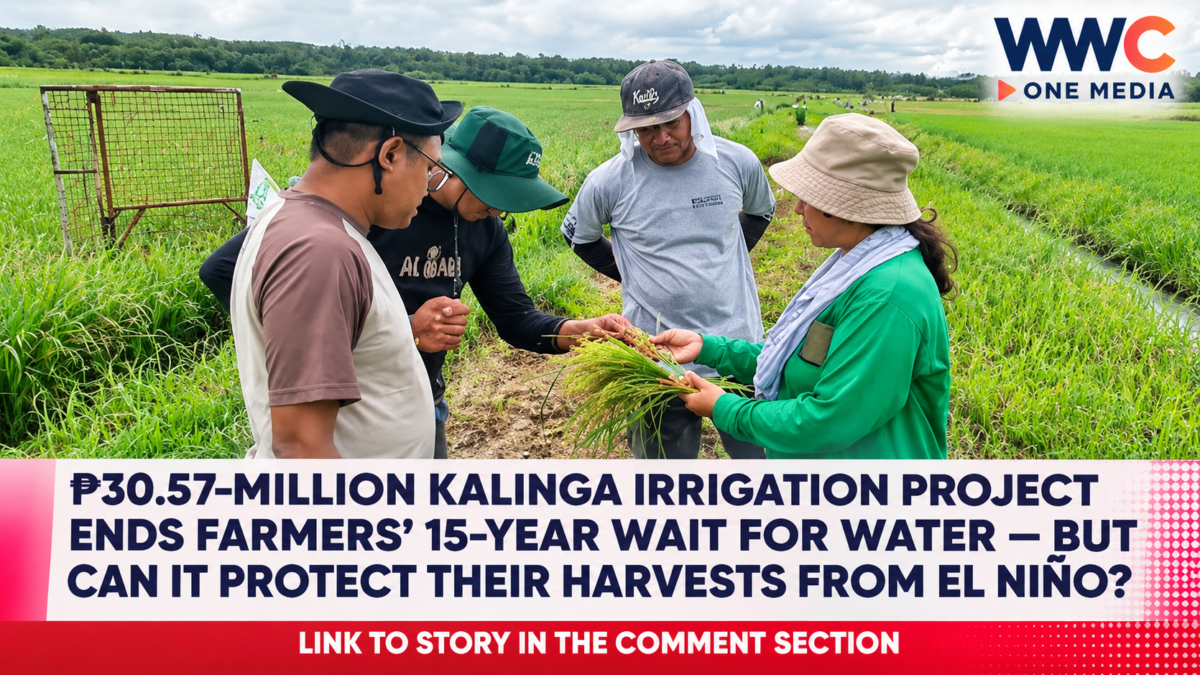
TABUK CITY, KALINGA — After years of struggling to grow crops without a dependable water supply, farmers in a remote Kalinga community finally have a new source of hope: a government-funded irrigation facility designed to keep agricultural production going even when rainfall becomes scarce.
The Department of Agriculture (DA) has completed the Bulo-Magasusu Small Water Impounding Project in Sitio Magasusu, Barangay Bulo, Tabuk City.
The facility, officially inaugurated on November 5, 2026, costs approximately ₱30.57 million and is expected to provide irrigation for 85 hectares of agricultural land cultivated by 35 farmers.
The project includes a water-storage pond, a 13-meter-high dam, an irrigation canal and an outlet pipe designed to deliver water to nearby farms.
But its significance extends beyond concrete structures and irrigation channels.
Local farmers say they had waited approximately 15 years for a dependable water source.
Their struggle has become particularly urgent as the Philippines faces prolonged dry conditions associated with El Niño, which could threaten agricultural production into 2027.
The new facility promises to reduce dependence on rainfall, lower irrigation costs and improve farmers’ ability to sustain production.
But the biggest question remains: Can the new irrigation system deliver enough water through a prolonged drought—or will increasingly extreme weather continue to threaten the harvests of Kalinga’s farmers?
Department of Agriculture Completes ₱30.57-Million Water Project
The Bulo-Magasusu Small Water Impounding Project was implemented through the DA’s Bureau of Soils and Water Management (BSWM).
It was funded under the department’s Fiscal Year 2024 locally funded programme for small-scale irrigation and water impounding infrastructure.
The project’s reported exact cost is ₱30,569,396.93.
National news reports rounded the amount to ₱30 million.
The facility was inaugurated on November 5, with DA Assistant Secretary Brando Aguilera representing Agriculture Secretary Francisco Tiu Laurel Jr.
Officials from the provincial government of Kalinga, Tabuk City and the local farmers’ association also participated.
The completion marks a significant development for Sitio Magasusu, where farmers have long struggled with unreliable water availability.
The project is intended to allow agricultural activities to continue during periods when natural rainfall is insufficient.
35 Farmers and 85 Hectares Expected to Benefit
According to the DA, the facility is designed to serve 35 farmers working approximately 85 hectares of agricultural land.
Rice farming is an important livelihood in Barangay Bulo.
But agricultural production depends heavily on access to sufficient water.
Without reliable irrigation, farmers may have difficulty preparing land, establishing crops and maintaining growth during dry periods.
The new impounding facility collects and stores water that can later be distributed to agricultural areas.
The arrangement could allow farmers to continue working when rainfall declines.
Agriculture officials also expect it to reduce production expenses.
However, the projected coverage of 85 hectares does not mean crop yields across that entire area have already increased.
The facility has only recently been inaugurated.
Its actual performance will need to be assessed across future planting seasons.
Inside the Irrigation Facility: Dam, Pond and Canal
The DA provided details of the infrastructure.
The project includes an approximately 18-hectare pond associated with a 177-hectare watershed.
A 13-meter-high dam forms part of the water-storage system.
The facility also includes a 1.75-kilometer irrigation canal and a 94-meter outlet pipe.
These components are intended to work together to retain and distribute water.
The watershed supplies runoff to the impounding area.
The storage pond holds water for later use.
The canal and outlet infrastructure support delivery to participating farms.
Such systems can be particularly useful in locations where farmers do not have dependable access to conventional large-scale irrigation networks.
However, the presence of an impounding facility does not guarantee unlimited water availability.
Actual performance depends on rainfall, reservoir storage, water demand, maintenance and distribution practices.
Those factors will become particularly important during prolonged dry conditions.
Farmers Say Project Ends a 15-Year Wait
Local reporting by Guru Press Cordillera provides an important human dimension to the project.
Farmer-beneficiary Martina Daligdig said the community had been waiting many years for reliable irrigation.
During earlier dry periods, farmers struggled to plant because sufficient water was unavailable.
Some reportedly traveled farther into forested areas to find locations where they could cultivate crops.
The new irrigation facility creates opportunities to tend gardens without depending entirely on rainfall.
For agricultural households, having a more predictable water supply can affect planting schedules, production decisions and household income.
Kalinga Vice Governor Dave Odiem described the facility as a source of hope for farmers facing El Niño.
He emphasized that the project represents more than a structure for storing water.
It is intended to help families continue earning a living.
El Niño Makes the Timing Particularly Important
The facility comes online as the Philippines prepares for potentially prolonged dry conditions.
El Niño involves unusually warm ocean temperatures in the central and eastern tropical Pacific.
It can affect rainfall patterns and increase the likelihood of dry conditions in parts of the Philippines.
PAGASA has warned that the current event could continue into the first half of 2027.
For farmers, the implications are serious.
Reduced rainfall can affect soil moisture and irrigation supplies.
High temperatures may increase evaporation and crop water requirements.
Farmers without adequate storage may be forced to delay planting or reduce cultivated areas.
As WWC ONE MEDIA reported in its coverage of Cebu City’s preparations for El Niño, agricultural authorities in other parts of the Philippines are considering rainwater harvesting, small impounding facilities and irrigation rehabilitation.
The Kalinga project offers a concrete example of the type of infrastructure being promoted.
But weather conditions vary across the country.
One community’s irrigation system cannot eliminate drought risks in other provinces.
Water Storage Could Help Reduce Farmers’ Production Costs
One of the project’s anticipated benefits is lower irrigation expense.
In some communities, farmers depend on fuel-powered water pumps when rainfall is insufficient.
Operating those pumps can involve fuel, maintenance and labor expenses.
A functioning water impounding and distribution system may reduce the need for some pumping activities.
That could lower production costs.
Agriculture Secretary Tiu Laurel said water-storage infrastructure could help farmers manage the uncertainty created by changing weather patterns.
He also emphasized the DA’s commitment to improving agricultural productivity and farmers’ incomes.
However, officials have not yet released an independently verified calculation showing exactly how much each beneficiary will save annually.
Likewise, no completed post-inauguration assessment establishes the project’s effect on farm earnings.
Those benefits remain reasonable expectations to be measured during actual operations.
DA Credits Local Farmers’ Association for Project Completion
The DA acknowledged the participation of the Magasuso Small Water Impounding System Association.
The organization, led by president Mokon Oticao, worked with government agencies during the project’s development.
Tiu Laurel urged the association to protect and maintain the new facility.
That responsibility is essential.
Water-storage structures and irrigation channels require regular attention.
Sediment accumulation may reduce storage capacity.
Damaged channels can interfere with distribution.
Unmaintained structures may become less effective over time.
A community-managed system can help identify operational problems early.
But local organizations may also need technical and financial assistance for major repairs.
The project’s long-term success will therefore depend on continued cooperation between farmer-beneficiaries and government agencies.
Fish Fingerlings Released Into the Facility
The inauguration also included a fisheries-related activity.
Local reporting said fish fingerlings were released into the impounding facility with assistance from the Bureau of Fisheries and Aquatic Resources in Kalinga.
The activity could create an additional livelihood opportunity alongside irrigation.
Fish production may provide food or supplementary income if suitable conditions are maintained.
However, releasing fingerlings does not guarantee a successful fish harvest.
Fish survival and growth depend on water quality, stocking density, management and other conditions.
The project’s primary purpose remains agricultural irrigation.
Any future fisheries benefits would require separate assessment.
Davao’s ₱585-Million El Niño Losses Show Why Irrigation Matters
The urgency of water infrastructure is evident in other regions.
As WWC ONE MEDIA reported in its investigation of agricultural losses in Davao, the region had recorded approximately ₱584.68 million in crop and livestock losses.
The assessment covered 6,205 farmers and 6,634 hectares of agricultural land.
Rice accounted for approximately ₱390.24 million of the reported losses.
The figures show how inadequate moisture can damage agricultural production and livelihoods.
Davao’s situation is separate from Kalinga.
There is no basis for assuming the new Bulo-Magasusu facility will prevent the same amount of losses.
Nevertheless, the comparison helps explain why local water-storage systems are becoming a priority.
Where sufficient runoff can be collected and stored, irrigation infrastructure may improve farmers’ ability to withstand seasonal water shortages.
Early Crop-Damage Reporting Remains Important
Farmers need more than irrigation infrastructure.
They also require access to information, technical assistance and financial protection when crops are damaged.
As WWC ONE MEDIA reported in its November 4 coverage of agricultural assistance in Davao, the DA has encouraged farmers to report moisture stress early.
Prompt reporting can help authorities document losses and determine which assistance programmes may be available.
Crop insurance may also help qualified farmers manage eligible losses.
However, insurance coverage and government assistance have separate requirements.
The Kalinga irrigation project does not automatically provide crop insurance or emergency cash transfers to its beneficiaries.
It is primarily a water infrastructure investment.
That makes it one part of a broader agricultural resilience strategy.
Could the Philippines Face a Bigger Agricultural Crisis in 2027?
The Department of Agriculture has warned that a prolonged El Niño could cause significant damage to agriculture.
Under a worst-case scenario discussed by officials, as many as 4.6 million farmers and fisherfolk could be affected.
Potential agricultural losses could reach ₱20 billion.
Those figures are projections, not confirmed nationwide losses.
As WWC ONE MEDIA reported in its coverage of the DA’s proposed national calamity response, authorities have been examining additional measures to protect agricultural production.
These include irrigation support, drought-tolerant crops and emergency assistance.
The Kalinga project shows what completed infrastructure can contribute at the community level.
But protecting national food production will require a much wider network of interventions.
A single impounding project designed for 85 hectares cannot resolve a nationwide agricultural water shortage.
Why Kalinga’s Agriculture Matters
Kalinga is an important agricultural province in the Cordillera Administrative Region.
Rice production supports local livelihoods and contributes to regional food supplies.
Mountainous terrain and differences in water availability can make irrigation especially important for particular farming communities.
Where farms depend primarily on seasonal rainfall, dry spells may disrupt cropping schedules.
Improved water storage can help farmers take greater control of agricultural planning.
It can also support more consistent land use where there is sufficient available water.
But the size of this project should be understood in context.
The facility is designed to assist a specific group of beneficiaries in Barangay Bulo.
It has not been presented as a province-wide irrigation system serving every Kalinga municipality.
Its value lies in addressing a localized need.
What Happens Next for the Bulo-Magasusu Project?
With the facility inaugurated, attention now turns to its operation and maintenance.
The farmers’ association and responsible agencies will need to ensure the system distributes water as intended.
Future evaluations can determine whether farmers are able to expand cropping activity, reduce pumping expenses or improve productivity.
Authorities may also examine how effectively the pond retains water during extended dry periods.
The project could provide lessons for other communities considering similar systems.
But those lessons should be based on measured results.
Important indicators include water availability during the dry season, operating costs, irrigation reliability and actual agricultural output.
The project will be most successful if it continues providing useful service beyond its inauguration.
The Bottom Line: Kalinga Farmers Have New Water Infrastructure, but the Real Test Comes During Drought
The Department of Agriculture has completed the Bulo-Magasusu Small Water Impounding Project in Tabuk City, Kalinga.
The facility cost approximately ₱30.57 million and was inaugurated on November 5, 2026.
It is designed to serve 35 farmers cultivating 85 hectares of agricultural land.
Its infrastructure includes an 18-hectare pond, a 177-hectare watershed, a 13-meter-high dam, a 1.75-kilometer irrigation canal and a 94-meter outlet pipe.
The project was developed through the DA’s Bureau of Soils and Water Management, with support from local government officials and the farmers’ association.
For beneficiaries who waited years for a dependable water supply, completion represents a major improvement in available infrastructure.
But the promised benefits must still be demonstrated through actual agricultural results.
And as a ₱30.57-million irrigation facility finally brings new hope to Kalinga farmers after years of dependence on rainfall, one question remains: Will the water stored behind the new dam be enough to protect the next harvest—or will a stronger El Niño expose the need for far more irrigation projects across the Philippines?