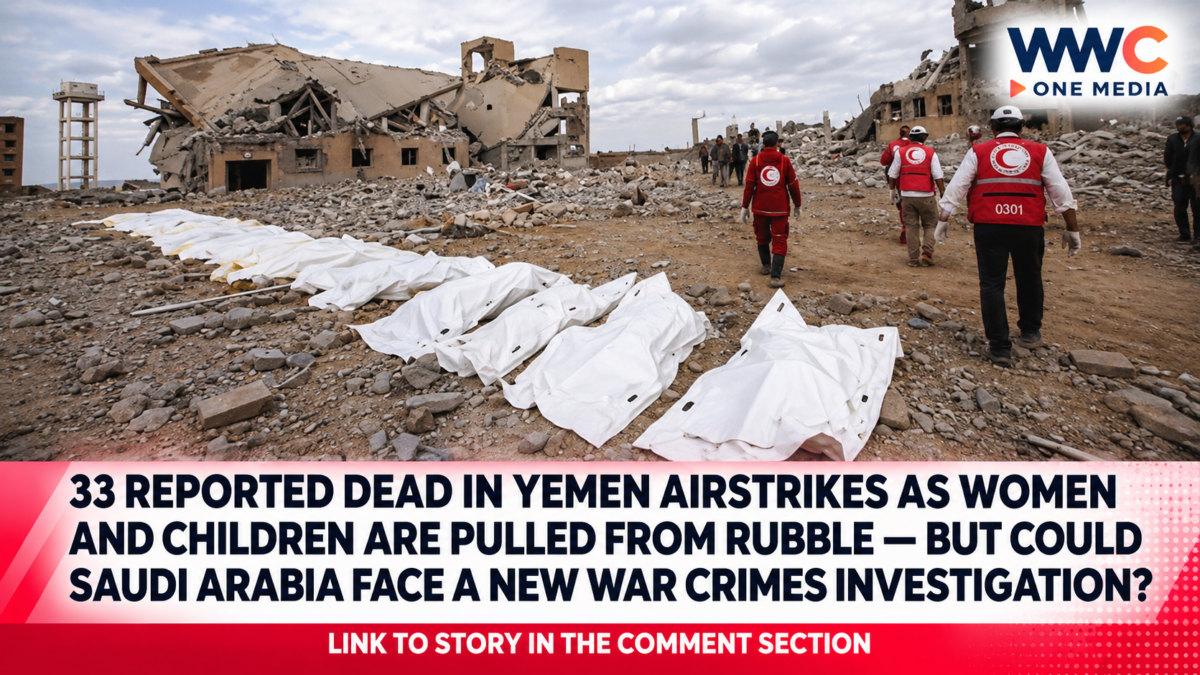
SANAA, YEMEN — A deadly wave of reported airstrikes has devastated a village near Yemen’s capital, killing at least 33 people and injuring 39 others, according to authorities controlled by the Iran-aligned Houthi movement.
Women and children were among the reported victims of Saturday’s attacks, which struck residential areas in Bani Hushaysh, east of Sanaa.
As rescue teams searched damaged buildings, hospital officials described critically injured patients arriving for emergency treatment while other people reportedly remained trapped beneath collapsed homes.
The Houthis accused Saudi Arabia of carrying out the strikes.
However, Reuters and the Associated Press could not independently verify either the casualty figures or who carried out the attacks. Saudi Arabia’s Center for International Communication said it was investigating the reports.
The violence represents another dangerous escalation in Yemen’s long-running civil war, where a fragile period of relative calm has collapsed amid renewed fighting between the Houthis and Saudi-backed forces.
The latest attacks also come as Yemen struggles with one of the world’s worst humanitarian emergencies, with millions of people facing food shortages, displacement and limited access to medical care.
As the death toll rises and both sides intensify military operations, a troubling question is emerging: Could Yemen’s renewed conflict turn into an even wider confrontation involving Saudi Arabia, Iran and regional shipping routes?
Houthi Authorities Report 33 Killed and 39 Injured
Yemen’s Houthi-run Health Ministry reported that Saturday’s airstrikes killed at least 33 people.
An earlier count had placed the toll at 27 dead and 36 wounded.
The figures were subsequently revised as additional casualties were reported.
According to ministry spokesperson Anees al-Asbahi, the latest death toll included 12 men, eight women and 13 children.
The reported injuries included 16 men, 10 women and 13 children.
These figures suggest a significant civilian toll.
However, they originate from authorities affiliated with one party to the conflict.
Independent journalists and humanitarian monitors have not confirmed the full breakdown.
The reported location was Bani Hushaysh, a district east of Sanaa, where the village of al-Shariya was identified in Associated Press reporting as one of the locations hit.
The area is under Houthi control.
Homes Destroyed as Families Search for Survivors
Witness accounts and footage described by the Associated Press showed damaged houses and injured civilians receiving medical attention.
The village is located approximately 15 kilometers northeast of Sanaa.
Video broadcast by the Houthi-run Al-Masirah television network showed rescuers and residents responding to damaged buildings.
Some footage showed children receiving treatment at hospitals.
The scale of the destruction raised fears that additional victims could remain beneath the rubble.
Hospital officials said emergency teams faced significant difficulties reaching everyone affected.
The accounts point to the immediate humanitarian consequences of attacks on populated areas.
But the available evidence does not establish whether the locations were deliberately targeted because civilians lived there.
Determining the intended targets, weapons used and circumstances of the strikes would require an independent investigation.
Hospital Director Says Rescuers Were Also Hit
Abdul-Aziz al-Dailami, director of Sehatuna Hospital in Sanaa, told Reuters that injured patients had arrived with serious wounds.
These included injuries affecting the head, chest and limbs, along with fractures.
He also said some first responders had been caught in subsequent attacks while trying to help victims.
Houthi officials accused aircraft of striking the area again after rescue workers arrived.
Such allegations are extremely serious.
Emergency medical personnel and civilians are protected under international humanitarian law, subject to the applicable rules governing armed conflict.
However, the reported follow-up strikes against rescuers have not been independently verified.
It would therefore be premature to conclude that emergency personnel were deliberately targeted.
The claims warrant examination, particularly because attacks affecting rescue efforts can increase the number of casualties and delay urgent medical treatment.
Did Saudi Arabia Carry Out the Airstrikes?
The Houthis have directly accused Saudi Arabia of responsibility.
Reuters reported that the Saudi Center for International Communication said it was investigating the allegations.
The Associated Press also sought comment from Saudi authorities.
No independently verified attribution was established in the reporting reviewed.
Saudi Arabia has supported forces aligned with Yemen’s internationally recognized government during the country’s long-running conflict.
The Saudi-led coalition has previously acknowledged conducting military operations against Houthi positions.
Nevertheless, a history of military involvement does not by itself prove responsibility for this particular attack.
Investigators would need information concerning aircraft movements, weapons, intended targets and operational orders.
For publication, the accurate description is that the Houthis blame Saudi Arabia for the strikes.
It would be misleading to present that accusation as an independently established fact.
Another Reported Attack Killed at Least 30 at a Market
The Bani Hushaysh incident followed another deadly attack reported on Friday, November 6.
Houthi authorities said strikes on a market in southwestern Yemen killed at least 30 people.
The attack reportedly occurred at al-Hadara market in the al-Waziyah area of Taiz province.
The Houthis blamed Saudi Arabia.
However, forces aligned with Yemen’s Saudi-backed government disputed that account and blamed the Houthis instead.
The Associated Press said it could not independently verify the competing claims.
The two incidents have intensified fears of civilian casualties during the renewed fighting.
But their reported death tolls should be kept separate until investigators establish the circumstances and confirm the figures.
There is no verified basis for describing the two incidents as a single coordinated operation by a confirmed attacker.
Yemen’s 2022 Truce Has Unraveled
The latest violence follows the breakdown of a period of relative calm.
In 2022, the United Nations helped broker a truce between the Houthis and their opponents.
Although the arrangement did not permanently end Yemen’s civil war, it substantially reduced several forms of fighting.
That fragile calm deteriorated during 2026.
By July, renewed military operations had escalated tensions between Saudi Arabia and Houthi forces.
The Houthis subsequently launched missiles and drones toward Saudi territory, including reported attacks involving airports and oil infrastructure.
Saudi-backed forces also intensified military operations in Yemen.
The deterioration has effectively reopened several fronts of a conflict that had already devastated the country for more than a decade.
How the Houthis Expanded Along Yemen’s Red Sea Coast
The latest attacks cannot be separated from changes on the battlefield.
Houthi forces have sought to strengthen their control over strategic territory in western Yemen.
Their operations have focused on positions along the Red Sea coast and near the Bab el-Mandeb Strait.
As WWC ONE MEDIA reported in its September coverage of renewed Saudi strikes and Houthi territorial advances, the escalation followed significant changes in control of coastal areas.
The Houthis have captured strategic locations and increased pressure on forces aligned with Yemen’s internationally recognized government.
Saudi Arabia has supported counteroperations intended to halt or reverse those advances.
However, territorial control in active conflict zones can change rapidly.
Reported advances should not automatically be interpreted as permanent control over every contested location.
Why the Bab el-Mandeb Strait Matters to the World
The Bab el-Mandeb Strait connects the Red Sea with the Gulf of Aden.
It is one of the world’s most important maritime chokepoints.
Ships traveling between Asia and Europe frequently use the route through the Red Sea and Suez Canal.
Disruptions can force vessels to take longer journeys around southern Africa.
That increases voyage distances and can raise transportation and insurance costs.
As WWC ONE MEDIA reported when the Houthis seized the strategic port city of Mocha, control of territory surrounding the strait has become an important objective of the conflict.
The Houthis have previously targeted commercial shipping and threatened vessels they associate with rival states.
Saudi Arabia and other countries have sought to protect trade routes and energy infrastructure.
This creates an international economic dimension to Yemen’s fighting.
A sustained escalation could affect maritime commerce far beyond the Arabian Peninsula.
But the latest village strikes have not, by themselves, established a new closure of the strait.
Trump Administration Faces Pressure Over Yemen Conflict
The renewed violence has also placed Washington in a difficult position.
The United States maintains close security ties with Saudi Arabia.
At the same time, President Donald Trump’s administration has sought to avoid becoming directly involved in another prolonged military campaign against the Houthis.
As WWC ONE MEDIA reported in its examination of Houthi advances and Trump’s decision to hold off on reported strikes, Washington has faced competing pressures over regional security and military intervention.
The United States previously conducted strikes against Houthi targets in 2025 before reaching a temporary ceasefire arrangement.
Renewed fighting has raised questions about how far the administration is willing to support its regional allies.
However, no verified announcement establishes that US forces participated in the November 7 attacks near Sanaa.
Any claim of American operational involvement would require separate evidence.
Iran’s Support for the Houthis Complicates Regional Diplomacy
The Houthis are widely described as an Iran-aligned movement.
Iran has provided support to the group over the course of the conflict, according to international reporting and government assessments.
However, the extent of Tehran’s direct involvement in individual Houthi military operations can be difficult to establish.
The renewed conflict is unfolding alongside wider regional tensions involving Iran and the United States.
That creates the risk that events in Yemen could affect other countries.
Missile and drone attacks against Saudi infrastructure could produce retaliation.
Disruption around the Red Sea could threaten international trade.
Further escalation could complicate diplomatic efforts to stabilize the broader Middle East.
Nevertheless, there is no verified evidence that Iran ordered the specific November 7 attacks.
The immediate accusations concern alleged Saudi airstrikes in Houthi-controlled territory.
Fighting Around Taiz Raises Fears of Another Humanitarian Disaster
Taiz has become another major focus of Yemen’s renewed conflict.
The city and surrounding areas have experienced prolonged fighting and restrictions on the movement of people and supplies.
Reports from humanitarian organizations describe shortages involving food, drinking water and medical resources.
Military operations have affected access routes used by civilians and aid organizations.
As WWC ONE MEDIA reported during Yemen’s renewed offensive toward strategic Red Sea territory, the escalation has involved significant casualties and displacement.
The situation around Taiz illustrates why the fighting has consequences beyond military positions.
When access routes become unsafe or blocked, civilians may struggle to obtain essential supplies.
Hospitals can face shortages of medicine and equipment.
Families may be forced to leave their homes.
The consequences can continue long after a particular battle ends.
More Than 22 Million Yemenis Need Humanitarian Assistance
Yemen was already experiencing a severe humanitarian emergency before the latest escalation.
The United Nations’ 2026 Humanitarian Needs and Response Plan estimated that approximately 22.3 million people would require humanitarian assistance and protection services.
That includes millions of displaced people and households struggling with food insecurity.
The United Nations also estimated that approximately 18.3 million people were facing acute food insecurity.
The renewed fighting threatens to make an already difficult situation worse.
Airstrikes and ground battles can force families from their homes.
Disruptions to transport routes can affect food deliveries.
Damage to infrastructure can reduce access to drinking water and medical services.
Humanitarian organizations also face operational restrictions and funding shortages.
The most vulnerable groups include children, pregnant women, older people and those with existing medical needs.
For these communities, even a temporary interruption in assistance can have serious consequences.
Displacement Continues as Fighting Intensifies
Reuters reported that the International Organization for Migration had recorded more than 200,000 people displaced by the latest round of fighting as of October.
More recent humanitarian reporting has described displacement exceeding 300,000 people, although estimates may use different dates and geographic coverage.
These figures should not be added together.
They reflect different assessments of people forced to leave their homes.
The broader concern is clear.
Large numbers of Yemenis are experiencing repeated displacement.
Some families have fled fighting several times over the past decade.
When people move into temporary shelters or crowded communities, access to safe water, sanitation and healthcare can become difficult.
Repeated displacement can also deprive children of schooling and families of stable livelihoods.
The November attacks near Sanaa may create additional needs if surviving residents cannot safely remain in their homes.
But there is no independently verified count yet of people displaced specifically by those strikes.
Could the Strikes Amount to War Crimes?
International humanitarian law requires parties to armed conflicts to distinguish between civilians and combatants.
Attacks must comply with the rules governing military objectives, proportionality and precautions to protect civilians.
Civilian homes are not automatically lawful military targets.
Medical personnel and rescue workers also enjoy specific protections.
If a military operation unlawfully targeted civilians or protected emergency responders, it could raise serious questions under international humanitarian law.
But determining whether a war crime occurred requires more than the existence of civilian casualties.
Investigators must examine the intended targets, available intelligence, weapons used, precautions taken and circumstances of the attack.
For the November 7 strikes, important facts remain unresolved.
These include who carried out the attacks and whether the reported follow-up strikes against rescuers occurred as alleged.
No specific international criminal investigation into these particular strikes has been confirmed in the reporting reviewed.
The legal questions are serious, but findings of criminal responsibility cannot be assumed.
What Happens Next in Yemen?
The immediate priority is the treatment of wounded civilians and the recovery of anyone still trapped beneath damaged buildings.
Hospitals may require additional medical supplies and emergency support.
Humanitarian organizations will also need safe access to affected communities.
Diplomatic attention will focus on whether the fighting continues to escalate.
Saudi authorities may provide further information about the allegations involving their forces.
The Houthis could respond with additional missile or drone attacks.
Military developments around Taiz and the Red Sea coast could further influence the conflict.
However, specific future operations cannot be predicted with certainty.
The most important next steps are independent verification of the attacks, protection of civilians and renewed efforts to reduce hostilities.
The Bottom Line: Yemen’s Civilians Face Another Devastating Escalation
Airstrikes near Yemen’s capital reportedly killed 33 people and injured 39 others on November 7.
The casualty figures were released by the Houthi-run Health Ministry.
The Houthis accused Saudi Arabia of carrying out the attacks.
Saudi Arabia said it was investigating the reports, and independent news organizations have not confirmed responsibility.
The incident occurred just one day after another reported attack killed at least 30 people at a market in southwestern Yemen.
Both incidents have intensified concerns about civilian protection as the country’s conflict escalates.
The humanitarian consequences are especially alarming.
Millions of Yemenis already need assistance, and renewed fighting is forcing additional families from their homes.
Meanwhile, Houthi advances and military operations around the Red Sea have increased the conflict’s strategic importance.
The next stage could affect not only Yemen’s population but also regional security and international shipping.
And as families search through the rubble near Sanaa while Saudi Arabia and the Houthis trade accusations over deadly attacks, one question now hangs over the Middle East: Will international pressure stop Yemen’s renewed war before more civilians are killed—or could the next round of retaliation draw the region into an even more dangerous conflict?