
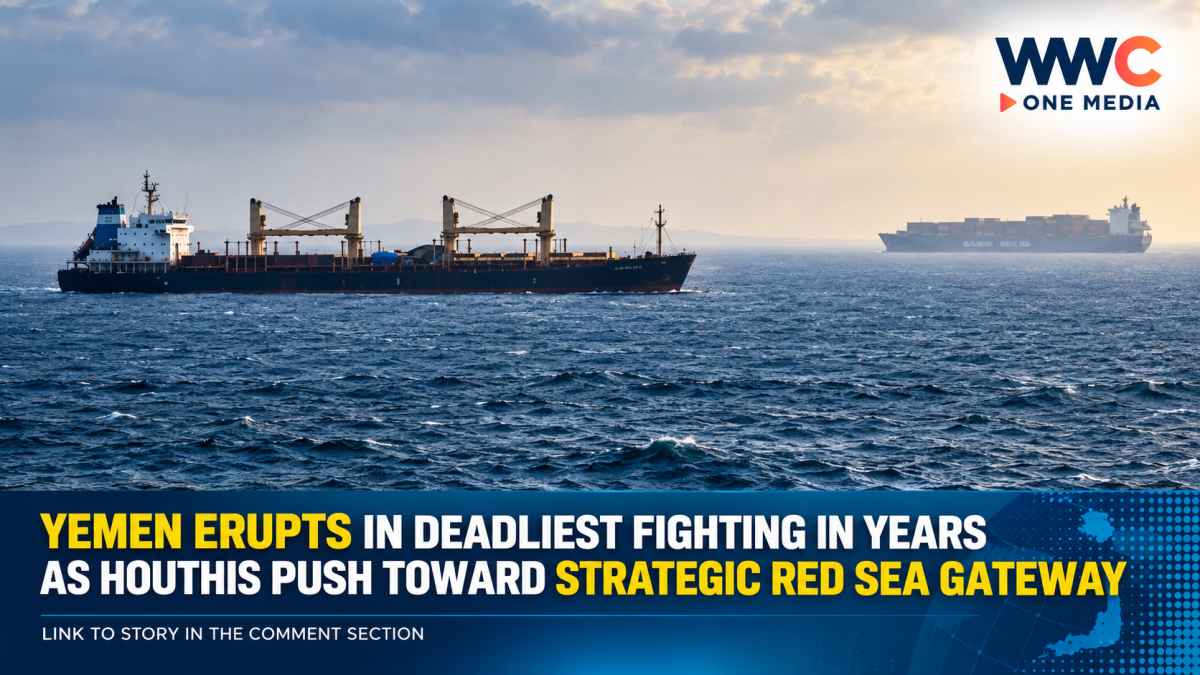
SANAA, Yemen — Yemen is facing one of its most serious military escalations in years after an offensive by the Iran-aligned Houthi movement triggered fierce clashes with forces supporting the internationally recognised government, with at least 129 people reported killed by Friday and fresh fighting continuing into Saturday.
The fighting has erupted across parts of western Taiz and southern Hodeidah, as the Houthis seek to strengthen their position near the Bab al-Mandeb Strait, one of the world’s most strategically important maritime passages.
AFP’s casualty tally, cited by multiple international outlets, put the death toll from the offensive at 129 as of Friday. The figure was compiled from military and medical sources and included 66 government-aligned fighters, at least 62 Houthi fighters and one civilian, according to reporting carried by the Times of Israel and other outlets.
But the violence did not stop there.
Fresh fighting adds to the toll
On Saturday, another major round of fighting left at least 57 combatants dead, according to medical and military sources cited by AFP: 26 government troops and 31 Houthi fighters.
A separate missile strike in Taiz killed six civilians and injured seven others, bringing the reported deaths from Saturday’s fighting and strike to more than 60. Because these are separate daily tallies, they should not automatically be added to the earlier 129 without confirmation that the casualty lists do not overlap.
The scale of the violence has prompted comparisons with the bloodiest fighting Yemen has experienced since a period of relative calm began to unravel.
Why are the Houthis fighting for this territory?
At the centre of the new offensive is geography.
The Houthis are attempting to secure high ground overlooking the Bab al-Mandeb Strait and the coastal city of al-Makha, also known as Mocha, according to Yemeni officials cited by AFP and Al Jazeera.
Government forces said they recaptured the strategically important al-Khazan and al-Makahna hills in Jabal Habashi district west of Taiz. At the same time, military sources said the Houthis had captured some positions during their advance, demonstrating that control of the battlefield remains fluid.
The stakes extend well beyond Yemen.
Bab al-Mandeb connects the Red Sea with the Gulf of Aden and is a major artery for international shipping. Any sustained disruption could increase pressure on global shipping and energy markets, particularly while maritime traffic through the Strait of Hormuz is already being affected by the wider Middle East conflict.
DW, citing AFP and other sources, reported that the Houthis appear to be targeting ports and elevated terrain that could improve their leverage around Bab al-Mandeb. Analysts cited by AFP said control of the strait or al-Makha port could give the Houthis greater leverage in negotiations with Yemen’s government and Saudi Arabia.
The fighting has already displaced families
The escalation is also producing a new civilian crisis.
Shelling and artillery fire have reportedly forced hundreds of families to flee from coastal areas around Hodeidah and al-Makha, according to DW’s reporting.
Al Jazeera reported that the latest offensive involved fighting across western Taiz and southern Hodeidah, while civilians were also caught in missile attacks.
The latest violence comes after months of relative de-escalation in Yemen.
A de facto truce between the Houthis and the Saudi-backed side had held since 2022 despite the absence of a formal permanent peace agreement. That fragile calm deteriorated in July amid the broader regional conflict involving Iran and the United States. The Washington Institute previously warned in July that Yemen’s truce was under severe strain.
Why the Red Sea is watching Yemen again
The renewed fighting comes after the Houthis have already demonstrated their ability to threaten commercial shipping.
In August, a Houthi attack on a small cargo vessel in the Bab al-Mandeb Strait killed crew members, according to Reuters. Another Houthi attack on shipping earlier that month also resulted in fatalities.
The group has also declared a maritime blockade against Saudi Arabia, further raising concerns over the security of shipping routes connecting the Red Sea, Gulf of Aden and wider Indian Ocean.
That means the current ground offensive is not simply another episode in Yemen’s long civil war.
If the Houthis succeed in improving their military position around Bab al-Mandeb, they could gain additional leverage over one of the world’s most important maritime corridors — at a moment when international shipping is already facing extraordinary disruption elsewhere in the Middle East.
Yemen’s humanitarian crisis makes the escalation even more dangerous
The military escalation is occurring in a country already suffering from a devastating humanitarian emergency.
The 2026 Yemen Humanitarian Needs and Response Plan estimates that more than 22 million people will require humanitarian assistance and protection services this year. The UN has also warned that funding shortages are making it increasingly difficult to meet those needs.
The renewed fighting threatens to make access to food, medicine, fuel and other basic necessities even more difficult, particularly in areas where humanitarian operations are already severely constrained.
What happens next?
The immediate question is whether the fighting remains concentrated along the Taiz-Hodeidah front or develops into a wider campaign for territory around al-Makha and Bab al-Mandeb.
The Houthis appear intent on exploiting the strategic importance of the western coastline, while government-aligned forces are reinforcing positions and attempting to reverse the group’s advances.
For civilians, however, the consequences are already being felt.
For the international community, the concern is even broader: a renewed Yemeni war around Bab al-Mandeb could turn a local battlefield into another major threat to an already disrupted global shipping system.
The next phase of the fighting may therefore determine whether Yemen is entering another prolonged period of escalation — or whether the latest offensive becomes a short but exceptionally bloody battle for strategic ground.




Leave a Reply