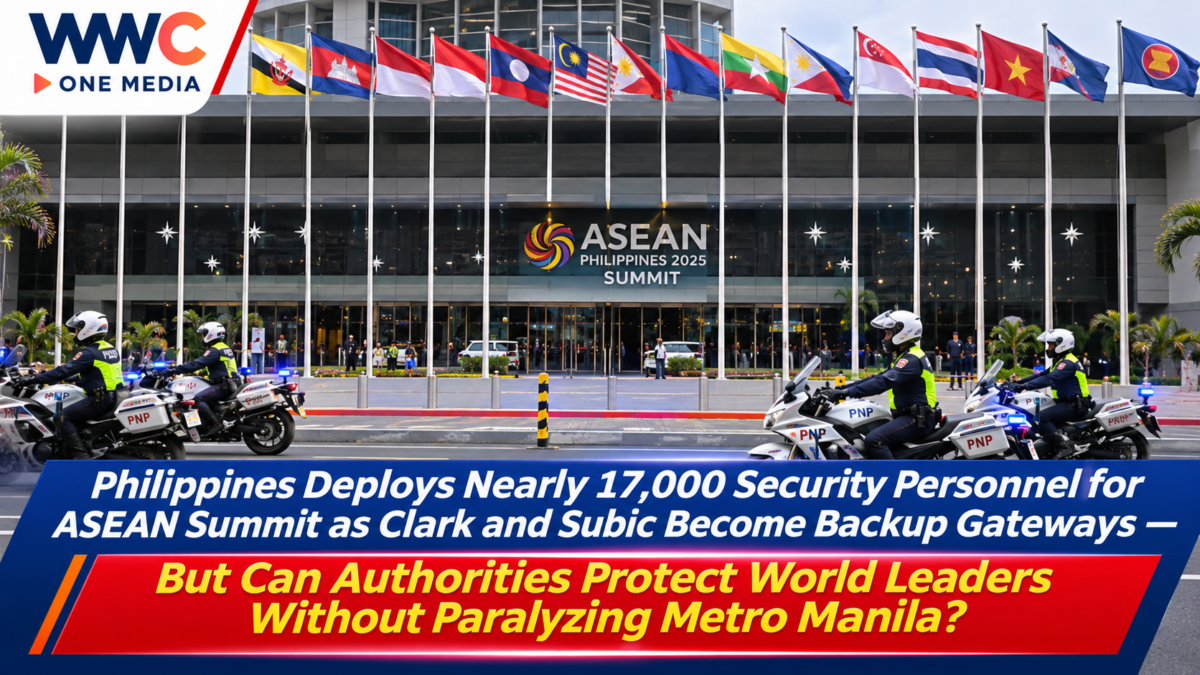
MANILA, PHILIPPINES — The Philippines is expanding security preparations beyond Metro Manila as world leaders prepare to arrive for the 49th ASEAN Summit and Related Summits, with Clark in Pampanga and Subic in Zambales identified as alternative entry points for visiting delegations.
The announcement comes just over a week before the November 16–18 gathering, one of the country’s most important diplomatic events of the year.
Retired Major General Potenciano Camba, deputy director general for operations of the ASEAN National Organizing Council, confirmed on Sunday, November 8, that authorities have prepared security arrangements across Metro Manila and surrounding areas.
Although Manila remains the primary arrival destination, Clark and Subic could accommodate delegations using alternative travel arrangements.
The move adds another layer to an extensive security operation involving police officers, military personnel, traffic authorities and local government units.
Earlier deployment plans identified approximately 16,823 security and support personnel for operations associated with the summit in Metro Manila.
Police are also monitoring possible protests and what Philippine National Police chief General Jose Melencio Nartatez Jr. has described as a low-level security threat.
At the Philippine International Convention Center in Pasay City, authorities will impose restricted-access zones to protect delegates and control vehicle movements.
But the government’s challenge extends beyond protecting foreign leaders.
Millions of commuters, workers and businesses could be affected by traffic adjustments, heightened security and temporary restrictions.
As the Philippines prepares to host major international figures, one question is becoming increasingly important: Can authorities deliver a secure, successful ASEAN Summit without creating widespread disruption for ordinary Filipinos?
Clark and Subic Added to ASEAN Security Preparations
Speaking to Super Radyo dzBB on November 8, Camba explained that the Philippines is preparing for the possibility that some international guests may arrive outside Manila.
Clark and Subic were identified as alternative arrival areas.
Both locations offer strategic advantages because of their transport infrastructure and proximity to Metro Manila.
Clark is home to an international airport and major road connections serving Central Luzon.
Subic has port facilities and transportation infrastructure that may support official logistical arrangements.
The organizing council’s decision to include these areas demonstrates the importance of having contingency options for visiting delegations.
However, the announcement does not establish that every foreign leader will use Clark or Subic.
Nor does it mean that all international arrivals will be diverted away from Manila.
The capital remains the primary arrival location.
The alternative arrangements provide additional flexibility should particular delegations require them.
Nearly 17,000 Personnel Included in Security Deployment Plan
Security planning for the summit involves a substantial personnel commitment.
According to an October 31 report by The Philippine Star, authorities identified 16,823 police personnel and force multipliers for the event.
The reported contingent includes 13,868 police personnel assigned to responsibilities involving venues, official routes and delegate accommodations.
Another 2,955 personnel from the Metropolitan Manila Development Authority and participating local governments are expected to provide support.
Participating local governments include Manila, Pasay, Parañaque, Makati and Taguig.
The National Capital Region Police Office has also identified personnel with medical training to assist with emergencies.
The figures illustrate the scale of preparations.
But they should not be interpreted as 16,823 officers deployed exclusively to the summit’s primary venue.
Security operations cover several locations and functions.
These include accommodation facilities, transportation routes, public areas and emergency preparedness.
The distribution of personnel may also change as authorities finalize operational requirements.
Police Monitor Low-Level Threat Ahead of Summit
On November 6, PNP chief Nartatez confirmed that police intelligence units were monitoring a low-level threat associated with the upcoming summit.
He emphasized that the police were preparing to secure heads of state, delegates, official venues and surrounding areas.
The PNP also said it had sufficient personnel, logistics and funding for its responsibilities.
The announcement is significant because a major international gathering requires extensive threat assessment.
However, a low-level threat classification is not confirmation of a planned terrorist attack or a specific imminent incident.
Authorities have not publicly identified a verified plot targeting the summit in the reporting reviewed.
The PNP’s approach includes preventive security, intelligence monitoring and contingency planning.
Such measures are standard components of preparations for high-profile diplomatic events.
Authorities Prepare for Possible Protests
The organizing council has also received information about possible demonstrations during the ASEAN meetings.
Camba acknowledged that protests are part of the Philippines’ democratic environment.
He expressed confidence that the PNP could address any security issues using established procedures.
Public demonstrations may involve groups seeking to draw attention to domestic or international policy concerns.
Some organizations have previously raised objections involving foreign policy and economic initiatives associated with the participating governments.
But authorities have not confirmed that every reported protest will proceed.
Nor should the existence of a peaceful demonstration automatically be treated as a security threat.
The Constitution protects freedom of speech and peaceful assembly.
Security agencies therefore face the responsibility of protecting visiting delegates while respecting lawful public expression.
The government’s response will be closely watched, particularly if demonstrations take place near restricted summit areas.
PICC to Enforce Restricted-Access Security Zone
The Philippine International Convention Center in Pasay City is among the principal venues for the international gathering.
According to Camba, authorities will establish an exclusion zone around the facility.
Vehicle access will be restricted.
Individuals without authorization will not be permitted to enter designated controlled areas.
Screening procedures will apply to people seeking access.
The objective is to prevent unauthorized entry and protect participants.
But the announcement should not be interpreted as a declaration that the entire city of Pasay will be closed.
Restrictions will apply to designated locations and routes under official security arrangements.
Motorists and pedestrians should follow advisories from the PNP, MMDA and local government units.
Traffic Disruptions Could Extend Beyond Pasay
The ASEAN Summit is expected to affect major roads and transport routes used by official delegations.
Police are preparing route security and traffic-management arrangements involving government convoys.
The National Capital Region Police Office has said that summit preparations must remain responsive to changes in traffic conditions, crowd movement and security requirements.
This means travelers could encounter temporary road closures or rerouting.
As WWC ONE MEDIA reported in its earlier coverage of MMDA restrictions in five Metro Manila cities, authorities have already introduced restrictions involving public-event permits and activities that could complicate transport during summit preparations.
The measures affect Manila, Pasay, Parañaque, Makati and Taguig.
For motorists, the most practical advice is to monitor official announcements rather than assume that every major road will be closed throughout the event.
Traffic arrangements can differ by location, date and the movement of official delegations.
Makati Imposes Month-Long Drone Ban
Security measures have also extended to unmanned aircraft.
The Makati City government announced a ban on drone flights throughout November 2026.
The restriction covers recreational, commercial and media operations.
As WWC ONE MEDIA reported in its November 2 coverage of the citywide drone restriction, authorities introduced the measure to reduce security and operational risks during high-level diplomatic meetings.
The restriction is particularly relevant to photographers, event organizers, real estate operators and businesses that regularly use drones.
However, the Makati ban should not automatically be described as a nationwide prohibition.
Other locations may have different restrictions under aviation regulations or temporary security advisories.
Drone operators should verify the rules applying to the specific area where they intend to operate.
November 16–18 Declared Special Non-Working Days in Metro Manila
President Ferdinand Marcos Jr. has declared November 16, 17 and 18, 2026, special non-working days in the National Capital Region.
The measure is intended to ease traffic and support security arrangements while the summit takes place.
The announcement provides some relief from the usual weekday volume of commuters and vehicles.
However, the special non-working-day declaration applies to Metro Manila.
It should not be described as a nationwide holiday.
It also does not automatically mean all businesses and essential services will close.
Work arrangements and applicable pay rules depend on the relevant labour regulations and employer circumstances.
Residents should consult official advisories before making travel or business arrangements.
Government Says Summit Preparations Are 90% to 95% Complete
Executive Secretary Ralph Recto, who chairs the ASEAN National Organizing Council, inspected the PICC preparations on November 6.
In a statement reported November 7, Recto said the government’s preparations were approximately 90% to 95% complete.
He identified weather-related contingencies and final security arrangements among the remaining tasks.
The assessment suggests that substantial logistical preparations have already been completed.
But it does not mean all possible challenges have been eliminated.
Weather conditions can affect flights, maritime operations and ground transportation.
Security arrangements may also need adjustments as foreign delegations confirm their schedules.
Recto’s statement therefore reflects a progress assessment, not a guarantee that the event will proceed without disruptions.
AFP Prepares Surveillance and Emergency-Response Capabilities
The Armed Forces of the Philippines is also participating in preparations.
According to the Philippine News Agency, AFP spokesperson Colonel Francel Margareth Padilla said military planning focuses on situational awareness, operational readiness and rapid response.
The AFP is preparing capabilities that can support security agencies if necessary.
These include communications, surveillance, mobility and intelligence-related support.
However, the AFP has not publicly confirmed that every available asset will be deployed.
The scale of military involvement will depend on the approved operational plan.
The PNP remains a central agency responsible for law-enforcement security at the summit.
Coordination between the police, military and other agencies is intended to avoid operational gaps.
Emergency Services and Local Governments Have Important Roles
The security operation involves more than police checkpoints.
The ASEAN organizing framework includes government agencies responsible for transportation, health services, emergency management and communications.
These functions are necessary because large international events can be affected by ordinary emergencies as well as security incidents.
Medical teams must be prepared to respond to health emergencies.
Traffic agencies must manage vehicle movements.
Local governments must coordinate public safety and community services.
Emergency personnel must also be ready for unexpected weather or infrastructure problems.
The National Capital Region Police Office has emphasized that normal anti-criminality operations should continue throughout the summit.
That is important because residents outside the diplomatic venues still require protection.
A successful event should not come at the expense of essential services in surrounding communities.
Why the Philippines Is Hosting a Major Diplomatic Gathering
The Philippines holds the ASEAN chairmanship in 2026.
The November summit will bring together leaders from Southeast Asia and important international partners.
The meetings provide opportunities to discuss regional economic cooperation, diplomatic relations, security challenges and development priorities.
The Philippines has been seeking to strengthen its regional role while managing complex relationships with major global powers.
For Manila, hosting the summit is both a diplomatic responsibility and an opportunity to demonstrate organizational capability.
The government must manage high-level international discussions while ensuring that participating delegations can travel and meet safely.
Donald Trump’s Expected Attendance Raises the Stakes
US President Donald Trump is among the high-profile leaders expected to participate in the summit.
His anticipated visit adds to the diplomatic and security importance of the gathering.
The United States is a longstanding Philippine treaty ally and maintains significant relationships across Southeast Asia.
As WWC ONE MEDIA reported in its coverage of US Ambassador Lee Lipton’s reaffirmation of Washington’s security commitments, the United States has emphasized continued cooperation with the Philippines on regional security and economic relations.
However, Trump’s expected participation should not be described as evidence that every proposed bilateral agreement will be signed during his visit.
Official diplomatic commitments depend on announcements from the participating governments.
For security authorities, the relevant issue is ensuring that visiting leaders and their delegations can attend safely.
ASEAN Hosting Also Creates Economic Opportunities
Beyond diplomacy and security, hosting the summit gives the Philippines an opportunity to showcase infrastructure, hospitality and investment destinations.
International meetings bring officials, business representatives, journalists and support personnel to the country.
This can increase demand for accommodation, transport and related services.
As WWC ONE MEDIA reported in its coverage of the Philippines’ ASEAN tourism investment initiative, the government is promoting stronger regional connectivity and investment-ready destinations.
Clark is particularly relevant because of its expanding role as an international transport gateway.
But the potential economic benefits should not be confused with confirmed revenue gains from this particular summit.
Actual effects will depend on visitor numbers, spending and the wider business environment.
What Commuters and Travelers Should Know
People traveling through Metro Manila, Clark or Subic during the summit period should check official government notices before departure.
Passengers using airports should verify airline schedules and allow for possible security or traffic-related delays.
Motorists traveling near PICC and the Cultural Center of the Philippines Complex should watch for route restrictions.
Businesses that depend on deliveries or transport in affected areas should consider contingency arrangements.
Residents should also be cautious about unverified social-media posts claiming that entire cities or airports are closed.
An alternative arrival designation for foreign delegations does not mean ordinary commercial travel has automatically been suspended.
Confirmed operational changes should come from airport authorities, airlines, traffic agencies or relevant government offices.
What Happens Next?
The next major stage will involve final security coordination as November 16 approaches.
Government agencies are expected to review deployment plans, delegate routes, venue access and emergency response procedures.
The organizing council will also continue monitoring possible demonstrations and developments affecting security.
Authorities may announce additional traffic restrictions or logistical changes as necessary.
However, the exact movements of foreign leaders and operational security details may not be released publicly.
For ordinary Filipinos, the most important developments will be announcements affecting travel, work schedules and access to public areas.
The government’s challenge is to keep those advisories timely and clear.
The Bottom Line: ASEAN Security Now Extends Beyond Metro Manila
The Philippine government has confirmed that security preparations for the 49th ASEAN Summit will cover Clark and Subic in addition to Metro Manila.
Retired Major General Potenciano Camba said those locations are being prepared as alternative arrival areas for visiting delegations.
Manila remains the main entry point.
The broader security operation includes nearly 17,000 police and support personnel under the previously reported capital-region deployment plan.
Authorities are also monitoring possible protests and a low-level security threat.
Restricted-access zones will be established around the PICC in Pasay City.
Meanwhile, Executive Secretary Ralph Recto says the government is 90% to 95% ready, with weather contingencies and final security preparations among the remaining priorities.
The summit presents a major opportunity to demonstrate the Philippines’ diplomatic importance.
But it also carries practical responsibilities affecting residents, businesses and transportation networks.
And as thousands of security personnel prepare to protect world leaders while Clark, Subic and Metro Manila become part of a wider ASEAN security network, one question remains: Can the Marcos administration deliver a safe, successful international summit without turning the capital’s already difficult traffic and daily routines into a logistical nightmare?