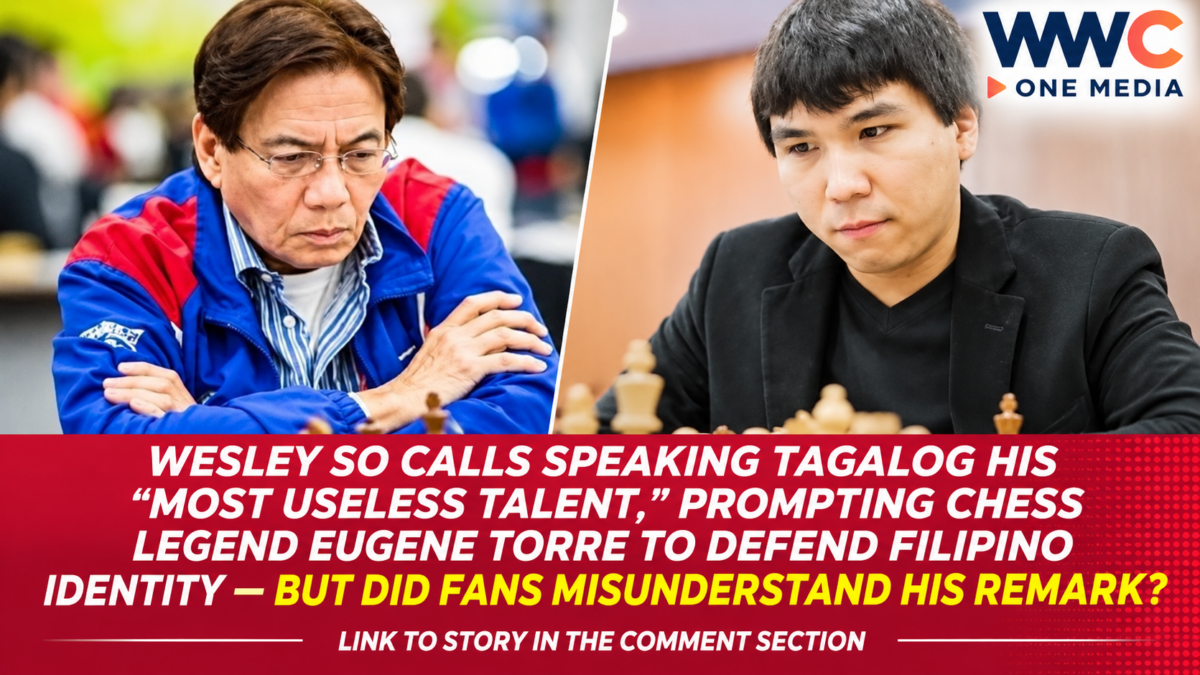
MANILA, PHILIPPINES — Two of the biggest names in Philippine chess have become the centre of a debate that goes far beyond the 64 squares of a chessboard.
Filipino-born American grandmaster Wesley So has drawn attention after describing his ability to speak Tagalog as his least useful talent during an interview with international chess platform ChessBase.
His remarks prompted a response from Philippine chess legend Eugene Torre, who defended the cultural importance of the language while acknowledging that Filipinos’ proficiency in English offers a significant practical advantage.
But rather than escalating the controversy into a personal confrontation, the 75-year-old Torre offered a more nuanced perspective.
He argued that speaking English well should not diminish the value of the language Filipinos use to express their identity, history and culture.
The exchange has raised questions about what happens when a Filipino athlete builds an international career, changes sporting nationality and develops a different relationship with the country where that journey began.
For some observers, So’s remarks reflect the practical realities of global competition.
For others, they raise concerns about the perceived value of Philippine languages.
The central question is whether the controversy represents a genuine disagreement about national identity—or a casual interview answer that has acquired greater significance than So intended.
What Exactly Did Wesley So Say About Tagalog?
The controversy originated from an interview with ChessBase, during which So was asked to identify his least useful talent.
He selected his ability to speak Tagalog.
The grandmaster explained that English is widely understood in the Philippines, making Tagalog less essential from his perspective.
When prompted to demonstrate his language skills, So thanked Filipino viewers in Tagalog.
The brief exchange was subsequently highlighted by Bilyonaryo News Channel on November 2.
It generated discussion because So is among the most successful chess players ever to emerge from the Philippines.
Born in Bacoor, Cavite, he developed his abilities in the country before pursuing an international career.
He later changed his chess federation affiliation to the United States.
For readers interpreting his remarks, context matters.
So described a skill he personally considered less useful; he did not announce a campaign against Tagalog or demand that Filipinos stop speaking it.
His explanation focused on communication and the widespread use of English.
That is different from establishing that Tagalog lacks cultural or social importance.
Eugene Torre Responds: Language Is Part of Filipino Identity
When asked about So’s comments, Torre initially sought clarification.
He wanted to know how the statement had been delivered and what So meant.
Rather than immediately criticizing the younger grandmaster, Torre suggested that the remark might have been made casually.
He also acknowledged that his own conversations with So had generally been conducted in English.
But Torre emphasized that the usefulness of a language cannot be measured solely through international communication.
For him, Tagalog and other Philippine languages represent important elements of Filipino identity.
He recognized that widespread English proficiency gives Filipinos an advantage, particularly when communicating with people from other countries.
His argument was that this advantage should not require Filipinos to diminish their own languages.
That distinction became the most significant part of his response.
Torre was not arguing that Filipinos should reject English.
He was arguing that speaking English and valuing Philippine languages are compatible.
Why Torre’s Reaction Matters
Eugene Torre holds a historic place in Asian chess.
In 1974, he became Asia’s first grandmaster.
He helped establish the Philippines as a country capable of producing players who could compete at the highest international level.
His achievements also include defeating then-world champion Anatoly Karpov in 1976 and reaching the Candidates stage of the world championship cycle in 1982.
Torre was inducted into the World Chess Hall of Fame in 2022.
His career therefore carries significance beyond individual tournament results.
He represents an earlier generation of Filipino athletes who helped raise the country’s international sporting profile.
When someone with that background comments on national identity, his perspective naturally attracts attention.
But his remarks should not be interpreted as an attempt to disown So.
In fact, Torre has previously defended the younger player’s decision to compete internationally under the American flag.
That history makes his November 2026 response especially noteworthy.
Torre Previously Told Filipinos to Keep Supporting Wesley So
This is not the first time Torre has addressed questions about So’s relationship with the Philippines.
In March 2021, GMA News reported that Torre encouraged Filipinos to continue supporting So despite his decision to represent the United States.
Torre recognized that So had pursued opportunities that allowed him to develop as an elite player.
He also emphasized that the grandmaster’s achievements retained significance for the country where he began his career.
In earlier ABS-CBN reporting, Torre discussed the possibility that So’s departure reflected frustrations surrounding support and recognition for Philippine chess athletes.
Those earlier comments provide important context.
Torre has consistently demonstrated respect for So’s abilities and international success.
His latest remarks therefore should not be framed as a declaration that So is no longer Filipino.
Instead, they reflect a longstanding distinction between an athlete’s sporting affiliation and the cultural roots that shaped his development.
Why Wesley So Changed Chess Federations
So’s move to the United States remains one of the most significant developments in modern Philippine chess.
He became a grandmaster at just 14 years old, making him one of the game’s outstanding young talents.
His rapid development attracted international attention.
In 2012, he moved to the United States to attend Webster University, where he continued pursuing competitive chess.
In 2014, he formally switched his chess federation representation from the Philippines to the United States.
The move drew criticism from some Filipino observers.
Others argued that he was pursuing stronger training opportunities and a professional environment better suited to his ambitions.
So later became a United States citizen in 2021.
Since changing federations, he has won major international titles and established himself among the world’s leading grandmasters.
But a chess federation transfer is not the same as erasing a person’s birthplace or childhood experiences.
That distinction is important when interpreting the debate surrounding his latest remarks.
Can an Athlete Represent Another Country and Still Have Filipino Roots?
So’s career raises a question that extends beyond chess.
Many Filipino-born athletes, performers and professionals pursue careers overseas.
Some eventually obtain citizenship elsewhere.
Others represent foreign countries in international competition.
Those decisions may reflect professional opportunity, family circumstances, personal preference or other considerations.
They do not necessarily mean that individuals reject every connection with the Philippines.
Torre’s earlier defence of So reflects this complexity.
He has recognized the achievements of a player who developed in the Philippines while making decisions intended to advance his career.
That is also why the current language controversy should be evaluated carefully.
A person’s perception of a language’s practical value is not necessarily a complete statement of their national identity.
At the same time, audiences may reasonably disagree with the suggestion that a Philippine language has little usefulness.
These perspectives can coexist without requiring the two grandmasters to become personal enemies.
The Bigger Debate: Is English More Useful Than Tagalog?
The Philippines uses Filipino and English as official languages.
Filipino is based primarily on Tagalog, but the two terms should not always be treated as interchangeable.
The country is also home to many other languages, including Cebuano, Ilocano, Hiligaynon, Waray and Kapampangan.
English plays an important role in education, business, government and international communication.
Its widespread use has helped many Filipinos participate in global industries.
But the value of a language extends beyond employment and international transactions.
Local languages support family relationships, cultural expression, storytelling, literature and community life.
They also allow people to communicate experiences that may be difficult to express in another language.
That makes the usefulness of Tagalog a subjective question.
For someone whose professional life operates largely in English, Tagalog may seem less important for daily work.
For someone whose family, community and personal history are expressed through Tagalog, its value may be immeasurable.
Torre’s response highlights this difference.
He sees no need to choose between international communication and cultural identity.
Filipino Identity Is Already Being Reexamined Through Art and Culture
The language discussion comes amid a broader conversation about what defines Filipino identity in a globalized world.
Filipino artists and designers are increasingly exploring cultural identity through everyday experiences rather than relying exclusively on traditional imagery.
As WWC ONE MEDIA reported in its feature on the Philippine School of Interior Design’s exploration of Filipino pop culture, music, childhood games, films and familiar community experiences can all contribute to how generations understand being Filipino.
Language plays a similar role.
It can preserve memories and cultural references even as communities adopt new technologies and global influences.
That does not make English incompatible with Filipino identity.
It simply means that cultural value and practical utility are not always the same thing.
Apl.de.Ap Offers Another Example of Filipino Identity Abroad
The debate also has parallels in the entertainment industry.
Filipino-American musician Apl.de.Ap built an international career as a founding member of the Black Eyed Peas.
Yet his work continues to incorporate themes connected to the Philippines.
As WWC ONE MEDIA reported on Apl.de.Ap’s recent music project emphasizing Filipino culture and civic responsibility, international success can coexist with public engagement in one’s cultural roots.
The comparison does not mean every Filipino-born international figure must express identity in the same way.
Individuals have different experiences and relationships with their birthplace.
But it demonstrates that language, culture, nationality and professional affiliation are related without necessarily being identical.
For So, his comments should be considered alongside the broader history of his life and career rather than reduced to one interview answer.
Philippine Chess Has New Generations of Talent to Support
Beyond the controversy, Torre and So’s achievements also raise questions about the future of chess in the Philippines.
The country has produced several notable players, but developing future international contenders requires sustained training and competitive opportunities.
One prominent example is Woman Grandmaster Janelle Mae Frayna.
As WWC ONE MEDIA reported in its coverage of Frayna’s unbeaten performance at the Philippine National Women’s Invitational Chess Championship, the country’s leading female players continue demonstrating their ability in demanding competitions.
Frayna became the Philippines’ first Woman Grandmaster, creating an important milestone for women’s chess.
Her development illustrates the importance of providing opportunities to talented players.
The next challenge is ensuring that promising young competitors receive the support needed to develop their abilities.
Philippine Chess Olympiad Performances Show the Talent Is Still There
Another example is Mhage Sebastian.
During the 2026 World Chess Olympiad in Samarkand, Uzbekistan, Sebastian attracted attention for her performances on the Philippine women’s team.
As WWC ONE MEDIA reported in its coverage of Sebastian’s contribution to the Philippines’ victory over Kyrgyzstan, the 24-year-old demonstrated how emerging players can contribute on the international stage.
Her example reinforces an important point.
The country’s chess future should not depend entirely on the legacies of Torre and So.
Their achievements can inspire new competitors, but institutions must also help develop the next generation.
That requires attention to coaching, tournaments, financial support and access to international competition.
The current controversy could provide an opportunity to redirect some public attention toward those practical needs.
Eugene Torre Also Warns Young Players Against Overreliance on AI
Torre has recently spoken about another challenge facing chess development.
In a separate interview reported by Fastbreak on November 7, he cautioned young players against depending too heavily on computer engines and artificial intelligence during training.
Torre acknowledged that modern tools can improve preparation.
However, he argued that players must continue developing independent analysis and decision-making skills.
His concern was that relying immediately on computer recommendations could weaken a player’s ability to evaluate positions without assistance.
That perspective reflects the same broader emphasis found in his language comments.
Technology and international opportunities can be valuable.
But they should not necessarily replace the skills and traditions that help individuals develop their own judgment and identity.
The two topics are distinct, yet both show Torre encouraging a balance between modern advantages and foundational capabilities.
Did Wesley So Actually Insult Filipino Culture?
The available evidence does not establish that So intended to insult Filipino culture.
He was responding to a personal question during a chess interview.
His explanation focused on the practical usefulness of a language in a country where English is widely spoken.
That interpretation can still be challenged.
Many Filipinos consider Tagalog and other local languages central to cultural identity.
However, disagreement with his reasoning is different from proving malicious intent.
Torre’s response is instructive because he asked for context before offering his assessment.
He acknowledged a positive element in So’s observation about English proficiency.
He also emphasized why Philippine languages continue to matter.
The result was not a bitter argument between two chess champions.
It was a difference in emphasis that sparked a wider conversation.
What Happens Next?
There is no verified announcement that Torre and So intend to debate the issue publicly or meet to resolve it.
There is also no confirmed statement from So responding directly to Torre’s latest remarks in the reporting reviewed.
For now, the controversy remains a discussion about the original ChessBase interview and Torre’s reaction.
Whether So offers further clarification is uncertain.
The broader conversation may continue among chess fans and Filipinos who have differing perspectives on language and cultural identity.
But it would be premature to describe the exchange as a major personal feud.
The two grandmasters have a history of mutual professional respect.
The Bottom Line: Torre Defends Filipino Identity Without Attacking Wesley So
Wesley So has sparked debate after describing speaking Tagalog as his least useful talent.
The Filipino-born American grandmaster explained that English proficiency in the Philippines reduces the practical need for the language from his perspective.
Eugene Torre responded by emphasizing that Philippine languages remain important to national identity.
He also acknowledged that Filipinos’ command of English is a valuable strength.
The exchange reflects two different ways of thinking about language.
One focuses on practical communication.
The other emphasizes cultural connection and identity.
Neither perspective requires a personal conflict between the two chess legends.
So continues to represent the United States in international chess.
Torre remains one of the Philippines’ most respected sporting pioneers.
Both have contributed significantly to the history of Philippine chess.
And as Filipinos debate Wesley So’s controversial description of Tagalog, one question remains: Did the grandmaster simply give a practical answer to an unusual interview question—or has Eugene Torre highlighted something more important about the value of the language and identity Filipinos carry wherever they go?