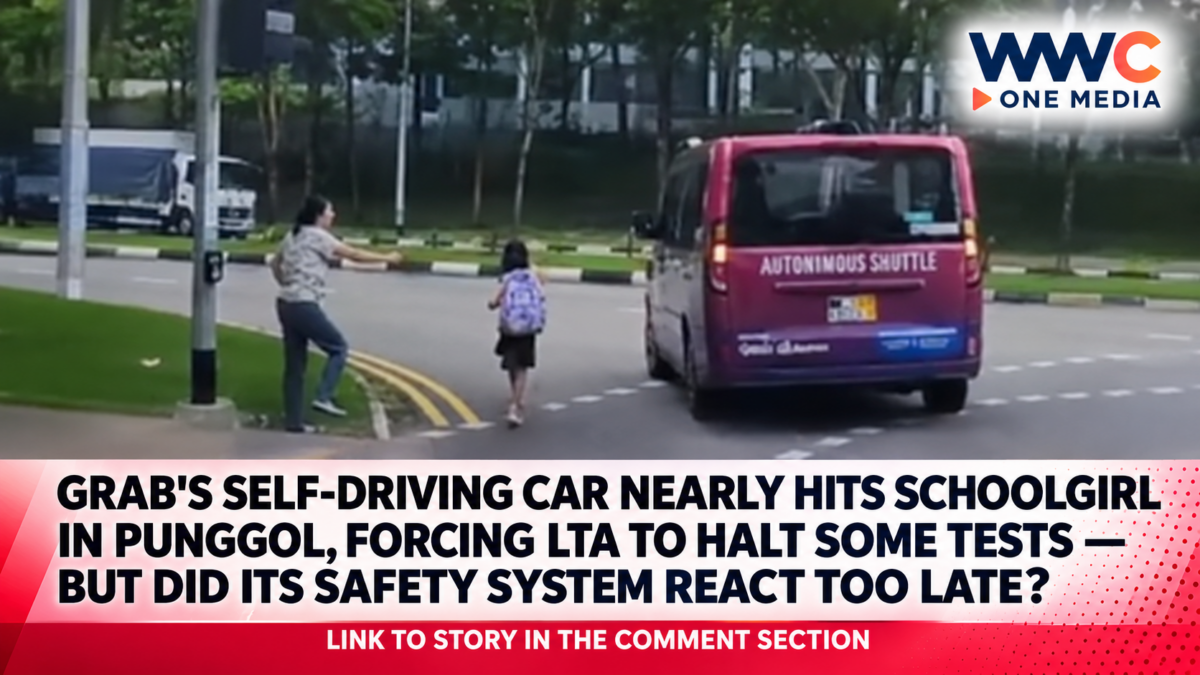
SINGAPORE — Singapore’s ambitious push toward driverless transportation has encountered a serious safety test after a Grab autonomous vehicle nearly struck a young schoolgirl at a pedestrian crossing in Punggol.
The incident, captured in a 36-second video circulating online, prompted the Land Transport Authority (LTA) to order Grab to pause certain autonomous-vehicle testing activities while regulators investigate what happened.
But the most troubling detail is not simply that the vehicle came dangerously close to a child.
According to preliminary information released by LTA, the autonomous system had already detected the pedestrians and was tracking their movements before the near-miss occurred.
The vehicle began braking and steering away when the schoolgirl started crossing the road.
An onboard safety operator then intervened, taking manual control and continuing the evasive manoeuvre.
The girl was not reported to have been struck or injured.
Nevertheless, the close encounter has raised questions about how self-driving vehicles should behave at pedestrian crossings, particularly when children are involved.
The incident comes as Grab prepares to expand autonomous transportation in Singapore, with plans announced in September to increase its fleet from 10 to 50 vehicles over six months.
Now, regulators must determine whether the vehicle’s response was appropriate—or whether its driving behaviour needs to change before more driverless services reach Singapore’s roads.
Viral Video Shows Frightening Near-Miss at Punggol Crossing
The incident occurred at approximately 8:11am on Thursday, November 5.
A video posted to the SG Road Vigilante Facebook group showed a Grab autonomous vehicle approaching a pedestrian crossing while making a discretionary left turn.
A schoolgirl stepped off the kerb as the vehicle continued turning.
The vehicle passed close to her, creating a potentially dangerous situation.
Footage also showed a woman approaching the child and pulling her away from the vehicle.
The autonomous vehicle subsequently slowed and continued along the road.
The Straits Times identified the location as being near Punggol Field Walk.
Its reporting said the video had attracted more than 260,000 views by November 6.
The footage quickly generated questions about whether the vehicle should have stopped earlier.
However, a short external video cannot reveal every action taken by the vehicle’s autonomous driving system.
For that reason, LTA’s review of onboard operational data is particularly important.
LTA Confirms Vehicle Detected Two Pedestrians
LTA said it was informed of the incident on November 5 and began investigating.
Its preliminary examination established that the autonomous vehicle had detected two pedestrians near the crossing.
The system was continuously tracking their movements.
According to LTA, the pedestrians were initially stationary.
After the traffic light turned green, the vehicle began making a left turn.
The schoolgirl then started crossing.
At that point, the autonomous driving system initiated braking and steered toward the right to avoid the child.
The safety operator onboard subsequently took manual control, continuing the braking and steering.
This sequence is important because it shows that the automated system was not simply unaware of the pedestrians.
The remaining question is whether it made a sufficiently cautious decision before beginning the turn and whether the response was early enough.
LTA said investigators would review whether the vehicle’s behaviour in such circumstances should be adjusted.
No final determination of fault or a technical malfunction had been announced.
Grab Ordered to Pause Testing at Similar Junctions
Following the incident, LTA directed Grab to suspend testing at junctions involving similar circumstances until the investigation is completed.
The restriction is not a blanket ban on every Grab autonomous vehicle operating in Singapore.
It applies to testing at the relevant type of junction.
That distinction matters because Singapore already has autonomous shuttle services operating on selected routes.
Grab uses autonomous vehicles developed by Chinese self-driving technology company WeRide.
ComfortDelGro separately operates an autonomous shuttle route using vehicles supplied by Pony.ai.
The regulator’s intervention demonstrates that the expansion of self-driving services remains subject to safety oversight.
It also shows that testing permissions can be restricted when a potentially dangerous situation requires investigation.
However, LTA has not announced a permanent ban, a cancellation of Grab’s expansion programme or a conclusion that all autonomous vehicles are unsafe.
Grab and WeRide Launch Joint Safety Review
Grab acknowledged the near-miss and said it was working with LTA and its technology partner WeRide to review the incident.
The company stated that safety remained its highest priority.
The review is expected to focus on the circumstances leading up to the near-miss, the vehicle’s automated response and the onboard operator’s intervention.
Important technical questions include how the system interpreted the pedestrian movements and why it proceeded with the left turn while pedestrians remained near the crossing.
Investigators may also assess the timing of braking and the transition from automated to manual control.
These are potential areas of inquiry, not findings that the system malfunctioned.
The final conclusions will depend on evidence collected by the relevant authorities.
For Grab, the incident comes at a sensitive time.
The company is attempting to move beyond fixed-route autonomous shuttles toward a more flexible on-demand transport service.
Public confidence will be essential to that transition.
Why Pedestrian Crossings Are a Critical Test for Driverless Cars
Pedestrian crossings present difficult situations for autonomous driving systems.
Vehicles must identify people near the road and predict whether they intend to cross.
That prediction can become especially challenging when pedestrians change direction or begin walking after standing still.
Children may also behave less predictably than adult pedestrians.
A cautious driving system must therefore account for uncertainty rather than rely exclusively on observed movement.
The Punggol incident illustrates this challenge.
LTA’s preliminary data showed that the system detected and tracked the pedestrians.
But the vehicle still entered a situation in which emergency braking and evasive steering became necessary.
That raises a fundamental engineering question.
Should the vehicle have waited until it was certain the crossing would remain clear?
Or did it behave within its approved operating parameters before circumstances changed?
Only the completed investigation can establish whether changes are required.
The Onboard Safety Operator Played an Important Role
The incident also highlights why Singapore continues to use human safety operators during autonomous-vehicle testing.
Although the vehicle was operating autonomously, it was not travelling without human supervision.
An onboard safety operator was present and took control during the near-miss.
That intervention formed part of the vehicle’s response.
However, the presence of a human operator does not eliminate every risk.
The operator must monitor the road and understand when intervention is necessary.
A transition between autonomous and manual control can also introduce challenges if it occurs during a rapidly developing situation.
Testing procedures therefore need to examine not only the software’s decisions but also how humans interact with the technology.
The objective is to ensure that automated and human safety measures work together effectively.
Singapore Experienced Another Autonomous-Vehicle Incident in January
The latest near-miss is not the first autonomous-vehicle safety incident reported in Punggol during 2026.
On January 17, a ComfortDelGro autonomous vehicle collided with a road divider along Edgedale Plains while undergoing testing.
The circumstances were different.
According to an official LTA statement issued on January 29, the vehicle had detected an object outside the roadway and initiated a precautionary manoeuvre.
A subsequent simulation indicated that the vehicle would probably have completed the movement safely without manual intervention.
However, the onboard safety officer took control after noticing the vehicle changing lanes for a reason that was not immediately apparent.
The manual takeover interrupted autonomous operation, and the vehicle subsequently struck the road divider.
LTA and ComfortDelGro reviewed their procedures for transitions between automated and manual driving.
Testing resumed after the review.
The January incident involved a different operator and different circumstances.
There is no evidence that it was caused by the same technical issue as the November near-miss.
Nevertheless, both cases demonstrate the importance of examining the relationship between autonomous systems and human safety operators.
Grab’s Plan to Expand From 10 to 50 Vehicles Faces Fresh Scrutiny
Grab announced in September that it intended to increase its autonomous fleet from 10 to 50 vehicles over six months.
The company also wants to extend autonomous transport beyond Punggol to other parts of Singapore.
The expansion is part of its wider effort to explore self-driving mobility services.
In July, Grab announced plans for an on-demand pilot that would allow riders to book autonomous vehicles between designated pickup and drop-off points.
Unlike a fixed shuttle route, the new service would select a more direct route between supported locations.
That could make the system more convenient for passengers.
But it also introduces more complex driving situations.
An expanded operating area may include additional junctions, pedestrian crossings and traffic conditions.
LTA said the vehicle involved in the November incident was testing a new route in preparation for the enhanced service.
The partial pause therefore affects a type of testing directly relevant to Grab’s expansion plans.
However, authorities have not confirmed whether the investigation will delay the full fleet rollout.
A potential delay remains a possibility, not an established outcome.
What Autonomous Shuttles Currently Offer Punggol Residents
Singapore has been introducing autonomous transport services gradually.
Grab operates two fixed shuttle routes in Punggol.
One connects Punggol Matilda Court with Oasis Terraces.
The other connects Punggol Matilda Court with Punggol Coast Mall.
The services provide connections between residential areas and everyday amenities.
ComfortDelGro operates another route using Pony.ai vehicles.
The government hopes autonomous transportation can eventually improve mobility and help address manpower challenges in the transport industry.
But the rollout remains experimental and carefully controlled.
As previously reported by WWC ONE MEDIA in its coverage of Singapore’s expanding driverless-vehicle programme, the government’s strategy involves gradual adoption rather than an immediate replacement of conventional taxis and buses.
The Punggol near-miss is a reminder of why that gradual approach matters.
Can Autonomous Vehicles Be Trusted Around Schools and Children?
The incident is particularly sensitive because it involved a schoolgirl.
Parents and other road users may reasonably expect self-driving vehicles to behave conservatively near children.
Road safety requires attention to pedestrians who are already crossing as well as those who may enter the road unexpectedly.
The fact that the autonomous system detected the child is encouraging in one respect.
It indicates that the vehicle’s perception system registered her presence.
But detection alone does not guarantee an appropriate driving decision.
An autonomous vehicle must interpret what it sees and respond safely.
That is why regulators need to examine the entire sequence, from initial detection to the decision to turn and the final evasive manoeuvre.
The incident should not be used to claim that autonomous vehicles are inherently more dangerous than human drivers.
Nor should it be dismissed simply because no collision occurred.
A serious near-miss can reveal weaknesses that deserve investigation before a more harmful incident takes place.
Singapore’s Robotaxi Debate Also Involves Thousands of Drivers
Safety is only one part of Singapore’s autonomous-vehicle debate.
The technology also raises concerns about employment.
Taxi and private-hire vehicle drivers worry that widespread robotaxi deployment could eventually reduce demand for their services.
In October, labour MP Yeo Wan Ling urged the government to manage the transition carefully.
She highlighted the importance of driving as a source of income for Singaporeans, including people seeking flexible employment or alternative work opportunities.
As WWC ONE MEDIA reported in its coverage of Yeo’s parliamentary warning, the discussion reflected concerns about how quickly automation could change the transport workforce.
The current near-miss adds another dimension.
Policymakers must consider not only whether autonomous vehicles can reduce manpower requirements but also whether they can operate safely enough to earn public trust.
Commercial benefits cannot substitute for safety evidence.
Drivers Are Already Being Offered New Career Pathways
Singapore’s transport authorities have begun preparing for the potential employment effects of automation.
In September, government agencies and industry partners announced initiatives to help taxi and private-hire vehicle drivers transition into other transport-sector roles.
One proposed pathway involves training experienced drivers to become public bus captains.
As WWC ONE MEDIA previously reported on the retraining initiative, the programme is intended to expand employment options as the sector adopts more advanced technology.
The initiative does not establish that widespread driver displacement has already occurred.
Rather, it reflects policymakers’ efforts to prepare for possible future changes.
The challenge is balancing three objectives: improved mobility, public safety and employment opportunities.
An autonomous system that fails to earn public confidence could struggle commercially, even if it offers potential operating efficiencies.
Grab’s Regional Ambitions Face a Larger Test
Grab is one of Southeast Asia’s most prominent ride-hailing platforms.
Its business operates across markets with very different traffic conditions, regulations and transport needs.
Autonomous mobility could eventually change the economics of ride-hailing.
Companies may seek to reduce their reliance on human drivers for selected services.
But deploying robotaxis in dense Asian cities can be technically and commercially challenging.
Singapore’s infrastructure and regulatory environment make it an important testing location.
Even so, the Punggol incident shows that controlled pilot programmes can encounter unexpected risks.
As WWC ONE MEDIA examined in its report on the pressures facing Grab and GoTo drivers, autonomous vehicles could eventually affect the business models of Southeast Asian ride-hailing companies.
But widespread deployment remains dependent on technology, regulation, public acceptance and financial viability.
The near-miss highlights why safety validation will remain a central part of that process.
What Could LTA Require Before Testing Resumes?
LTA has not announced the final outcome of its investigation.
However, its statement identifies the main issue under examination: whether the vehicle’s response to pedestrians at such junctions should be adjusted.
Possible safety improvements could involve changes to how a vehicle approaches pedestrian crossings, interprets pedestrian intentions or responds when a person begins crossing.
Additional testing could assess whether altered driving behaviour provides a greater safety margin.
Human intervention procedures may also require review.
These are possible responses rather than measures LTA has formally ordered.
The authority has confirmed only that Grab must pause testing at such junctions pending the investigation.
Any decision to resume testing or impose further restrictions will depend on the regulator’s findings.
What Pedestrians Should Know About Autonomous Vehicles
The incident also provides a practical road-safety reminder.
A vehicle may begin turning even when pedestrians are nearby.
People crossing roads should ensure that approaching vehicles have stopped and that the crossing is safe.
This advice applies to conventional and autonomous vehicles alike.
LTA reminded pedestrians to watch for oncoming vehicles to come to a complete stop before crossing.
That does not remove the responsibility of vehicle operators to comply with traffic rules and protect other road users.
Road safety depends on the behaviour of everyone involved.
For self-driving systems, the goal should be reducing the potential consequences of foreseeable human behaviour, including hesitation, sudden movement and mistakes.
The Bigger Question: Is Singapore Moving Too Fast With Driverless Technology?
The Punggol near-miss is likely to intensify debate about Singapore’s autonomous-vehicle ambitions.
Supporters see driverless transport as a way to improve connectivity, address manpower constraints and modernize mobility services.
Critics and cautious observers want stronger assurances that automated systems can handle real-world traffic safely.
The incident provides evidence for the importance of testing, monitoring and independent regulatory oversight.
It does not prove that all autonomous-vehicle technology has failed.
The car detected the pedestrians and initiated an evasive response.
But the near-miss still occurred, and a human operator intervened.
The central challenge is determining whether the system responded adequately and whether its behaviour should become more conservative.
For regulators, public trust will depend on their ability to identify risks and require improvements before expanding deployment.
For Grab and WeRide, the challenge is demonstrating that their technology can operate safely in the unpredictable conditions of everyday urban traffic.
The Bottom Line: Singapore’s Driverless Future Faces a Crucial Safety Test
Singapore’s Land Transport Authority has directed Grab to pause autonomous-vehicle testing at certain types of junctions after a near-miss involving a schoolgirl in Punggol on November 5.
Video footage showed a self-driving vehicle passing close to the child while making a left turn.
According to preliminary operational data, the vehicle had detected two pedestrians and was tracking their movements.
When the girl began crossing, the autonomous system initiated braking and steered away.
An onboard safety operator then took control and continued the evasive manoeuvre.
No collision or injury to the schoolgirl was reported.
Grab says it is reviewing the incident with LTA and technology partner WeRide.
The investigation comes as the company prepares to expand autonomous services and increase its fleet from 10 to 50 vehicles.
The regulator has not announced that the overall expansion has been cancelled.
But the incident raises important questions about the safety margins required when automated vehicles operate around children and pedestrians.
Singapore’s autonomous-vehicle ambitions remain intact.
What happens next will depend on whether investigators determine that the existing systems and procedures are sufficiently safe.
And as Grab prepares to put more self-driving vehicles on Singapore’s roads, one question now hangs over the country’s robotaxi revolution: Was the Punggol near-miss an isolated incident that better testing can prevent—or has it exposed a safety weakness that must be fixed before driverless transport becomes part of everyday life?