PARIS, FRANCE / MANILA, PHILIPPINES — November 7, 2026 | WWC ONE MEDIA | World News, European Politics, Economic Crisis and Civil Unrest
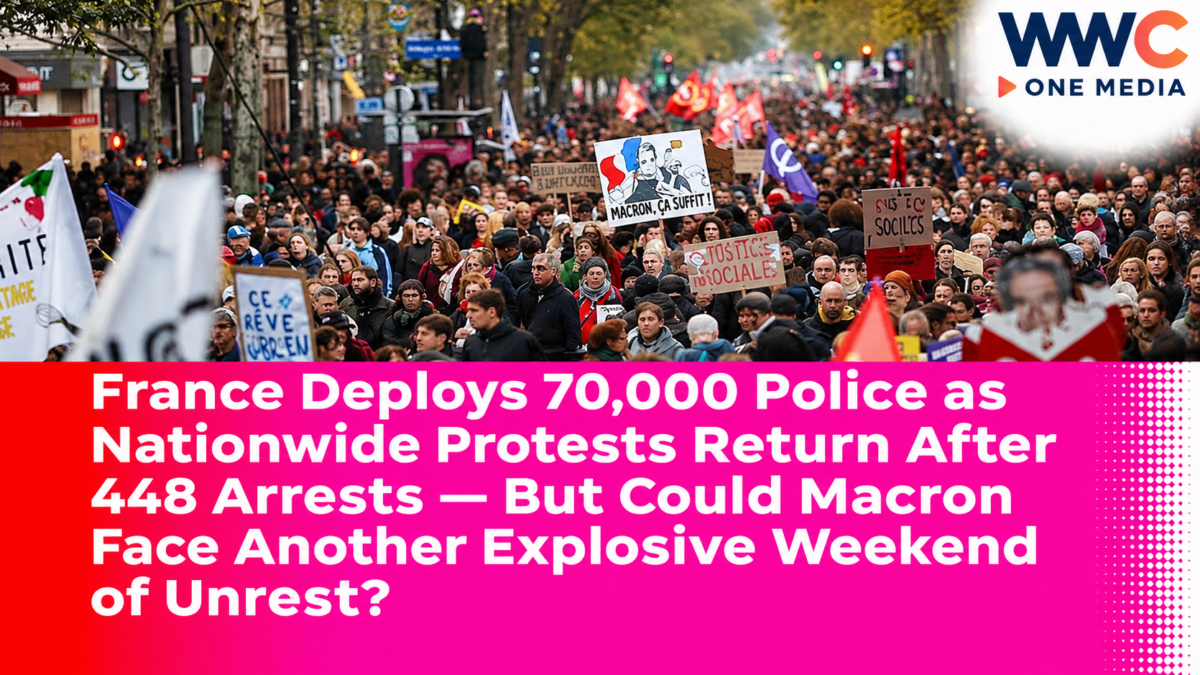
France is preparing for another potentially volatile wave of nationwide demonstrations, with the government maintaining a massive deployment of 70,000 police officers and gendarmes as protesters return to the streets on Saturday, November 7.
The decision follows a turbulent week in which hundreds of thousands of French citizens demonstrated against rising living costs, stagnant wages, deteriorating public services and worsening conditions in schools.
According to France’s Interior Ministry, Thursday’s nationwide mobilization attracted approximately 575,000 participants across 193 demonstrations, including 65,000 in Paris.
Organizers offered a much higher estimate, with the CGT trade union claiming approximately 1.6 million participants.
The vast majority of authorized marches proceeded without major incidents, according to the ministry, but violent confrontations erupted on the fringes of demonstrations in several cities.
Authorities reported 448 arrests and 53 injured security personnel during the November 5 mobilization.
Now, President Emmanuel Macron’s government is facing another test as Yellow Vest activists, student organizations and other protest groups prepare further action.
Interior Minister Laurent Nuñez announced on November 6 that France would maintain the same security deployment used during the preceding protests.
His warning was blunt: authorities believe threats of violence, attacks on public buildings and attempts to block major roads remain credible risks.
But deploying tens of thousands of officers creates a political dilemma.
Can Macron protect peaceful demonstrators and prevent another outbreak of violence—or could increasingly restrictive security measures intensify the anger already spreading across France?
France Maintains 70,000 Police and Gendarmes for Saturday Protests
France’s Interior Ministry confirmed that its security operation would continue at approximately the same scale as the November 5 national mobilization.
Speaking at a November 6 press conference, Interior Minister Laurent Nuñez said authorities expected a different pattern of demonstrations on Saturday.
Unlike Thursday’s large union-organized marches, some of Saturday’s gatherings have less clearly defined leadership and organizational structures.
The minister warned that this could complicate negotiations over routes and crowd management.
Authorities have also identified social media messages calling for violence against police, damage to public buildings, looting and disruption of transport routes.
Those messages are part of the government’s risk assessment; they do not establish that the organizers or participants of peaceful protests support violence.
To manage the situation, the government is maintaining a national operation involving approximately 70,000 police and gendarmes.
Earlier deployments included mobile public-order units, specialist intervention teams, surveillance drones, helicopters, water cannons and armored police vehicles.
Security measures are intended to protect authorized gatherings while enabling officers to intervene against individuals suspected of violent conduct.
However, the presence of a large security force does not guarantee that every protest will proceed without confrontation.
The government will be judged on both public safety and its respect for the right to peaceful assembly.
575,000 March in France — But Unions Claim 1.6 Million
Thursday’s demonstrations highlighted the extraordinary scale of public dissatisfaction.
According to the Interior Ministry’s final reported figures, 575,000 people participated in 193 demonstrations nationwide.
The ministry counted 65,000 participants in Paris.
The CGT union estimated that approximately 1.6 million people participated nationally.
Such differences are not unusual during major French protests.
Police and union organizations use different methods to estimate crowd sizes.
However, both figures indicate that the movement has mobilized a substantial number of people.
The demonstrations involved teachers, students, public-sector employees, transport workers, retirees and other citizens demanding economic and social reforms.
Marchers called for stronger wages, protection against rising living expenses, better staffing in schools and improvements to public services.
The unrest is no longer confined to a single sector or political constituency.
It has developed into a broader debate about economic security, public spending and the government’s ability to respond to social grievances.
As WWC ONE MEDIA previously reported on the student-led movement that brought 550,000 demonstrators onto French streets in October, what began as localized educational protests has become a much larger political challenge.
The latest marches demonstrate that the movement remains capable of attracting large crowds.
448 Arrests and 53 Injured Officers Raise Security Concerns
French authorities reported 448 arrests and 53 injured police officers and gendarmes during the November 5 protests.
The Interior Ministry described most authorized marches as generally peaceful.
Nevertheless, incidents were reported in cities including Paris, Lyon, Rennes and Toulouse.
According to official accounts, groups operating on the fringes of demonstrations attempted to breach security restrictions, damage property or confront officers.
Police responded with arrests and crowd-control measures.
Protesters and rights advocates have also raised allegations of excessive police force.
Those accusations require examination independently of the government’s accounts of violent incidents.
A mass demonstration can contain peaceful protesters, people engaging in civil disobedience and individuals committing criminal offenses.
They should not automatically be treated as one group.
That distinction is central to the debate over France’s security response.
As WWC ONE MEDIA reported on earlier violent clashes and mass arrests during the October unrest, authorities have struggled to protect public spaces while responding to severe disorder.
The latest deployment reflects the government’s determination to avoid a repeat.
But critics fear that sweeping restrictions could discourage peaceful participation and deepen tensions between police and demonstrators.
Why Are French Citizens Protesting?
France’s latest protest movement began in September with dissatisfaction among high school students.
Young people complained about inadequate educational resources, staff shortages and deteriorating conditions in schools.
Their demonstrations eventually attracted broader support from teachers and workers.
By October, the protest movement had expanded to include concerns over inflation, wages, pensions, housing affordability and public services.
The Yellow Vest movement, known in France as the Gilets Jaunes, has also reemerged.
Originally associated with protests against fuel taxes in 2018, the movement became a powerful symbol of public frustration over living costs and economic inequality.
In 2026, its supporters have joined demonstrations calling for changes in government economic policy.
The latest protests therefore involve different groups with overlapping but not identical demands.
Students want improvements in education.
Workers want higher pay.
Retirees are concerned about purchasing power.
Other participants are protesting policing practices and restrictions on demonstrations.
For Macron’s government, the challenge is that addressing one issue may not be sufficient to satisfy the wider movement.
Yellow Vests Plan Another Saturday of Demonstrations
Saturday’s mobilization marks another stage in the return of the Yellow Vest movement.
Organizers have described the November 7 demonstrations as the fourth major Saturday of action in the current protest cycle.
The theme is centered on demands for greater equality.
Events have been discussed in Paris and several other French cities, including Bordeaux, Toulouse and Lyon.
However, the number of gatherings and the extent of union participation may differ significantly from Thursday’s national mobilization.
Some major labor unions have concentrated their efforts on the November 5 strike.
That means Saturday’s demonstrations could be smaller even as authorities continue preparing for the possibility of disorder.
The government has emphasized that less structured gatherings can create additional challenges for police coordination.
Organizers, meanwhile, argue that they have a right to continue demonstrating until the government addresses their concerns.
The resulting confrontation is likely to test the ability of both sides to prevent escalation.
Paris Faces Protest Restrictions and Metro Closures
The French capital is preparing for significant disruption.
Authorities have announced restrictions affecting unauthorized gatherings in parts of central Paris on November 7.
Police are particularly concerned about activity around Place de la Concorde and the Champs-Élysées.
Yellow Vest organizers have promoted a gathering at Place de la Concorde, although its authorization status has been disputed.
Separately, authorities have identified an authorized march route between Place de la République and Place de la Nation via Boulevard Voltaire.
These are distinct protest arrangements and should not be confused.
Several central Paris Metro stations are also expected to be closed or temporarily bypassed.
Paris’s official tourism information service listed affected stations including Concorde, Tuileries, George V, Franklin D. Roosevelt and Charles de Gaulle–Étoile.
Further changes may occur depending on security conditions.
However, there is no general curfew in Paris under the November 6 official travel information.
Restrictions on specific protest gatherings should not be described as a citywide ban on public movement.
Visitors and residents should follow updated instructions from local authorities and transport operators.
Is France Becoming Too Restrictive Toward Protesters?
The massive police deployment has intensified debate about civil liberties.
French authorities argue that restrictions are necessary to protect public safety, prevent looting and ensure authorized demonstrations can proceed.
Rights organizations and some protest groups warn that overly broad measures can interfere with legitimate peaceful assembly.
The disagreement has become particularly important after earlier police decisions to reject or modify proposed demonstration routes.
Some restrictions have been challenged in court.
As WWC ONE MEDIA examined in its report on Macron’s efforts to restrict protest activity after the October unrest, public authorities face a difficult balance between maintaining order and protecting democratic rights.
A restriction designed to prevent violence may be justified under applicable law in particular circumstances.
But it must also be proportionate and legally defensible.
For demonstrators, the right to protest peacefully remains a central democratic principle.
For police, preventing attacks, fires and serious property damage is a legitimate public-safety responsibility.
France’s challenge is to maintain both protections at the same time.
Macron Faces a Major Political Test Before the 2027 Election
The unrest comes at a sensitive moment for French politics.
France is approaching its 2027 presidential election, when voters will choose a successor to Emmanuel Macron, who cannot seek a third consecutive term.
The continuing demonstrations have created an opportunity for opposition parties to challenge the government’s economic and social policies.
Marine Le Pen’s National Rally has attracted substantial support in polling, while other political figures are seeking to position themselves as alternatives.
However, opinion polls are snapshots of voter sentiment and do not establish the outcome of the election.
The present crisis could influence political expectations, but its ultimate electoral consequences remain uncertain.
Macron’s government must also manage difficult budget negotiations.
France faces pressure to control government borrowing while maintaining public services and responding to demands for higher wages.
Concessions to protesters may require additional spending.
But spending increases could complicate the government’s efforts to stabilize public finances.
This creates a difficult economic and political trade-off.
France’s Financial Problems Complicate the Government’s Response
One reason the demonstrations have become difficult to resolve is that many protest demands involve public spending.
Workers want higher wages.
Students and teachers want more resources.
Some groups are calling for greater investment in housing and social services.
At the same time, France is trying to reduce its budget deficit and reassure financial markets about government debt.
Reuters has reported that the unrest is contributing to uncertainty surrounding the country’s 2027 budget.
Investors are monitoring whether the government can maintain fiscal discipline while responding to public anger.
Higher borrowing costs could make the task more difficult.
The government has considered measures involving wages and education funding.
Prime Minister Sébastien Lecornu has also announced a meeting with unions and employers for November 9.
That meeting could create an opportunity for negotiations.
However, it is not yet evidence of a completed agreement that satisfies protest organizers.
The outcome will depend on whether the government offers measures seen as sufficient to address the movement’s economic demands.
Businesses and Tourism Face Further Disruption
The repeated demonstrations are also affecting the private sector.
Retailers face uncertainty over customer traffic, security arrangements and the possibility of property damage.
Public transportation disruptions can prevent workers and consumers from reaching businesses.
Schools and universities have also experienced interruptions.
According to Reuters and other reporting, the November 5 national strike disrupted parts of France’s transport network, public services and education system.
Tourism businesses may face additional challenges if visitors avoid areas affected by demonstrations or encounter transport restrictions.
As WWC ONE MEDIA previously reported on damage to shops and commercial properties during October’s unrest, some business owners have experienced significant losses linked to violent incidents.
However, it would be inaccurate to assume that all demonstrations cause major destruction.
Many authorized gatherings proceed peacefully, and most participants do not engage in criminal activity.
The economic impact depends on the location, duration and conduct of individual protests.
A New Generation Is Driving France’s Protest Movement
The involvement of young people has become a defining feature of the unrest.
Students from working-class suburbs have complained about educational inequality, discrimination and limited employment opportunities.
Some have used social media to organize demonstrations and share their experiences.
The movement has also attracted attention through music, costumes and other creative protest methods.
As WWC ONE MEDIA explored in its article about Europe’s increasingly vocal younger generation, younger protesters in several European countries are expressing frustration over housing costs, employment insecurity and public services.
Those movements have distinct national causes.
They are not evidence of a single coordinated European uprising.
But they demonstrate that concerns about economic opportunity are influencing political participation across the continent.
In France, the youth movement has helped transform school-specific complaints into a national debate about inequality.
What the France Protests Mean for the Philippines
For the Philippines, France’s unrest matters primarily through international business, travel and broader economic confidence.
France is a major European economy and an important participant in international trade and investment.
Extended disruptions could affect particular businesses with operations or commercial relationships in affected areas.
Filipino travelers in Paris and other French cities may also encounter localized transport closures, restricted protest routes or delays.
However, no nationwide shutdown of French transport or tourism has been established for November 7.
Travelers should consult official transport notices and avoid restricted areas where authorities anticipate confrontation.
The broader political issue also carries international relevance.
Many countries are grappling with public dissatisfaction over living costs, education, employment prospects and confidence in government institutions.
France’s experience illustrates how quickly localized grievances can evolve into wider national movements when economic concerns remain unresolved.
Three Possible Outcomes for France’s Latest Protest Wave
Scenario 1: Saturday’s demonstrations remain largely peaceful.
Police and organizers could successfully coordinate routes and maintain public safety.
This would reduce immediate concerns about further violence while leaving the government’s economic negotiations unresolved.
Scenario 2: Confrontations lead to renewed arrests and disruption.
Groups operating outside authorized protest arrangements could clash with police, potentially causing further restrictions or localized damage.
That could increase political pressure on Macron’s government.
Scenario 3: Negotiations begin reducing tensions.
The government’s planned November 9 meeting with unions and employers could produce proposals on wages, working conditions or public services.
Meaningful concessions might reduce the intensity of demonstrations, although different protest groups may respond differently.
None of these scenarios is guaranteed.
The key developments will be the actual conduct of Saturday’s gatherings, confirmed police reports and the government’s subsequent negotiations.
The Bigger Question: Can Macron Restore Order Without Ignoring the Anger?
France’s latest protest wave has become a serious test of government authority.
What began as student dissatisfaction with school conditions has developed into a nationwide movement involving workers, unions, retirees and Yellow Vest activists.
Hundreds of thousands have demonstrated against the cost of living and perceived failures in public services.
The government has responded with one of the largest recurring domestic security operations in recent French politics.
For November 7, approximately 70,000 police and gendarmes have been assigned to maintain public order.
The authorities say the deployment is necessary to prevent violence and protect peaceful demonstrations.
Critics warn that increasingly strict policing could deepen mistrust.
Meanwhile, underlying economic grievances remain unresolved.
The 70,000-person police deployment may help prevent violence, but security personnel alone cannot resolve disputes over wages, living expenses and public services.
Macron’s government must now demonstrate that it can protect public safety while providing a credible political response.
And as demonstrators return to France’s streets, the question facing Paris is growing more urgent.
Will Emmanuel Macron’s massive security operation prevent another damaging outbreak of unrest—or could the continuing frustration over inequality and living costs turn France’s protest movement into an even greater political crisis before the 2027 election?