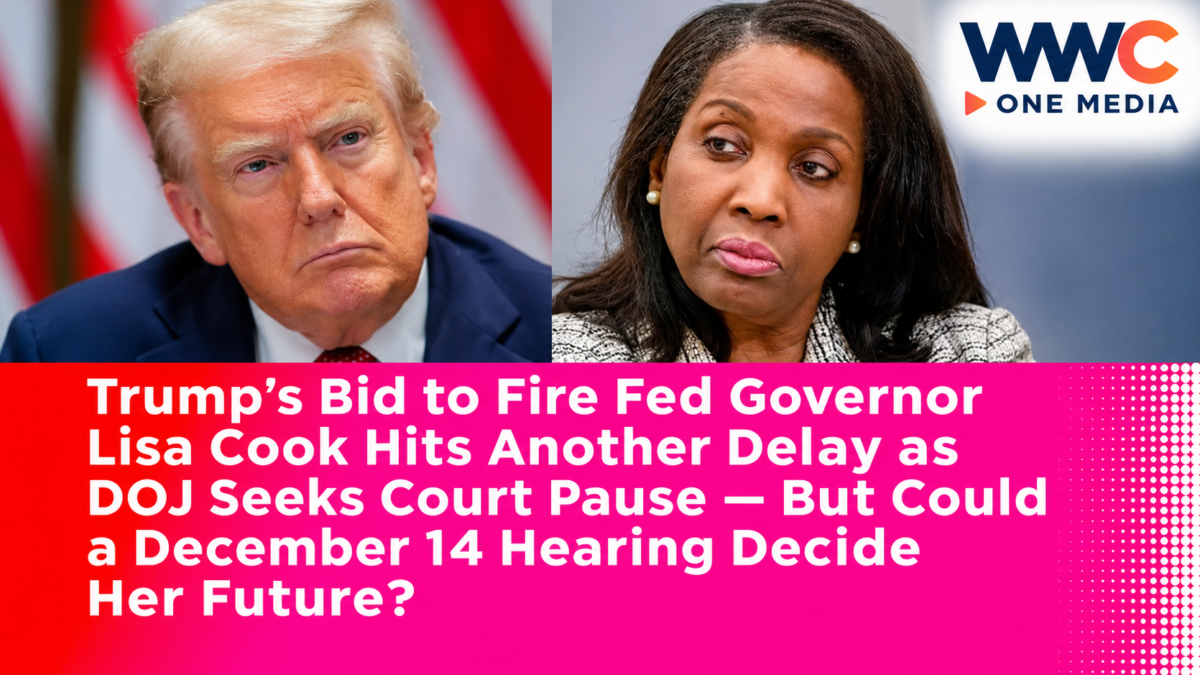
WASHINGTON, D.C. / MANILA, PHILIPPINES — November 7, 2026 | WWC ONE MEDIA | US Politics, Federal Reserve, Financial Markets and Banking Regulation
President Donald Trump’s unprecedented effort to remove Federal Reserve Governor Lisa Cook has entered another critical phase after the US Department of Justice and Cook’s lawyers jointly asked a federal judge to pause their ongoing legal battle.
The unusual request, filed on Friday, November 6, comes as the White House prepares to hold a hearing on allegations of mortgage fraud against Cook—allegations she strongly denies.
Instead of pressing ahead with immediate court proceedings, both sides now want additional time while the administration considers whether it has legally sufficient grounds to remove one of the nation’s most powerful monetary policymakers.
According to Bloomberg, attorneys for the Justice Department and Cook submitted a joint report to US District Judge Jia Cobb requesting that upcoming litigation deadlines be suspended.
The parties indicated that they would provide another update to the court in early January 2027.
Meanwhile, a White House hearing is scheduled for December 14.
The developments represent another turning point in a dispute that has tested the limits of presidential power over America’s central bank.
Trump has spent more than a year attempting to remove Cook following allegations involving mortgage applications.
Cook maintains that she committed no mortgage fraud and that the allegations are being used as a pretext to dismiss her over disagreements about monetary policy.
The Supreme Court previously refused to permit her immediate removal, emphasizing the legal protections that distinguish Federal Reserve governors from ordinary political appointees.
But that decision did not permanently end the dispute.
Now the White House is pursuing a new process designed to address the procedural defects identified by the justices.
As the legal battle moves toward a December hearing, one question could reshape Washington’s relationship with the Federal Reserve: Can Trump establish lawful grounds to remove Cook—or will the courts reinforce the central bank’s independence from presidential pressure?
Justice Department and Lisa Cook Jointly Seek Court Pause
The latest development concerns the management of the pending lawsuit, not a final resolution of the dispute.
Bloomberg reported that lawyers for both sides filed a joint status report on November 6 requesting a suspension of upcoming deadlines.
The request was submitted to Judge Jia Cobb, who has overseen litigation surrounding Trump’s attempted removal of Cook.
The parties want time for the White House to conduct its planned hearing and consider the next steps.
They proposed submitting another report to the judge in early January.
The agreement to request additional time is significant because the two sides remain sharply divided over whether Cook should be removed.
A joint procedural request does not mean either party has accepted the other’s underlying legal position.
The Justice Department continues representing the administration’s interests.
Cook continues defending her right to remain on the Federal Reserve Board.
The case has not been settled, and the reported filing does not establish that Judge Cobb has already approved the requested pause.
White House Schedules December 14 Hearing
The next major event is a hearing scheduled for December 14, 2026.
The White House originally planned to hold a hearing on November 5.
However, the date was changed as Cook’s legal team raised concerns about the proposed process.
Reuters reported that the hearing would be overseen by a committee including Kevin Hassett, one of Trump’s senior economic advisers.
The committee is expected to examine allegations involving Cook’s mortgage applications and determine whether the evidence could support a finding of cause for removal.
The distinction matters because Federal Reserve governors cannot be dismissed simply because the president disagrees with their economic views.
Federal law provides them with special protection against removal without cause.
The White House argues that allegations concerning Cook’s financial disclosures warrant investigation.
Cook’s lawyers contend that the process must be fair, impartial and consistent with the Supreme Court’s decision.
The hearing could therefore become the most important procedural stage in the administration’s renewed removal effort.
Cook’s Lawyer Questions Whether the Hearing Will Be Fair
Attorney Abbe Lowell, who represents Cook, has raised several objections to the White House’s proposed proceedings.
According to Reuters, Cook’s legal team wants greater clarity about the evidence that will be considered.
Her lawyers have also questioned the neutrality of the officials conducting the hearing.
They want to understand who will participate, what roles those individuals will play and whether Cook will have a genuine opportunity to respond.
These concerns are especially important because the Supreme Court previously faulted the administration for failing to provide adequate procedural protections.
Cook’s attorneys have indicated that she could participate if those issues are appropriately resolved.
But their willingness to discuss procedures does not mean they have accepted the allegations.
Nor does it mean they agree that the president has established cause for removal.
The question is whether the hearing will provide a meaningful opportunity for Cook to defend herself before any new decision is made.
How the Mortgage Fraud Allegations Began
The controversy began in August 2025.
Federal Housing Finance Agency Director Bill Pulte publicly raised allegations involving mortgage documents associated with Cook.
The claims concerned statements about whether certain properties were intended to serve as primary residences.
Trump subsequently attempted to remove Cook from the Federal Reserve Board.
The president argued that the allegations undermined confidence in her integrity.
Cook immediately challenged the decision in court.
She denied committing fraud and argued that the administration had not established legally sufficient grounds for dismissal.
She also maintained that the president had failed to give her an adequate opportunity to respond before attempting to remove her.
The mortgage allegations have remained central to the dispute ever since.
However, Cook has not been convicted of mortgage fraud, and the allegations must not be reported as established criminal findings.
Supreme Court Blocks Trump’s Original Attempt
The confrontation reached the US Supreme Court.
On June 29, 2026, the justices rejected the administration’s request to allow Cook’s immediate removal while the litigation continued.
The court ruled 5–4.
Chief Justice John Roberts wrote the majority opinion.
The decision emphasized that Federal Reserve governors are protected by a statutory requirement allowing removal only for cause.
The justices rejected the argument that the president’s determination of cause was effectively beyond judicial review.
They also found that Cook had not received adequate notice and an opportunity to respond before the attempted dismissal.
The ruling allowed Cook to remain in office while further proceedings continued.
But it did not conclusively determine whether any properly established misconduct could eventually justify removal.
That unresolved question explains why the administration has renewed its efforts through a White House hearing.
Why the Federal Reserve Has Special Legal Protections
The Federal Reserve was designed to make monetary-policy decisions with substantial independence from short-term political pressure.
Its Board of Governors consists of seven members appointed by the president and confirmed by the Senate.
Governors ordinarily serve staggered 14-year terms.
They may be removed only for cause.
Those protections are intended to prevent presidents from replacing policymakers whenever interest-rate decisions become politically unpopular.
Central-bank decisions can affect borrowing costs, inflation, employment, investment and the value of the US dollar.
A president may favor lower interest rates to encourage economic growth.
But central-bank officials may believe higher rates are necessary to contain inflation.
The purpose of institutional independence is to allow monetary policy to be based on economic conditions and statutory responsibilities rather than immediate political demands.
The Cook case directly tests how those principles operate when a president alleges misconduct by a sitting governor.
Trump’s Demand for Lower Interest Rates Adds Political Pressure
The dispute has unfolded during a prolonged disagreement between Trump and Federal Reserve policymakers.
Trump has repeatedly demanded substantially lower borrowing costs.
He has argued that the central bank should reduce interest rates to stimulate economic activity.
But Federal Reserve officials have remained concerned about persistent inflation.
In September, the central bank raised its benchmark interest-rate target to 3.75%–4.00%.
The decision came despite Trump’s public calls for rates of 1% or lower.
WWC ONE MEDIA previously examined this conflict in Trump Wants U.S. Rates at 1% or Less — But His Own Fed Chair Just Raised Them and May Not Be Finished.
The report detailed the disagreement between the White House and Federal Reserve Chair Kevin Warsh.
Cook’s legal team argues that the president’s actions should be understood against this broader political backdrop.
The administration maintains that its case concerns alleged misconduct rather than ordinary policy differences.
Determining whether there is legally sufficient cause for removal remains a separate question for the relevant proceedings.
The Fed’s September Rate Increase Raises the Stakes
The Federal Reserve’s September decision reinforced how significant the dispute has become.
Policymakers unanimously raised interest rates by 25 basis points.
The decision reflected concern about inflation remaining above the central bank’s 2% target.
WWC ONE MEDIA covered the move in Federal Reserve Raises Interest Rates for First Time in Three Years.
The September decision demonstrated that even officials appointed by Trump were prepared to support higher borrowing costs when they considered them economically necessary.
This creates a difficult political situation for the administration.
Trump favors cheaper credit.
The Federal Reserve has emphasized the risks associated with persistent inflation.
The legal protections surrounding Fed governors are intended to prevent disagreements over such decisions from becoming automatic grounds for dismissal.
The Cook case may therefore influence how future administrations interact with central-bank officials.
Bill Pulte’s Role Adds Another Layer to the Controversy
The mortgage allegations originated partly from actions by Bill Pulte, the director of the Federal Housing Finance Agency.
His agency oversees major institutions involved in America’s mortgage-finance system.
Pulte has defended referrals concerning suspected mortgage irregularities as part of legitimate efforts to identify potential fraud.
Critics have questioned whether such allegations have been pursued selectively against prominent officials who disagree with Trump.
WWC ONE MEDIA examined a separate oversight controversy involving Pulte in Trump’s Housing Regulator Accused of ‘Unprecedented’ Obstruction as Watchdog Faces 80% Staff Cuts — But Who Will Police America’s Mortgage Giants?.
That report discussed allegations raised by the FHFA’s inspector general concerning access to information and the watchdog’s proposed budget reductions.
The regulator has disputed allegations of improper obstruction.
The oversight dispute and Cook’s removal case are separate legal matters.
Nevertheless, Pulte’s involvement in the original mortgage allegations makes his actions relevant to understanding how the confrontation developed.
No court finding establishes that Pulte committed a crime by raising the allegations against Cook.
Why the December Hearing Could Be Challenged Again
The Supreme Court’s earlier ruling identified significant procedural protections.
The administration must provide a meaningful opportunity for Cook to understand and contest the allegations.
The legal question also concerns whether the alleged conduct satisfies the statutory standard for removal.
According to the Supreme Court, that standard must reflect the Federal Reserve’s special institutional position.
The seriousness of alleged misconduct and its relationship to a governor’s official responsibilities can matter.
A hearing might address some of the procedural deficiencies identified by the justices.
But holding a hearing does not automatically prove that lawful cause exists.
If the administration decides to remove Cook again, the decision could face additional judicial review.
Cook’s attorneys may challenge the adequacy of the hearing, the evidence supporting the allegations or the legal basis for dismissal.
The December proceedings could therefore become another stage in a longer dispute rather than its conclusion.
Could Trump Replace Cook With an Ally?
Removing Cook could potentially give Trump another opportunity to nominate a governor who is more closely aligned with his monetary-policy preferences.
Cook’s current term runs through 2038.
That long tenure is one reason the dispute is politically significant.
Federal Reserve governors can remain in office across multiple presidential administrations.
Replacing a governor before the end of a term is therefore an exceptional action.
But even if a vacancy arises, appointing a successor would generally require Senate confirmation.
The November 3 midterm elections changed the political outlook for that process.
Democrats are preparing to take control of the Senate in January 2027.
That could make confirmation of a strongly partisan replacement more difficult.
However, Cook’s departure is not established, and no replacement appointment has been confirmed.
Democrats Could Increase Scrutiny of Trump’s Fed Strategy
The changing balance of power in Washington adds another dimension.
Democrats are preparing to assume control of congressional committees responsible for banking and financial oversight.
Senator Elizabeth Warren is positioned to play an influential role in scrutinizing Federal Reserve appointments and financial regulation.
WWC ONE MEDIA examined the wider political implications in Democrats Prepare Five-Front Congressional Offensive Against Trump After Historic Midterm Sweep — But Could Subpoenas, Iran War Probes and Crypto Investigations Shake the White House?.
The report outlined potential congressional investigations involving the administration’s economic and regulatory decisions.
The Cook dispute could become part of that broader oversight agenda.
Lawmakers may seek records about the White House investigation, the role of political advisers and the administration’s justification for attempting to remove a sitting central-bank governor.
But the specific scope of any future congressional investigation has not been finalized.
Oversight possibilities should not be presented as already completed findings of misconduct.
Why Financial Markets Are Watching the Legal Battle
The dispute could have implications beyond Washington.
The Federal Reserve influences the world’s most important reserve currency and one of the largest government bond markets.
Investors closely follow its decisions because changes in US interest rates can affect global borrowing costs.
If markets begin to believe that monetary policy is becoming increasingly subject to political influence, they may reassess inflation expectations and the risks associated with dollar-denominated assets.
However, the November 6 court filing does not establish that investors have already abandoned US bonds or that the dollar has collapsed.
The immediate development is procedural.
The wider market significance concerns the precedent that could eventually emerge from the dispute.
A decision reinforcing the Fed’s removal protections might strengthen confidence in its institutional independence.
A decision permitting a broader presidential removal power could raise additional questions about future central-bank governance.
What This Means for the Philippines
The Federal Reserve’s independence also matters to countries such as the Philippines.
US monetary policy can influence global interest rates, international capital flows and exchange-rate expectations.
Changes in dollar borrowing costs may affect emerging-market financing conditions.
The peso’s value against the US dollar can also respond to shifts in interest-rate expectations and investor sentiment.
But it would be inaccurate to claim that the latest filing immediately changed the Bangko Sentral ng Pilipinas’ policy rate or directly caused a specific movement in Philippine financial markets.
Those outcomes depend on broader economic conditions and monetary-policy decisions.
The longer-term concern is whether the United States can maintain a stable and predictable central-bank framework.
For businesses and investors around the world, that institutional credibility remains important.
What Happens Next?
The next expected milestone is the December 14 White House hearing.
Before that date, Cook’s lawyers are seeking assurances about the process.
They want clarity concerning the evidence, committee composition and opportunities to respond.
Meanwhile, Judge Cobb will consider the parties’ joint request concerning litigation deadlines.
The legal teams have proposed providing the court with another update in early January 2027.
Several outcomes remain possible.
The White House could proceed with the hearing and decide that the evidence supports removal.
It could determine that no further action is warranted.
Additional procedural disagreements could delay the process.
And any renewed attempt to remove Cook could generate further litigation.
None of those outcomes should be treated as certain before the relevant decisions are announced.
The Bigger Question: Who Controls America’s Central Bank?
The conflict over Lisa Cook has become one of the most consequential tests of Federal Reserve independence in modern American history.
Trump initially attempted to remove Cook in August 2025.
The Supreme Court blocked that effort while allowing the broader litigation to continue.
The administration then renewed its pursuit of removal, citing allegations that Cook denies.
Now the Justice Department and Cook’s lawyers have jointly requested a pause in upcoming court deadlines while a new White House hearing approaches.
The agreement provides additional time, but it does not settle the central disagreement.
Can the president demonstrate legally sufficient cause to dismiss Cook?
Will the White House hearing satisfy the procedural protections identified by the Supreme Court?
And how will the courts respond if the administration attempts to remove her again?
For Cook, the outcome could determine whether she remains on the board through her term.
For Trump, it could define the limits of his authority over one of America’s most influential institutions.
For financial markets, the broader issue concerns whether central-bank policy can remain insulated from political pressure.
As Trump and Federal Reserve Governor Lisa Cook temporarily align on pausing their court fight while preparing for a December 14 hearing, one question could reshape American monetary policy for years: Will the White House finally establish lawful grounds for her removal—or could the Supreme Court’s protections leave the president facing another decisive defeat in his battle for influence over the Fed?