
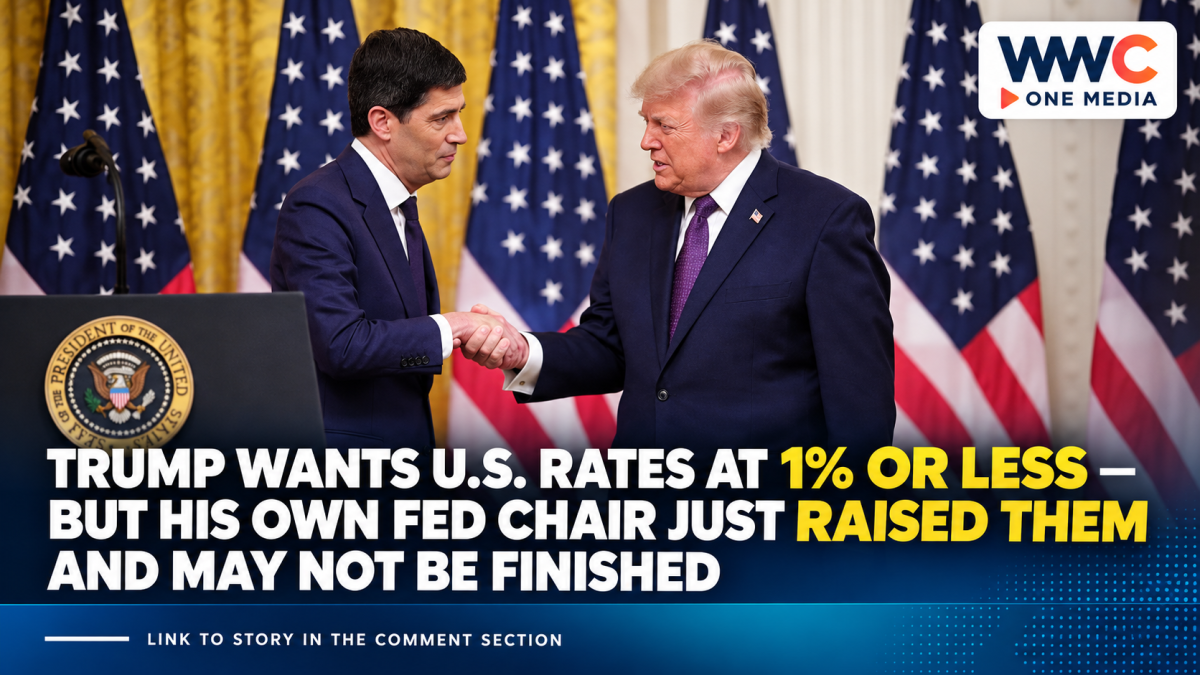
WASHINGTON — President Donald Trump is demanding dramatically lower U.S. interest rates after the Federal Reserve did exactly the opposite, raising borrowing costs for the first time in three years as Chair Kevin Warsh warned that inflation remains too high.
The Federal Open Market Committee voted 12-0 on September 16 to raise the federal funds target range by a quarter percentage point to 3.75%–4.00%. The Fed said economic activity remained solid, domestic spending resilient and inflation elevated, arguing that tighter policy would support a faster return toward its 2% inflation goal.
Trump responded within hours.
“Interest Rates in the United States should be 1%, or less,” he wrote on Truth Social, before demanding that the Fed lower borrowing costs “fast.” He later told reporters that he still had confidence in Warsh despite disagreeing with the central bank’s decision.
That creates one of the clearest tests yet of the relationship between a president who has repeatedly pushed for cheaper money and the Fed chair he personally chose to lead an institution designed to make monetary-policy decisions independently.
And the bigger problem for Trump is that Wednesday’s increase may not be the last one.
The Fed didn’t just hike—it signaled more tightening
The quarter-point increase was widely anticipated by financial markets.
What mattered almost as much was what Fed policymakers expect next.
The central bank’s updated projections put the median federal funds rate at 4.1% at the end of 2026, corresponding roughly to a 4.00%–4.25% target range. Reuters reported that 16 of 18 policymakers expect at least one additional quarter-point hike before year-end, while only two projected no further increase.
Warsh himself did not submit an interest-rate projection, according to Reuters, consistent with his preference for less forward guidance.
So although the Fed has not promised another hike, the September projections show that most officials currently believe policy may need to become tighter still.
That is the opposite direction from Trump’s preferred 1% rate.
Why Warsh voted for higher rates
Warsh said the decision reflected more than one unusually bad inflation report.
He pointed to resilient consumer spending, strong productivity, robust capital investment and a labor market that remains firm enough for the central bank to focus more aggressively on price stability.
The Fed’s official statement said economic activity was expanding at a “solid pace,” while employment growth had kept pace with the workforce and the unemployment rate had changed little.
Warsh’s argument was straightforward: inflation has remained above target for too long, and economic conditions are strong enough for monetary policy to apply additional restraint.
At his press conference, he described the increase as a “sober,” “serious” and “responsible” decision.
Inflation is still nowhere near 2%
The latest consumer-price data help explain the Fed’s concern.
The U.S. Consumer Price Index rose 0.4% in August and 3.4% from a year earlier, according to the Bureau of Labor Statistics. Gasoline prices increased 3.9% during the month and accounted for more than one-third of the monthly CPI increase.
The Fed’s preferred inflation measure—the Personal Consumption Expenditures price index—is also expected to remain well above target.
Federal Reserve projections now put 2026 PCE inflation at 3.7%, slightly above the 3.6% forecast issued in June. Policymakers do not expect headline PCE inflation to return to 2% until 2029 under their median projections.
Core PCE inflation, which excludes food and energy, is projected at 3.4% this year.
That gives the Fed a fundamentally different starting point from Trump.
The president is emphasizing the economic benefits of cheaper borrowing.
The central bank is emphasizing the risk that cutting too quickly could allow inflation to remain above target.
Trump says America should have some of the world’s cheapest money
Trump has argued repeatedly that U.S. interest rates should be exceptionally low because of the country’s creditworthiness and economic importance.
Ahead of the Fed meeting, he said the United States should have the lowest interest rates in the world, and after the hike he repeated his call for 1% or lower.
Lower policy rates can reduce borrowing costs over time and may support investment, housing demand and economic activity.
But a sharp reduction toward 1% while inflation remains well above the Fed’s 2% goal would represent a very different monetary-policy strategy from the one the FOMC adopted Wednesday.
Rates around 1% have historically been associated with periods in which the Fed was trying to provide substantial economic stimulus, Reuters noted.
The current Fed sees less reason for that kind of stimulus because economic growth and spending remain comparatively strong.
Trump says he spoke with Warsh
The political tension became more direct when Trump told reporters that he had spoken with Warsh.
Trump said he told the Fed chairman that he might as well vote with the rest of the board because one vote would not alter the result. Trump also described the board as “very hostile” and “very political.”
Warsh has not publicly confirmed details of any such conversation.
Asked whether he would meet Trump to discuss the rate decision, Warsh told reporters he had nothing to provide regarding conversations with the president.
The distinction is important because the Federal Reserve is structured to make monetary-policy decisions independently of the White House, even though presidents nominate members of the Board of Governors and the Senate confirms them.
Warsh has said since taking the job that he intends to preserve that independence on interest-rate decisions.
This is a very different relationship from what Trump appeared to expect
Trump selected Warsh in January to succeed Jerome Powell.
Warsh formally assumed leadership of the Fed in late May after Senate confirmation. Reuters reported that he entered the job amid expectations from Trump that the central bank would move toward lower rates.
Initially, Warsh supported keeping rates unchanged.
At the Fed’s July meeting, he argued for waiting while policymakers collected more information.
By September, his position had changed.
Warsh said data released over the summer did not convince him that underlying inflation trends were improving sufficiently.
That makes Wednesday’s decision more consequential than an ordinary quarter-point adjustment.
It shows that Trump’s appointment of Warsh has not translated into White House control over the FOMC’s rate decisions.
Trump also tied interest rates to America’s trade deficits
Trump’s post went beyond monetary policy.
He argued that the United States loses money through trade deficits and suggested that eliminating trade with countries where the U.S. runs deficits could generate enormous gains.
Reuters noted that trade balances and the Federal Reserve’s short-term policy rate are not directly interchangeable policy tools. A trade deficit reflects many factors—including domestic consumption, saving and investment patterns, exchange rates, fiscal conditions and international capital flows—rather than simply the level of the federal funds rate.
The Fed’s statutory responsibilities, by contrast, center on maximum employment and stable prices.
Its September statement explicitly framed the rate increase around that dual mandate.
Markets immediately took the Fed seriously
Financial markets reacted as investors reassessed the likelihood that borrowing costs will remain elevated.
The U.S. dollar strengthened after the decision, while the yield on the two-year Treasury note—one of the bond-market measures most sensitive to expectations for Fed policy—jumped to its highest level in more than two years.
U.S. stocks also weakened following the announcement.
The Dow Jones Industrial Average fell more than 600 points, while the S&P 500 declined and longer-term Treasury yields remained near elevated levels.
Markets were responding not merely to the 25-basis-point move itself, which had been heavily anticipated, but to the possibility that the Fed has entered a broader tightening phase.
Rate futures after the meeting were pricing a high probability of another quarter-point increase before year-end, Reuters reported.
Why a Fed hike does not mean every interest rate rises exactly 0.25 points
The Fed directly controls the target range for overnight federal funds lending.
It does not directly set mortgage, auto-loan or credit-card rates.
But changes in Fed policy influence borrowing costs across financial markets.
Credit-card rates commonly move with short-term benchmark rates.
Auto financing and business loans can also become more expensive.
Mortgage rates are more closely tied to longer-term bond yields, inflation expectations and financial-market conditions than to a one-for-one change in the federal funds rate.
Reuters reported that average U.S. 30-year mortgage rates were already approaching 7% as the Fed met.
That means consumers may feel the rate decision through housing, borrowing and refinancing costs even though the exact impact differs by product.
Savers sit on the other side of the equation
Higher rates are not negative for every household.
Banks and money-market funds can offer higher yields on deposits when short-term interest rates rise.
Bond investors may also receive higher yields on newly issued securities.
The economic trade-off is therefore broader than “higher rates are bad” or “lower rates are good.”
Lower rates tend to make borrowing easier but can stimulate demand.
Higher rates restrain borrowing and demand while offering higher returns to savers.
The Fed’s current position is that additional restraint is justified because inflation remains too far above target.
The economy is making the Fed’s choice harder
Normally, slowing economic growth gives a central bank an obvious reason to reduce rates.
That is not the current picture.
Fed officials raised their median projection for 2026 real GDP growth to 2.3%, from 2.2% in June.
They also lowered their expected year-end unemployment rate to 4.1% from 4.3%.
Separate Commerce Department data reported by Reuters showed August retail sales rising 1.2%, stronger than economists expected, reinforcing the picture of a resilient consumer economy.
For monetary policymakers, strong demand can be a double-edged sword.
It lowers the immediate risk of recession.
But it can also make inflation harder to bring down if spending continues growing faster than the economy’s capacity to supply goods and services.
Energy prices have complicated everything
The Fed is also operating during an extraordinary energy shock.
Oil prices rose above $100 a barrel amid disruptions tied to conflict in the Middle East, while U.S. gasoline prices have climbed sharply. Reuters reported before the meeting that high energy prices were one of the major forces complicating the inflation outlook.
But Warsh emphasized that the Fed no longer views inflation as simply the product of temporary energy or supply disruptions.
The September policy statement dropped earlier language attributing elevated inflation primarily to supply shocks, reflecting broader concern among policymakers that price pressures have spread.
That change helps explain why the Fed was willing to raise borrowing costs even though some inflation has clearly been driven by events the central bank cannot control.
The Fed cannot produce more oil.
It can try to prevent an energy shock from feeding into persistent economy-wide inflation.
Warsh is trying to talk less than his predecessors
There is also a stylistic shift at the central bank.
Warsh has argued that the Fed should provide less detailed forward guidance and allow economic data to guide policy decisions rather than signaling future moves too explicitly.
His September press conference was notably shorter than those typically held under previous chairs.
That means markets may receive fewer guarantees about what comes next.
The Fed’s projections indicate that most officials expect another increase.
Warsh himself is deliberately avoiding a commitment.
So the next decision will depend heavily on inflation, employment, economic growth and financial conditions.
The next fight could arrive quickly
The September meeting may therefore have opened rather than closed the argument.
Goldman Sachs said after the decision that it now expects the Fed to raise rates again by another quarter point at its October meeting. That is an outside forecast, not a Fed commitment.
Fed policymakers collectively project at least one more increase before the end of 2026, but their forecasts can change as new economic data arrive.
Trump, meanwhile, is asking for something radically different: not simply a pause, but rates around 1% or below.
That leaves a gap of roughly three percentage points between the president’s stated preference and where the central bank currently has policy.
The real story is no longer just Trump versus the Fed
Presidential criticism of Federal Reserve policy is not new.
What makes this episode unusual is the identity of the chairman.
Trump spent years criticizing Jerome Powell, an appointee from his first presidential term.
This time, the rate increase came under Kevin Warsh, the chairman Trump selected specifically in 2026.
Warsh voted with every other FOMC member to raise rates.
Trump publicly disagreed.
But Trump also said he still has confidence in him.
That leaves the relationship in an unusual position.
There is open disagreement over interest rates.
There is no announced move to replace Warsh.
And there is no evidence that the Fed intends to change policy simply because the White House prefers a different number.
The next inflation report will therefore matter for much more than markets.
It will help determine whether the Fed’s first rate increase since 2023 becomes a one-off adjustment—or the beginning of a new tightening cycle.
Trump wants rates at 1% or less.
The Fed has just moved them to 3.75%–4.00%.
And based on its own projections, the central bank may still be moving in the opposite direction.



Leave a Reply