
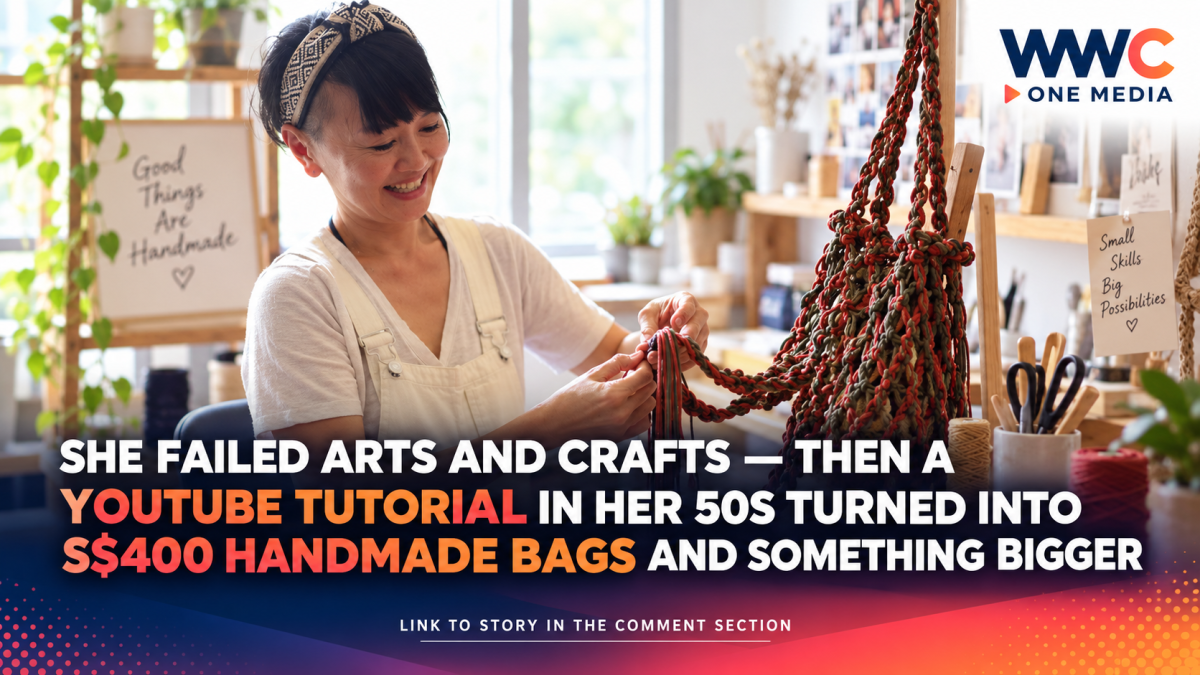
SINGAPORE — Lu-Lyn Chang once believed she was hopeless at making things. She says she failed arts and crafts at school, could not sew and joked that even folding a paper aeroplane was beyond her.
Then, in her 50s, during the uncertainty of the COVID-19 pandemic, she clicked on a YouTube tutorial about making a macramé plant holder.
What began as something to occupy an anxious mind eventually became Bound Designs, a Singapore slow-fashion label selling handmade bags and accessories that deliberately refuses one of retail’s most basic rules: if something sells well, make more of exactly the same thing.
Chang does the opposite.
Every Bound bag is intended to be different.
Even when a customer asks her to recreate a sold-out design, Chang says she changes the knots, colours or other details so the new piece is never an exact duplicate.
And that stubborn insistence on individuality has helped turn a lockdown hobby into something much broader — part fashion label, part craft practice and part platform for teaching and paying people from communities that are often excluded from mainstream employment.
It started with anxiety, not a business plan
Chang’s introduction to macramé came during a period when much of life felt beyond her control.
She told CNA Lifestyle that during the pandemic she worried about her children, her mother and the possibility of family members becoming ill.
She tried several ways to occupy herself, including yoga, baking, gardening, meditation, crocheting and puzzles.
None held her attention in the same way as knotting.
After finding a plant-hanger tutorial online, Chang discovered that the repetitive sequence of tying and arranging knots helped her focus on a single physical task.
It is important not to overstate that experience as medical treatment.
Chang describes macramé as personally calming and useful for managing her own anxious thoughts; neither she nor the sources cited present it as a substitute for professional mental-health care.
What mattered for her story is what happened next.
She did not particularly want another plant hanger.
She wanted a bag.
One black clutch changed the direction
Chang began researching materials and eventually produced a simple black clutch.
Then another bag followed.
And another.
She experimented with different knots, fibres, silhouettes and colour combinations. Friends started asking for pieces of their own.
Eventually, what had begun as a private craft exercise became Bound Designs.
Bynd Artisan, which collaborated with Chang on a macramé-and-leather collection in 2024, said she had been running Bound for almost three years at that point. That places the label’s beginnings roughly in the early post-lockdown period, although Bound does not prominently publish a precise incorporation or launch date.
The timing matters because Chang was not starting from zero as an entrepreneur.
She had already spent decades in marketing.
CNA reports that she co-founded a digital marketing agency with two partners in 2000 and sold a majority stake to a UK media company in 2018, after which she stepped away from a full-time operating role.
Her current professional profile still identifies her with the digital marketing industry, while Bound represents a very different kind of commercial project — intentionally small, handmade and resistant to mass production.
Bound does not look like traditional beige macramé
Macramé is often associated with cream-coloured wall hangings, hanging plant holders and 1970s bohemian interiors.
Bound’s bags go in another direction.
Some are monochrome.
Others mix intense colours.
Many feature long tassels, contrasting fibres, rattan handles or sculptural woven forms.
Chang has experimented with raffia, rattan, wool, jute, denim cord and recycled sari material, among other textiles.
Her current online shop includes rattan-handle bags, trapezium shapes, totes, clutches and doctor-bag silhouettes.
Current listed examples include bags priced around S$389 to S$489, although CNA reports the overall bag range begins at S$269 and accessories at S$79.
That puts Bound far above the price of a mass-produced craft-market tote.
The brand’s argument is that buyers are paying for something closer to a wearable craft object.
Each piece requires extensive hand knotting and weaving, and Bound says its products are made to order rather than mass manufactured.
Scarcity is not a marketing trick — it is the model
Many fashion brands use artificial scarcity.
Bound’s scarcity is closer to a production constraint and creative philosophy.
Chang says she has little interest in producing identical copies of a bestseller.
If a bag is recreated, something changes.
The result might be a different knot pattern, another colour combination or a material substitution.
That gives the customer something close to a bespoke object without turning Bound into a traditional luxury atelier.
It also means the business is inherently difficult to scale.
A factory can produce thousands of identical bags.
A designer who intentionally changes each handmade piece cannot.
For many businesses, that would be an obvious weakness.
For Bound, it is the point.
The brand describes itself as a slow-fashion label built around traditional macramé and weaving, with an emphasis on avoiding mass production and reducing waste.
The sustainability claim is more specific than simply “handmade”
“Handmade” and “sustainable” are not automatically the same thing.
Bound makes more specific claims about how it sources and uses materials.
The brand says it works with natural or recycled cotton strings, jute fibres and threads derived from upcycled textile waste wherever possible.
It also says leftover cord and string are reused in packaging or smaller objects such as jewellery and brooches. Its product bags are designed from materials such as jute and canvas so customers can reuse them instead of treating them as disposable packaging.
Those are brand-reported practices rather than an independent lifecycle assessment of every Bound product.
So it would be too strong to declare that each bag is environmentally superior to every mass-market alternative.
But the practices do show that reducing waste is built into the label’s stated production philosophy rather than added only as a marketing slogan.
Bynd Artisan brought Bound into a wider Singapore design conversation
The label has also moved beyond direct-to-consumer sales.
In 2024, Singapore craft company Bynd Artisan selected Chang for its 10th-anniversary “10 Years and Beyond” programme.
For the collaboration, Chang combined Bound’s macramé techniques with Bynd Artisan leather, creating a shoulder bag and multifunctional straps that could be adapted as bag straps, wristlets, belts or necklaces.
The partnership placed Bound alongside other Singapore creatives in Bynd Artisan’s anniversary programme and provided another signal that macramé could be treated as contemporary design rather than only decorative craft.
Chang described the collaboration as an attempt to balance fashion, utility and traditional handcraft.
That same combination runs through much of Bound’s work.
The tassels may be dramatic.
The production process is deliberately old-fashioned.
But the object still has to function as a bag.
Then the craft moved somewhere unexpected: prison
The most distinctive part of Chang’s story may have little to do with selling handbags.
She told CNA that she watched a documentary about women in prison and was struck by inmates describing anxiety over situations outside the institution that they could not control.
That reminded her of how she had felt during the pandemic.
Through a later introduction, Chang began teaching macramé to a small group of five women at Singapore’s women’s prison.
Bound’s own site says the prison programme ran for four weeks, during which participants learned to make a mobile-phone bag using macramé weaving techniques, and identifies the effort as a collaboration involving the Yellow Ribbon Project and Singapore Women’s Prison.
That was the point at which the craft that had originally helped Chang personally began taking on another role.
She started thinking about skills training.
The social-impact work became much larger
Chang later became a partner trainer with SG Enable, Singapore’s focal agency for disability inclusion.
According to CNA, she has worked on projects involving people with intellectual disabilities and autistic individuals, teaching the craft and then engaging participants to produce bags, wall art and other objects for Bound and commercial commissions.
SG Enable provides more detailed figures.
It says Bound developed a training programme called Macramé for Fashion Handbag & Accessories Making, teaching participants macramé knotting and basic colour theory.
The programme trained 24 people with disabilities from MINDS to produce items including clutch bags, bucket bags, tassel keyrings, rope necklaces, wristlets and crossbody straps.
Most significantly, SG Enable says two participants, Hidayah and Halidah, were hired to produce the resulting bag line.
That moves the initiative beyond an arts-and-crafts workshop.
Training becomes more economically meaningful when it is connected to paid work.
Bound has worked with several community organisations
The company’s own records show that its inclusion work has extended to several groups.
Through SG Enable and Social Gifting, Bound helped train residents at Bishan Home for the Intellectually Disabled to produce a recycled-material Christmas brooch commissioned for ION Singapore.
It has also run a tassel-keyring programme through Touch Community Services and worked with MINDS participants on fashion accessories.
These are partly self-reported project descriptions, so they should be presented as Bound’s documented collaborations rather than independently audited measures of social impact.
But they reinforce a consistent pattern.
Chang is not merely donating part of her proceeds.
The skill used to make the product is itself becoming the intervention.
That creates an unusual business tension
Bound wants to remain small.
Its products are handmade.
Its founder refuses to make exact copies.
Its production process takes time.
And some of its social collaborations require training people who may initially have no experience with macramé.
That is almost the opposite of the classic fashion-growth formula.
Conventional consumer brands chase scale.
They standardise.
They outsource.
They repeat winning products.
They reduce production time.
Bound’s identity depends partly on not doing those things.
That raises an interesting question about what success means for a company like this.
If every bag is supposed to be different, does producing 10 times more make the company better?
If the founder’s personal creative involvement is central to the brand, how far can production expand before that identity disappears?
And if the social mission depends on patient skills training, should speed even be the primary measure of growth?
Chang appears comfortable with the contradiction.
CNA says she deliberately wants Bound to stay small enough for her to create at her own pace.
A second career that was never in the plan
There is another reason the story resonates beyond fashion.
Chang did not discover her signature craft in design school.
She discovered it in her 50s.
By then, she had already built a career, launched a company, raised a family and imagined retirement looking very different.
She told CNA that she once pictured herself travelling and eating her way around the world by this stage of life.
Instead, she is designing handbags, teaching macramé, sourcing unusual fibres and working with community organisations.
The story can easily be turned into a cliché about “following your passion.”
The reality is more interesting.
Chang did not identify a lifelong dream and finally pursue it.
She found something she had no idea she was good at because circumstances pushed her to try something unfamiliar.
That is a very different kind of reinvention.
She failed the subject — but kept making things anyway
The irony running through Bound is hard to miss.
Chang once concluded that she simply was not creative.
Then, decades later, she built a fashion label around one of the most labour-intensive forms of handcraft.
Today, Bound sells one-off pieces made with knots, fibres, tassels, recycled textiles, rattan and leather.
The work has been featured in collaborations with Singapore design businesses.
It has entered prison-training programmes.
It has been taught to people with disabilities.
And in some cases, that training has led to paid production work.
What started with a YouTube tutorial therefore became more than a S$269 handbag business.
It became proof of something Chang had spent much of her life assuming was not true.
She could make things.
The bigger surprise is that teaching herself to tie knots eventually gave her a way to help other people make things too.




Leave a Reply