
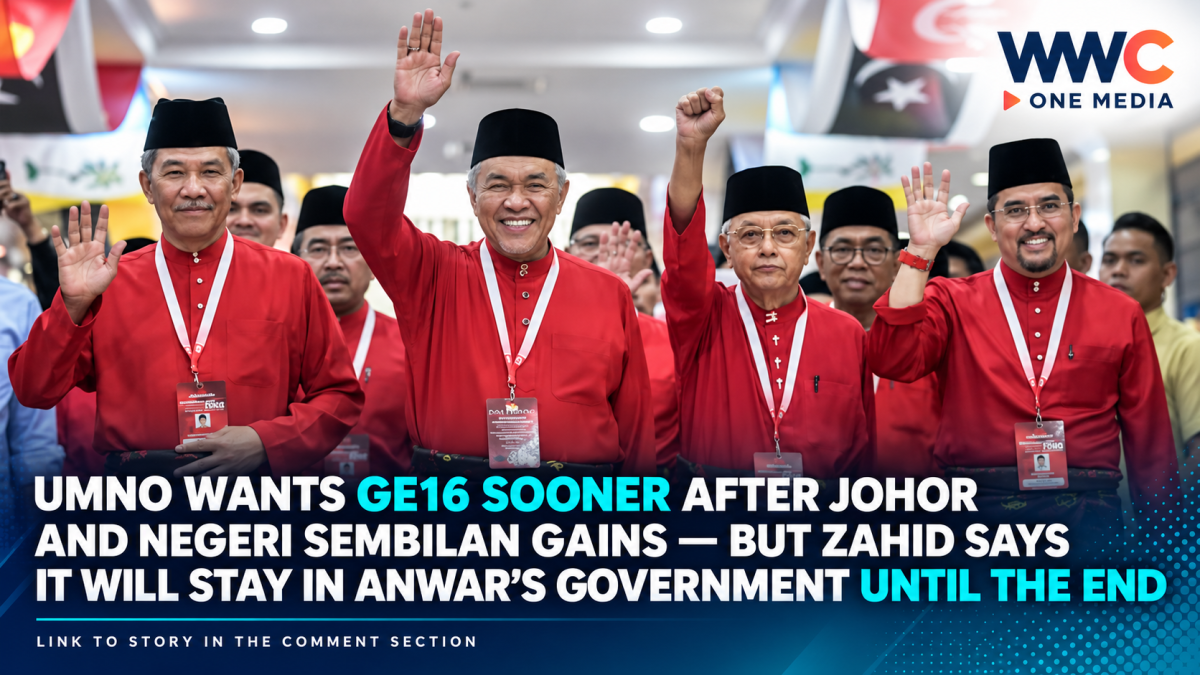
KUALA LUMPUR — Malaysia’s UMNO is sending two messages at once as the country moves closer to its next general election.
The first is aimed at its own supporters: the party wants GE16 brought forward and believes Barisan Nasional should again seek a mandate to lead the federal government.
The second is directed at Prime Minister Anwar Ibrahim and the markets: UMNO says it is not walking out of the unity government before the current term ends.
That apparent contradiction dominated UMNO’s 2026 General Assembly, where party president and Deputy Prime Minister Ahmad Zahid Hamidi called for the next national election to be held sooner, reopened the possibility of cooperation with PAS and took several thinly veiled swipes at Anwar’s administration.
Yet by the end of the gathering, Zahid was also stressing that UMNO would continue performing its duties inside the federal government professionally and would honour the assembly’s previous commitment to remain in the coalition until the end of its term.
That leaves Malaysian politics in an unusual position.
UMNO is helping govern the country while simultaneously preparing to challenge for greater control of the government at the next election.
Zahid: Bring GE16 forward
Zahid made the clearest declaration in his September 11 presidential address.
He told thousands of delegates that the time had come for the 16th General Election to be brought forward, describing GE16 as a defining opportunity for UMNO-led Barisan Nasional to seek a mandate to lead.
Malaysia does not have a fixed GE16 polling date yet.
The current Parliament may continue for five years from its first sitting unless it is dissolved earlier. Under Article 55 of the Federal Constitution, a general election must then be held within 60 days of dissolution.
On the current timetable, GE16 is due by February 2028 if Parliament serves its full term, although an earlier dissolution remains possible.
Anwar said on September 5 that he would consider calls for an earlier election, while stressing that his government still has a mandate and remains focused on the economy, public welfare and combating corruption and abuse of power.
So Zahid’s demand is politically significant.
It is not an announcement that GE16 has actually been called.
Johor changed the conversation
UMNO’s renewed confidence follows two state elections in which BN significantly improved its position.
In Johor on July 11, Barisan Nasional won 48 of 56 state seats, up from 40 in the previous state election.
UMNO captured 36 seats, MCA eight and MIC four.
Pakatan Harapan won the remaining eight, while Perikatan Nasional failed to secure a seat.
That gave BN a commanding two-thirds majority in the state legislature.
The result matters politically because Johor is one of Malaysia’s largest and economically most important states.
But it should not automatically be treated as a forecast of what will happen nationwide.
State elections involve different candidates, issues, turnout patterns and constituency dynamics from a federal election.
The result shows what happened in Johor in July 2026.
It does not establish what Malaysian voters will do in GE16.
Negeri Sembilan produced a very different political formula
The August 1 Negeri Sembilan election gave UMNO another strong result—but through a more complicated route.
Official Election Commission figures showed:
BN: 18 seats
PH: 11 seats
PN: 7 seats
A simple majority required 19.
BN therefore fell one seat short of governing alone.
It subsequently formed the state administration together with Perikatan Nasional, giving the two blocs 25 of the legislature’s 36 seats.
That experience has become especially relevant to Zahid’s national strategy.
It demonstrated that BN and opposition forces associated with PN can cooperate after an election even while BN remains a member of Anwar’s federal unity government.
But there is an accuracy distinction worth keeping.
CNA’s commentary describes the outcome as BN and PAS forming a 25-seat supermajority.
More precisely, BN won 18 and PN won seven. PAS secured four of PN’s seven seats; another PN component, Parti Wawasan Negara, won three.
So the state outcome is evidence of BN-PN cooperation, not a 25-seat BN-PAS result by themselves.
Zahid has reopened the door to PAS
The clearest evidence of changing relationships came at the UMNO assembly itself.
PAS secretary-general Takiyuddin Hassan led a delegation to the gathering, while Pakatan Harapan leaders were not invited.
Zahid subsequently said the door to cooperation between UMNO and PAS was “wide open” and spoke of the possibility of a tahaluf siyasi, or political understanding.
He also instructed UMNO Youth to work with its PAS counterparts toward a large Malay-Muslim unity rally.
That represents a noticeable shift in tone.
UMNO and PAS previously entered the Muafakat Nasional cooperation arrangement after the 2018 general election.
The partnership later deteriorated as Malaysian alliances repeatedly changed.
Zahid has not announced that Muafakat Nasional itself is being restored.
Instead, he has used phrases such as “grand collaboration” and political understanding.
Bernama reported that Zahid described the proposed arrangement as cooperation intended to prevent damaging political clashes—not a merger in which parties lose their separate identities.
PAS is also keeping its options open
PAS has separately said it remains open to cooperation with other parties as long as such arrangements do not compromise its principles.
At its September party congress, PAS president Abdul Hadi Awang listed wider political cooperation among the party’s priorities ahead of GE16.
That does not amount to a finalized UMNO-PAS federal-election pact.
No comprehensive national seat-sharing agreement for GE16 has been publicly announced.
No joint manifesto has been unveiled.
And no final coalition structure has been confirmed.
For now, therefore, it is more accurate to describe the two parties as exploring and expanding cooperation rather than as having completed a national electoral alliance.
And UMNO is still inside Anwar’s government
This is where the story becomes more complicated.
Zahid is not an opposition politician.
He is Anwar’s deputy prime minister.
UMNO and BN remain components of the federal unity government created after the inconclusive 2022 general election.
As recently as September 12—after calling for an early GE and challenging critics who wanted UMNO out of government—Zahid reiterated that his party would remain in the unity government until the end of its term.
He had made the same commitment in July, saying BN had no intention of bringing down Anwar’s administration and was committed to political stability.
On September 6, Zahid also rejected reports of a personal rift with Anwar, saying the two had no problems in either their personal or official dealings and that government decisions continued to be made professionally.
Those statements do not erase their political disagreements.
They do establish that UMNO has not formally withdrawn support from the federal government.
The “guru” exchanges showed the tension publicly
Even if Zahid rejects talk of a personal feud, the political rivalry has become unusually visible.
During the UMNO assembly, Zahid mocked policy changes involving the BUDI95 fuel programme and referred repeatedly to a “guru”, or teacher—a term widely interpreted by Malaysian media as a reference to Anwar.
The phrase carried history.
A leaked 2021 phone conversation had featured Zahid referring to Anwar as “guru”, and the relationship was later described through the teacher-student metaphor.
While attending the BRICS summit in India, Anwar responded online with his own reference to “Guru” in discussing his diplomatic mission.
The exchanges were political theatre.
More consequential was Zahid’s closing challenge.
Responding to calls for UMNO to quit the government, he said those who no longer wanted the party in Putrajaya should either seek a fresh electoral mandate or formally remove it and test confidence in Parliament.
That sharpened the tension without actually ending the coalition.
UMNO is trying to occupy two political spaces at once
UMNO’s current position can look contradictory because it serves two different objectives.
Inside government, staying with Anwar allows BN ministers to retain Cabinet roles and participate in federal policymaking.
Outside government, preparing for GE16 requires UMNO to differentiate itself from Pakatan Harapan and persuade voters that BN represents a distinct political choice.
The result is a form of competitive coalition politics.
UMNO can support the federal government institutionally while criticizing policies politically.
That balancing act becomes increasingly difficult as an election approaches because the parties that govern together today may contest against each other when voters next choose a Parliament.
Recent state elections have already shown that those relationships can vary dramatically from state to state.
In Johor, BN defeated PH decisively.
In Negeri Sembilan, BN and PN ultimately governed together.
At the federal level, BN is still governing with PH.
There is therefore no single alliance map that explains every level of Malaysian politics in 2026.
“Grand collaboration” raises questions beyond PAS
Zahid’s language has also been broader than a straightforward UMNO-PAS alliance.
Bernama reported that he proposed a “Grand Collaboration” based on political understanding between coalitions, saying it would not require parties to merge.
That ambiguity gives UMNO flexibility.
It can continue negotiations with PAS.
It can cooperate with parts of PN where useful.
And it can leave open the possibility of arrangements with other parties without formally binding itself now.
CNA columnist James Chin interprets the proposal as a new version of the political logic behind Muafakat Nasional and argues that UMNO is positioning itself for a stronger role after GE16. That is the columnist’s analysis, rather than an established outcome.
The actual shape of GE16 cooperation will depend on negotiations that have not yet been concluded.
Sabah and Sarawak remain another major part of the equation
The political manoeuvring on the peninsula is occurring while the federal government is also addressing longstanding demands from Sabah and Sarawak.
On September 11, Anwar announced that the Cabinet had agreed in principle to increase Sabah and Sarawak’s share of parliamentary representation, saying their current proportion is lower than envisaged in the historical context of the Malaysia Agreement 1963.
Such a change would require a constitutional amendment.
That means it cannot happen merely through a Cabinet announcement.
It would require parliamentary action.
The issue matters politically because East Malaysian parties have become central players in Malaysia’s fragmented federal landscape.
But it would be premature to assume how Sabah or Sarawak coalitions would align after GE16.
Their leaders will make those decisions based on their own electoral results, negotiations and policy priorities.
GE16 timing is now a political issue in its own right
UMNO is no longer merely preparing for GE16.
It is publicly arguing over when Malaysians should vote.
Zahid wants it sooner.
UMNO deputy president Mohamad Hasan has also urged the party to prepare immediately, warning delegates against assuming it can safely wait until the full parliamentary term expires.
UMNO secretary-general Asyraf Wajdi Dusuki has similarly said the government has entered what he calls an election period and argued for an earlier contest.
Anwar has said he will consider the idea.
But consideration is not dissolution.
As of September 17, there is no announced GE16 date.
State-election results are evidence—not a national forecast
This is where political analysis needs the most caution.
Johor and Negeri Sembilan clearly changed the immediate political environment.
BN won 48 of 56 seats in Johor.
It won 18 seats in Negeri Sembilan and subsequently formed the state government with PN.
Those are significant factual results.
But using them to calculate a future federal parliamentary majority would require assumptions about voter behaviour across very different states, constituencies and alliances.
Malaysia uses single-member constituencies in federal elections.
Candidate selection, three-way contests, turnout, local issues and seat negotiations can all alter outcomes dramatically.
For that reason, CNA’s commentary about what particular coalition combinations could achieve nationally should be understood as an analyst’s scenario—not as a projection established by the state-election results.
The hard evidence says UMNO has recently performed strongly in two state elections.
It does not tell Malaysians the result of an election that has not happened.
The real question is what UMNO does before polling day
The next phase therefore has several moving pieces.
UMNO must decide how far to take negotiations with PAS and potentially other parties.
BN and PH must determine whether their federal partnership can continue functioning while both prepare for an election.
Anwar must decide whether to recommend an earlier dissolution or use more of the existing parliamentary term.
And all sides must eventually negotiate constituencies, candidates and potential electoral cooperation.
None of those issues has been fully settled.
That makes Zahid’s 2026 assembly important—but not because it revealed who will govern Malaysia after GE16.
It revealed UMNO’s direction going into the contest.
The party wants an earlier election.
It wants to seek a larger federal role.
It is reopening political channels with PAS.
And at the same time, it says it will continue serving in Anwar’s government until the current term actually ends.
That is the tension at the heart of Malaysian politics heading toward GE16.
UMNO is preparing for the next government without yet leaving the current one.
And until an election date and final coalition arrangements are announced, everything beyond that remains negotiation rather than result.



Leave a Reply