
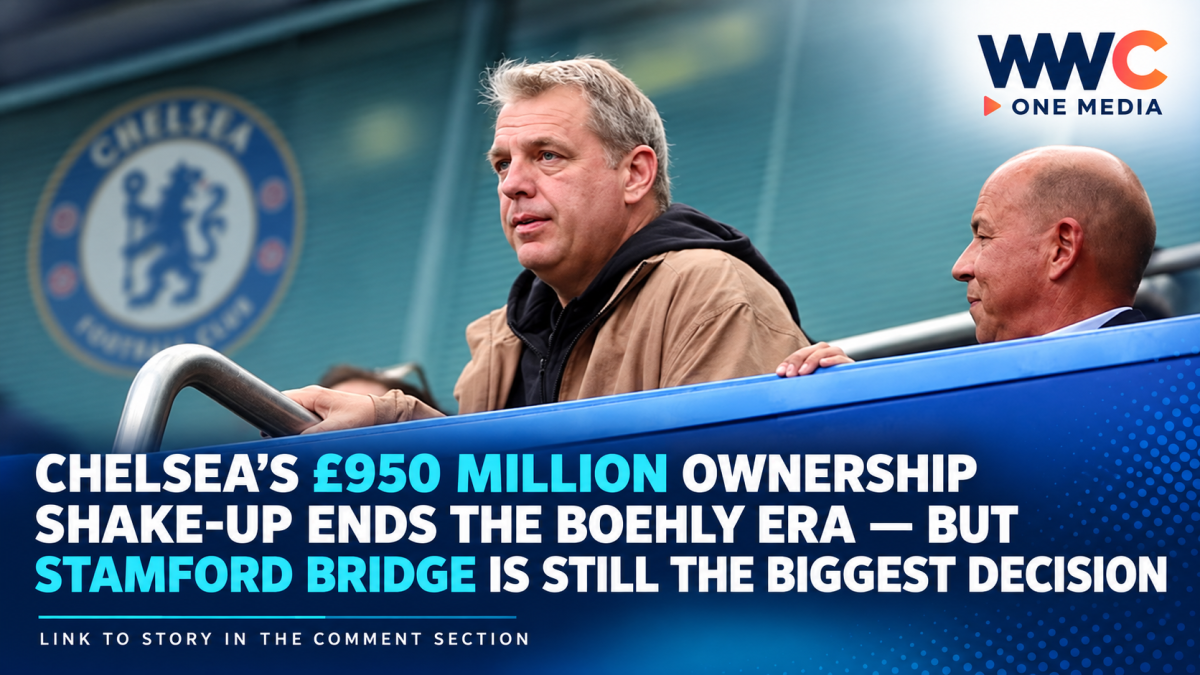
LONDON — Todd Boehly’s high-profile spell as Chelsea chairman is ending four years after he fronted the consortium that bought the Premier League club from Roman Abramovich, with Clearlake Capital moving to consolidate control in a transaction reportedly worth around £950 million.
Chelsea confirmed that affiliates of Clearlake will acquire the ownership interests of both Boehly and fellow American investor Mark Walter, while Boehly will leave his role as chairman. Clearlake said the transaction will give it full control of the club.
But one original investor is staying.
Swiss billionaire Hansjörg Wyss will remain a stakeholder and partner in the ownership group, meaning this is a consolidation of control rather than Clearlake purchasing every share in Chelsea.
That distinction matters because the latest deal is about much more than changing the name on the chairman’s office.
It potentially ends years of tension inside Chelsea’s ownership structure and could give Clearlake greater freedom to make one of the club’s most important long-term decisions:
What happens to Stamford Bridge?
Boehly and Walter are selling roughly a quarter of Chelsea
Before the transaction, Clearlake controlled approximately 61.5% of Chelsea, while Boehly, Walter and Wyss each held about 12.8%, according to reporting by The Guardian.
Boehly and Walter therefore account for roughly 25.6% combined.
Reuters reported that Clearlake has teamed up with Wyss to acquire those holdings, with media reports valuing the deal at around £950 million, or about US$1.27 billion.
The Financial Times independently reported the same £950-million figure and said the transaction values Chelsea at approximately £5 billion including debt.
Chelsea did not disclose the transaction price in its official announcement.
So the accurate wording is:
The stakes are reportedly being sold for about £950 million—not that Chelsea has officially announced a £950-million sale price.
Clearlake gets full control—but Wyss stays
Chelsea’s own statement is unusually clear on the governance change.
Clearlake said it will acquire Walter’s interest and Boehly’s holding and thereby gain “full control” of Chelsea, while Wyss remains an important stakeholder.
That means ownership and control are not identical concepts here.
Clearlake does not need to own every share to exercise controlling authority over the club.
The exact post-transaction shareholding percentages have not yet been publicly detailed.
What is clear is that the previous governance arrangement—in which Clearlake was majority shareholder but shared control with Boehly’s group—is coming to an end.
Chelsea said there will be no change to day-to-day operations, leadership or club strategy as a result of the transaction.
So supporters should not expect an immediate wholesale executive reshuffle simply because the shareholder structure has changed.
Boehly leaves after four turbulent years
Boehly became the public face of Chelsea’s post-Abramovich era when the consortium completed the takeover in May 2022.
The original transaction is often described as a £4.25-billion takeover, but that shorthand requires clarification.
Chelsea’s official 2022 announcement said £2.5 billion was allocated to purchase the shares, while the buyers separately committed another £1.75 billion for future investment in areas including Stamford Bridge, the academy, Chelsea Women and the Chelsea Foundation.
In other words, £4.25 billion was the overall transaction-and-investment package—not simply the cash purchase price paid to Abramovich.
That is an important distinction when comparing it with today’s reported Chelsea valuation.
Chelsea spent aggressively—and rebuilt almost everything
The Boehly-Clearlake ownership became synonymous with extraordinary player turnover.
By August 2024, Reuters calculated that Chelsea had already spent roughly €1.3 billion on about 40 signings since the takeover.
And the spending did not stop.
During the 2026 summer transfer window alone, Chelsea spent approximately £349 million, second only to Manchester City among Premier League clubs, according to Reuters.
The ownership strategy has centered heavily on acquiring younger players on longer contracts, building a squad with substantial future resale value and attempting to spread transfer costs over extended accounting periods.
That approach produced criticism when results initially failed to match the spending.
Managers changed.
Squads became unusually large.
And Chelsea finished 12th in the Premier League in the ownership group’s first full season.
But the sporting picture subsequently improved considerably.
The ownership era also delivered major trophies
The Boehly-Clearlake period should not be summarized only through transfer spending and boardroom disagreements.
Chelsea finished fourth in the 2024-25 Premier League, returning to the Champions League.
They then won the UEFA Conference League, beating Real Betis 4-1 in the final, and followed it by winning the expanded 2025 FIFA Club World Cup.
Chelsea’s own records show the team scored a tournament-leading 17 goals during that Club World Cup campaign and beat Paris Saint-Germain in the final.
So Boehly leaves after an ownership period that was both enormously expensive and eventually trophy-winning.
That makes the transition more complicated than a simple story of failed ownership.
The club has arguably emerged with a younger squad and international silverware—but also with substantial financial pressures.
Chelsea just reported a record £262.4 million pre-tax loss
That is the other number Clearlake inherits.
Chelsea reported a £262.4-million pre-tax loss for the financial year ending June 2025, despite revenue climbing to £490.9 million, its second-highest total on record.
The loss was the largest pre-tax deficit reported by a Premier League club, according to the Financial Times and Guardian.
Chelsea attributed the financial picture partly to higher operating costs, European competition expenses and player-related accounting charges.
Future revenues may improve substantially because of Champions League participation and income from the Club World Cup.
But the financial results demonstrate that sporting success does not automatically make Chelsea’s current business model inexpensive.
Clearlake therefore gains clearer control at precisely the moment when the club must balance continued investment against profitability and football’s financial regulations.
Why Boehly and Clearlake had been drifting apart
The sale did not come completely out of nowhere.
Reports of tension between Boehly and Clearlake had circulated since at least 2024.
At one point, both sides were reportedly exploring whether one could buy the other out.
Clearlake consistently signaled that it did not intend to sell its majority holding, while reports suggested Boehly might be open to exiting.
By 2026, the biggest strategic disagreement reportedly concerned Chelsea’s stadium.
The Guardian reported that Boehly and Clearlake had clashed over whether Chelsea should redevelop Stamford Bridge or pursue a completely different site.
That disagreement matters because Chelsea’s stadium problem predates the current ownership group.
Stamford Bridge is small by elite-club standards
Chelsea’s home holds roughly 40,000 spectators.
That is considerably smaller than the stadiums of several major Premier League rivals.
More seats mean more matchday tickets.
More hospitality.
More food and merchandise sales.
And potentially significantly more annual commercial revenue.
Chelsea’s 2024-25 accounts showed £86.8 million in matchday revenue, with average attendance of approximately 40,000.
For a club trying to compete financially with teams operating much larger stadiums, capacity is not merely a supporter-comfort issue.
It is a revenue problem.
That is why the Stamford Bridge decision could become one of the first major tests of Clearlake’s consolidated authority.
Redevelop—or move?
There are broadly two strategic options.
Chelsea could remain at Stamford Bridge and attempt an expensive redevelopment of the historic site.
Or it could pursue a new stadium elsewhere, with nearby Earl’s Court repeatedly discussed in public reporting as one possible location.
Neither option is easy.
Redeveloping Stamford Bridge would require complicated construction work in a dense West London neighborhood with railway lines and surrounding development constraints.
Moving, meanwhile, would involve planning, financing, land acquisition and an emotional debate over leaving the club’s home since 1905.
The Guardian reported that the stadium issue was one of the subjects on which Boehly and Clearlake had struggled to reach agreement.
With Boehly leaving and Clearlake assuming full control, one important source of internal deadlock disappears.
That does not mean a stadium decision is now automatic.
But it could become easier to make.
Walter’s exit has its own background
Mark Walter’s sale also comes against separate financial pressures affecting his wider business interests.
The Guardian and Financial Times have reported that Walter has been seeking liquidity while his financial group faces scrutiny in the United States concerning alleged undisclosed affiliated loans involving insurance businesses.
Those are allegations and ongoing matters, and they should not be described as proven wrongdoing.
Walter’s representatives previously said he had not initiated the Chelsea transaction and that the potential sale valued his stake above his original investment.
The Chelsea ownership agreement also restricted shareholders from simply selling stakes freely to outside buyers, giving Clearlake substantial influence over any exit process.
The £950 million deal suggests Chelsea has gained enormous value
Whatever prompted the sale, its reported valuation is striking.
Boehly and Walter bought their stakes as part of the consortium that paid £2.5 billion for Chelsea’s shares in 2022.
Now their combined roughly quarter stake is reportedly worth about £950 million, while the FT says the deal values Chelsea at around £5 billion including debt.
That suggests Chelsea remains an extraordinarily valuable global sports asset despite huge spending, management upheaval and recent financial losses.
Football valuations are increasingly influenced by more than current profit.
Global fan bases.
Premier League media rights.
Champions League participation.
Commercial sponsorship.
Stadium redevelopment potential.
And scarcity—there are very few football clubs with Chelsea’s global profile available to investors.
Those factors help explain why elite clubs can command multibillion-pound valuations even when their annual financial accounts show large losses.
Boehly is leaving the chairman’s seat, not professional sport
Boehly’s Chelsea exit does not represent an exit from sports ownership generally.
He remains involved in other major U.S. sports investments, including the Los Angeles Dodgers. Reuters noted his continuing role as a Dodgers co-owner in reporting the Chelsea deal.
Chelsea’s announcement quoted Boehly saying he was confident the club was positioned for continued success under Clearlake.
For Clearlake co-founders Behdad Eghbali and José E. Feliciano, meanwhile, the deal gives them the authority to take greater ownership—figuratively as well as financially—of every major Chelsea decision that follows.
Clearlake says the football strategy is not changing
That may be the most important short-term message for supporters.
Chelsea explicitly said the ownership transition will not alter its day-to-day leadership or current strategic direction.
Clearlake says it intends to keep investing in:
the club’s infrastructure,
sporting performance,
player development,
and long-term competitiveness.
So supporters should not necessarily expect an immediate reversal of Chelsea’s recruitment strategy or a mass organizational reset.
The change is more fundamental.
The people already exercising substantial influence now have fewer co-owners with whom they must negotiate.
Chelsea’s boardroom problem may be solved—the stadium problem isn’t
Four years after Abramovich’s sanctioned sale transformed Chelsea’s ownership, the structure is changing again.
Boehly is leaving.
Walter is selling.
Wyss remains.
Clearlake takes full control.
And a combined stake of roughly one-quarter of Chelsea is reportedly changing hands for about £950 million.
That ends one of the Premier League’s most unusual power-sharing arrangements.
But control does not automatically solve Chelsea’s biggest strategic questions.
The club must keep competing for trophies while controlling costs.
It must turn enormous transfer investment into sustainable sporting success.
It must deal with record financial losses.
And eventually, it must decide whether the future of Chelsea Football Club remains inside a redeveloped Stamford Bridge—or somewhere else entirely.
The ownership argument may finally be ending.
Now Clearlake owns the decision.




Leave a Reply