
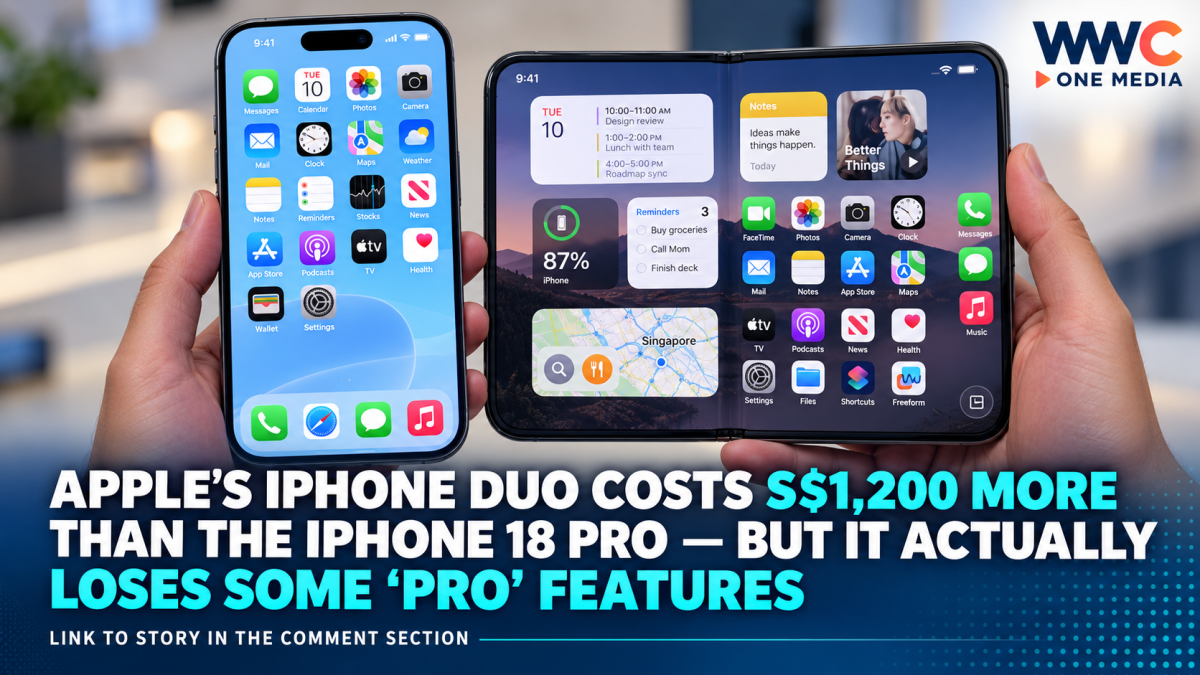
SINGAPORE — Apple has given premium iPhone buyers a problem they have never had before.
Spend S$1,899 on the new iPhone 18 Pro and get Apple’s most advanced conventional smartphone camera, Face ID, the new A20 Pro processor and up to 34 hours of video playback.
Or wait another month and spend at least S$3,099 on the first foldable iPhone, the iPhone Duo, which opens into a tablet-like 7.6-inch display and introduces an entirely new way to multitask on iOS.
The surprising part?
The phone that costs S$1,200 more does not automatically give you more of everything.
The iPhone Duo lacks the iPhone 18 Pro’s dedicated telephoto camera.
It does not get the Pro’s new variable-aperture main camera.
It uses Touch ID rather than Face ID.
And it gives up the Action button.
What the extra money buys is something Apple has never sold before:
two iPhone displays connected by a hinge.
That makes Apple’s 2026 flagship decision less about which phone is objectively “better” and more about which kind of premium experience buyers actually want.
The price gap is huge
Apple Singapore lists the 256GB iPhone 18 Pro at S$1,899.
The 512GB model costs S$2,199, while higher-capacity configurations extend to 2TB.
The iPhone 18 Pro Max starts at S$2,099 for 256GB and rises to S$2,399 for 512GB.
Then comes the Duo.
Apple’s first foldable begins at:
S$3,099 for 256GB.
S$3,399 for 512GB.
S$3,999 for 1TB.
And an extraordinary S$4,899 for 2TB.
At the entry level, therefore, choosing a Duo instead of an iPhone 18 Pro costs another S$1,200.
Even compared with the larger iPhone 18 Pro Max, the premium is still S$1,000.
That puts the Duo in a different pricing category from the conventional iPhone lineup.
In the United States, Apple starts it at US$1,999, making it the most expensive iPhone the company has ever launched. Reuters reported that analysts expect the price to confine much of the early demand to affluent enthusiasts and long-time Apple users attracted by the novelty of the company’s first foldable.
So what does S$3,099 actually buy?
The headline feature is impossible to miss.
Closed, the Duo has a 5.4-inch outer Super Retina XDR screen.
Open it and users get a 7.6-inch folding Super Retina XDR display, the largest display Apple has ever put on an iPhone. Both support ProMotion, Always-On functionality and up to 3,000 nits of peak outdoor brightness.
Apple has also applied a nano-texture treatment to the inner screen intended to reduce glare and make the fold crease less noticeable.
The design lets the device behave in several ways.
Use it closed like a compact smartphone.
Open it fully like a small tablet.
Partially fold it for hands-free video watching or FaceTime.
Or run two applications side by side using the new Split View functions built into iOS 27.
The Verge’s early assessment argues that this software integration may ultimately be more important than the physical hinge itself. Foldable Android phones have existed for years, but Apple controls both the hardware and iOS ecosystem, potentially making app switching, multitasking and display transitions feel more cohesive.
That is arguably the real product Apple is selling for S$3,099.
Not merely a folding screen.
A pocketable iPhone that can transform into something closer to an iPad mini.
Apple was seven years late to the foldable party
Samsung launched its first Galaxy Fold in 2019.
Since then, Huawei, Honor, Oppo, Xiaomi, Google and others have refined the category through multiple generations.
Apple waited.
That makes the iPhone Duo less revolutionary in hardware terms than Apple’s marketing might suggest.
Passport-style foldables already exist.
Flexible OLED displays already exist.
Hinges that can hold themselves at intermediate angles already exist.
Samsung even responded to Apple’s launch with a “Welcome to Foldables” campaign, emphasizing that it had been making these devices for years.
Yet Apple’s late arrival could also be deliberate.
The foldable market has spent years fixing its earliest problems—fragile displays, thick bodies, unreliable hinges, visible creases and awkward software.
Apple is entering only after many of those technologies have matured.
Reuters cited industry analysts expecting Apple to capture roughly a quarter of the foldable smartphone market despite entering years behind Samsung.
If that happens, it would follow a familiar Apple pattern.
The company was not first to MP3 players.
Not first to smartphones.
Not first to smartwatches.
And certainly not first to foldable phones.
Its strategy has often been to enter later and try to make the category easier for mainstream consumers to understand.
But the iPhone 18 Pro actually has the better camera
This is where Apple’s product hierarchy becomes unusual.
Normally, spending more moves buyers toward increasingly sophisticated hardware.
Not here.
The iPhone 18 Pro has three 48-megapixel rear cameras:
a main camera,
an ultra-wide camera,
and a dedicated telephoto camera.
The biggest addition this year is the new variable-aperture 48MP Fusion Main camera.
Its physical aperture can switch among f/1.48, f/1.8, f/2.8 and f/4.0.
That gives photographers far greater control over light and depth of field.
Opening the aperture helps in darker environments and can produce shallower depth of field.
Closing it increases the amount of a scene that remains in focus.
Apple has also added manual-style Pro controls for shutter speed, white balance and other settings while retaining automatic modes for users who simply want to point and shoot.
TechRadar described the variable-aperture camera and new Pro controls as the most significant improvements in the 18 Pro generation.
The Pro also offers a dedicated 48MP telephoto camera, supporting 4x optical telephoto and an 8x optical-quality option.
The Duo cannot match that.
The S$3,099 Duo has only two rear cameras
Apple equipped the Duo with a 48MP main camera and 48MP ultra-wide camera.
It can generate a 2x optical-quality crop from its main sensor, but there is no dedicated telephoto lens.
It also lacks the Pro’s variable aperture.
Tom’s Guide and TechRadar both highlighted those omissions when comparing Apple’s new models.
That makes the purchasing decision unusually clear for serious mobile photographers.
The iPhone Duo is Apple’s most expensive phone.
It is not Apple’s best camera phone.
The iPhone 18 Pro and 18 Pro Max retain that distinction.
The Duo instead uses its folding design to create different camera experiences.
For example, its outer display can show the person being photographed a live preview of the image.
Its “Kid Cue” feature displays animations on the exterior display to encourage children to look toward the camera.
And Smart Take can automatically recognize when everyone appears ready before capturing a photo.
Those features are clever.
They are different from having a telephoto camera.
The Duo even loses Face ID
Perhaps the stranger compromise is biometric authentication.
The iPhone 18 Pro uses Face ID, powered by Apple’s TrueDepth camera system.
The iPhone Duo instead brings Touch ID to a side button.
That is a notable reversal for Apple.
Face ID has been associated with premium iPhones since the iPhone X in 2017.
Tom’s Guide identified the absence of Face ID as one of the Duo’s most obvious compromises compared with the Pro range.
The likely engineering logic is straightforward.
Placing the full Face ID sensor array into a thin foldable body while maintaining multiple displays and minimizing screen interruptions would add complexity and thickness.
The Duo also includes an under-display FaceTime camera inside, allowing the large 7.6-inch screen to remain visually uninterrupted.
But the result is still unusual.
A S$3,099 iPhone asks buyers to return to fingerprint authentication.
The processor, however, is essentially Pro-class
Where Apple did not compromise is performance.
Both the iPhone Duo and iPhone 18 Pro use the A20 Pro chip.
Apple lists a six-core CPU, seven-core GPU with Neural Accelerators and dual 16-core Neural Engine on the Pro, while the Duo uses the same basic A20 Pro platform.
Apple says the CPU is up to 20% faster than the previous A19 Pro generation, while the GPU delivers up to 40% better performance along with improved efficiency.
The chip is manufactured on a 2-nanometer process and paired with vapor-chamber cooling in both flagship families.
That matters because Apple is increasingly designing its processors not merely around applications and games but around local artificial-intelligence workloads.
Siri AI is becoming part of the hardware pitch
Both phones ship into Apple’s new Siri AI era.
Apple says the upgraded assistant can maintain more conversational exchanges, understand personal context and interact with information visible on-screen.
For example, Siri can recognize contextual details in messages and help create calendar events, edit text or retrieve information relevant to a conversation.
Apple says many tasks are processed on-device, while more demanding requests can use its Private Cloud Compute infrastructure.
The A20 Pro’s Neural Engine is designed specifically to accelerate those workloads.
The Duo may have one natural advantage here.
Its larger inner display gives users more space to view AI results alongside the application they are using.
Apple has redesigned iOS 27 for the foldable so users can keep Siri visible while working across applications or use Split View to drag content between them.
That makes the Duo arguably less of a photography device and more of a productivity-and-multitasking experiment.
Battery life is more complicated than one number
CNA correctly notes strong battery performance for the Pro models.
Apple rates the iPhone 18 Pro for up to 34 hours of video playback.
The iPhone 18 Pro Max reaches 43 hours.
The Duo technically reaches an even higher 44 hours—but only when video is played on its smaller outer screen.
When users rely on the large folding inner display, Apple rates the device for 31 hours of video playback.
That distinction is important.
A foldable phone effectively has two battery-life personalities.
Use the small outside screen and it can be extremely efficient.
Open the larger display and power consumption increases.
Apple uses a dual-battery system inside the Duo, distributing battery cells across both halves of the folding chassis.
The company says wired fast charging can reach roughly 50% in around 20 minutes.
The 18 Pro can reach roughly 50% in around 15 minutes using a compatible 60W-or-higher adapter.
The Pro arrives first
There is also a practical timing difference.
The iPhone 18 Pro and 18 Pro Max become available in Singapore on September 18 after pre-orders began on September 12.
The iPhone Duo arrives much later.
Pre-orders begin October 16, with retail availability starting October 23.
That gives potential buyers more than a month to decide whether the novelty of the foldable is worth waiting for.
It also gives reviewers more time to answer questions that specifications cannot.
How noticeable is the crease after weeks of use?
How durable is the hinge long term?
How quickly will major third-party apps adapt to the new display?
Does the larger screen materially improve everyday productivity?
And does using two displays actually justify a S$1,200 premium?
Early hands-on coverage has generally praised Apple’s software integration and build quality, but long-term durability remains something no launch-day review can fully establish.
The Duo enters a small market
Foldables receive enormous media attention.
Their actual share of global smartphone sales remains relatively small.
Reuters reported that foldable smartphones are expected to account for less than 3% of global handset sales in 2026.
That helps explain the Duo’s S$3,099 price.
Apple does not need its first foldable to replace the conventional iPhone immediately.
It can sell the device as an ultra-premium showcase to customers willing to pay for something genuinely different.
Analysts cited by Reuters expect roughly six million units to be sold initially, supported by pent-up demand among Apple enthusiasts.
If successful, future generations could become thinner, cheaper and more mainstream.
The first Duo therefore looks less like the next default iPhone and more like Apple establishing an entirely new top tier above the Pro Max.
The missing iPhone 18 creates another reason to wait
There is another wrinkle.
Apple announced the iPhone 18 Pro and 18 Pro Max—but not the standard iPhone 18 at the same event.
CNA notes that Apple is still expected to introduce a less expensive regular iPhone 18 later, although Apple has not publicly provided its release date.
That leaves buyers with three different strategies.
Buy the 18 Pro now.
Wait until October for the Duo.
Or wait even longer for Apple’s cheaper standard model.
That third option could make sense for users who do not care about professional camera controls, telephoto photography or foldable multitasking.
Apple currently still sells the iPhone 17 from S$1,449, the iPhone Air from S$1,749 and iPhone 17e from S$1,099 in Singapore.
The gap between those prices and S$3,099 illustrates just how far Apple has stretched the iPhone portfolio.
One CNA storage point needs correcting
CNA also suggests that buyers can compensate for smaller physical storage with iCloud+, which is correct.
But its description of Apple’s subscription pricing needs clarification.
Apple Singapore charges:
S$1.48 per month for 50GB of iCloud+;
S$3.98 for 200GB;
and S$13.98 for 2TB.
Those plans provide cloud storage and iCloud features.
They do not include Apple TV and Apple Arcade.
The bundle that combines iCloud+, Apple TV, Apple Music and Apple Arcade is Apple One.
Apple One Individual costs S$23.95 per month, while the Family plan costs S$29.95.
That distinction matters when comparing the cost of buying more storage upfront against relying on recurring cloud subscriptions.
256GB may actually be enough for many buyers
CNA argues that 256GB “may not be enough” and calls 512GB the best compromise.
That is ultimately a usage judgment rather than a specification fact.
For someone recording large amounts of 4K or ProRes video, downloading large games or keeping an extensive local photo library, 512GB can be worthwhile.
For users who stream media and rely heavily on iCloud Photos, 256GB may remain perfectly adequate.
The cost jump is also substantial.
Moving from 256GB to 512GB on the iPhone 18 Pro raises the price from S$1,899 to S$2,199.
On the Duo, the same storage jump takes the price from S$3,099 to S$3,399.
There is no universally correct storage tier.
The decision depends on whether buyers prefer a one-time hardware expense or recurring cloud-storage costs.
The Pro is the traditional flagship
The iPhone 18 Pro follows the conventional premium-phone formula.
Better processor.
Better cameras.
Long battery life.
Fast display.
Familiar form factor.
Improved cooling.
It is not radically different from the iPhone 17 Pro, and TechRadar’s review describes the generation more as a strong refinement than a revolutionary redesign.
But that can itself be an advantage.
There is no new hinge to learn.
No radically different app layout.
No foldable-display durability question.
No unusual authentication compromise.
And the camera is more capable.
For users upgrading from an iPhone that is three or four years old, the difference in processor performance, battery life, camera quality and AI features could be substantial even if the external design feels familiar.
The Duo is the experiment
The iPhone Duo represents almost the opposite strategy.
Its specifications involve compromises.
But the device can do things the Pro physically cannot.
It can become a miniature tablet.
It can stand by itself for calls.
It can show one app beside another.
It can present camera previews to the person being photographed.
It will support the USB-C Apple Pencil later this year, taking the iPhone closer than ever to territory previously reserved for the iPad.
That is why comparing the Duo purely by camera count or price misses part of Apple’s argument.
The company is trying to create a new category inside its own ecosystem.
Reuters described the device as a US$1,999 question about who the product is actually for, noting that Apple must still prove whether the Duo’s ideal customer is a professional, entertainment-focused user, early adopter or simply someone who wants the most conspicuous new iPhone available.
That uncertainty may be the device’s greatest weakness.
It may also be what makes it interesting.
So who should choose which?
The answer becomes clearer once the marketing is stripped away.
The iPhone 18 Pro is built around maximizing the traditional smartphone experience.
Its advantages are:
a more advanced three-camera system,
variable aperture,
dedicated telephoto,
Face ID,
long battery life,
smaller and lighter everyday form,
and a dramatically lower entry price than the Duo.
The iPhone Duo is built around changing the form factor.
Its advantages are:
the 7.6-inch foldable screen,
Split View multitasking,
a compact 5.4-inch exterior display,
hands-free folding positions,
Apple Pencil support,
and camera experiences enabled by having a second screen.
They share A20 Pro-level performance and Apple’s latest AI platform.
The decision therefore comes down to what the buyer considers premium.
For photographers, creators and users who simply want the strongest conventional iPhone, the Pro has the clearer hardware proposition.
For early adopters who value screen space and multitasking more than telephoto photography or Face ID, the Duo offers something no previous iPhone can provide.
Apple’s most expensive iPhone is not its most complete iPhone
That may be the most interesting part of Apple’s 2026 lineup.
For years, higher price generally meant moving farther up a relatively predictable hierarchy.
More cameras.
More power.
More premium materials.
More capability.
The Duo breaks that logic.
At S$3,099, it costs 63% more than the S$1,899 iPhone 18 Pro at entry level.
Yet it gives up Face ID.
It gives up the telephoto camera.
It gives up variable aperture.
And it gives up some familiar Pro controls.
In exchange, Apple gives buyers the largest screen ever fitted to an iPhone and an entirely different style of computing.
That makes this year’s buying decision unusually simple in one sense.
If you want the best conventional iPhone, buy the Pro.
If you want the iPhone that feels least conventional, that is what the extra S$1,200 is paying for.




Leave a Reply