
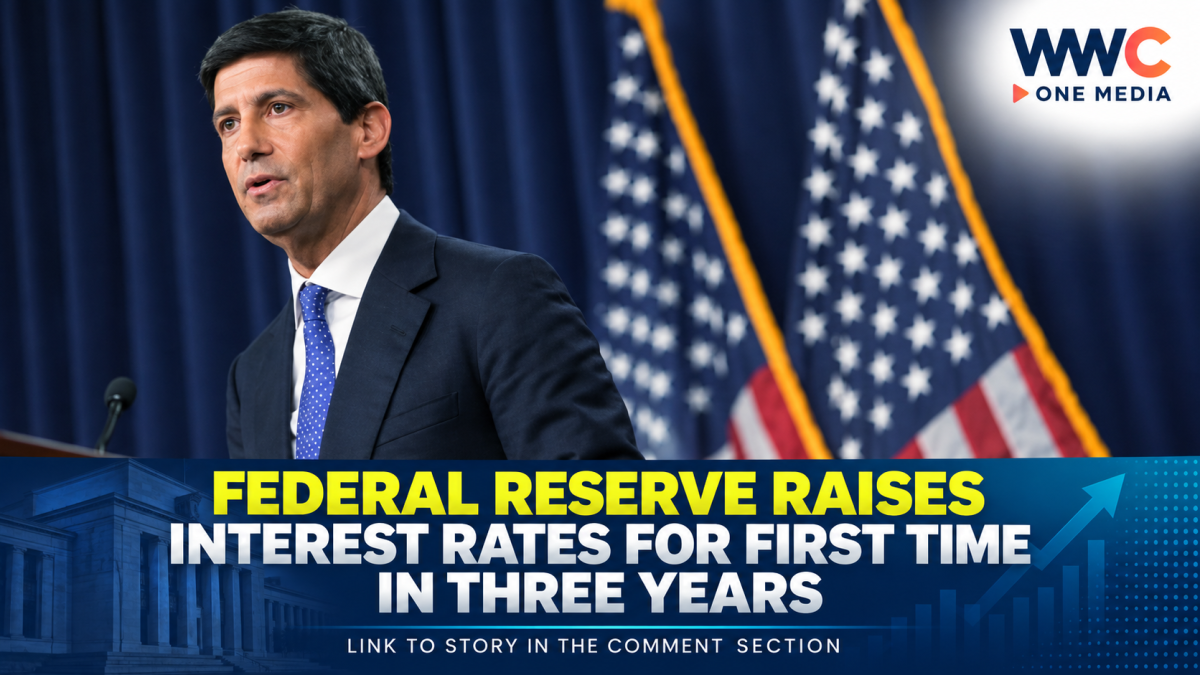
The US Federal Reserve raised its benchmark interest rate by a quarter percentage point on Wednesday, marking its first rate increase since 2023 as policymakers respond to persistent inflation and stronger economic activity.
The increase brings the federal funds rate to a range of 3.75% to 4%, equivalent to about 3.9%. The move could eventually increase borrowing costs for mortgages, car loans and credit cards.
Fed Chair Kevin Warsh said inflation remains above the central bank’s 2% target and has not been falling quickly enough to give policymakers confidence that price pressures are under control.
Warsh said the US economy had shown signs of strengthening since the Fed’s previous meeting in July, pointing to resilient consumer spending, solid job growth and strong investment. Higher energy prices linked to renewed conflict involving Iran have also added to inflation concerns.
The decision came despite President Donald Trump’s repeated calls for significantly lower interest rates. Trump has argued that borrowing costs should be reduced to support investment and economic activity and again called for rates of 1% or lower after the Fed’s announcement.
The Fed’s decision was unanimous, despite disagreements at its previous meeting. Policymakers also signalled that another increase could come before the end of the year.
Sixteen of the 18 officials who submitted economic projections indicated that they expected at least one additional rate increase this year, while four projected two more increases. The Fed’s projections put the policy rate at between 4% and 4.25% by the end of 2026.
The central bank also raised its inflation forecast. Inflation measured by the Fed’s preferred gauge is now expected to reach 3.7% this year, while officials do not expect it to return to the 2% target until 2029.
The decision has broader implications for American households, which are already facing elevated costs for housing, food and fuel. Higher interest rates can make borrowing more expensive, although they can also provide better returns for savers.
Financial markets reacted quickly to the announcement, with the US dollar strengthening and short-term Treasury yields rising as investors assessed the possibility of further rate increases.
The Fed is scheduled to meet again in late October. Its next policy decisions will depend on incoming data, particularly inflation, employment, consumer spending and developments in energy prices.



Leave a Reply