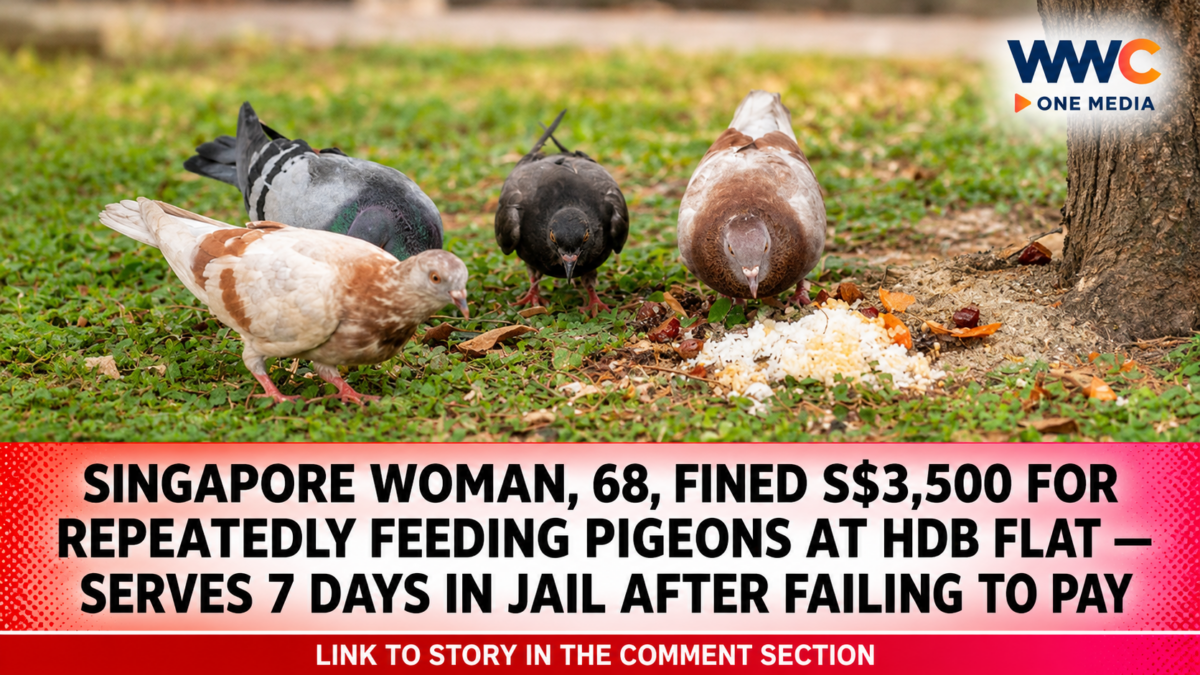
A 68-year-old woman in Singapore has been fined S$3,500 after repeatedly feeding wild pigeons around her HDB neighbourhood despite years of warnings, enforcement action and earlier penalties. When she did not pay the latest fine, she served seven days in jail instead.
The woman, identified in Chinese-language media reports by the transliterated name Chen Qingzhu, faced seven charges under Singapore’s Wildlife Act. She pleaded guilty to three charges, while the remaining four were taken into consideration during sentencing on November 4, 2026.
Her repeated feeding of pigeons with rice and bread attracted large numbers of birds to her flat, with droppings and other disturbances affecting neighbours living above and below her.
The case highlights Singapore’s increasingly strict approach to illegal wildlife feeding, particularly in residential estates where food left for birds can create persistent hygiene problems for surrounding households. Lianhe Zaobao+1
Years of Warnings Failed to Stop the Pigeon Feeding
Court proceedings revealed that Chen had a lengthy history of warnings and penalties for feeding wild pigeons.
The authorities first warned her on September 25, 2017, after she was found repeatedly feeding wild pigeons illegally.
But the warnings did not stop the behaviour.
In June and September 2018, she received composition fines of S$200 and S$400 respectively for further offences. In October 2019, she committed two more violations and was fined another S$400.
She subsequently received stern warnings on March 31, 2021, and January 8 and 21, 2022.
Despite those interventions, authorities continued receiving reports about pigeon-feeding activity around her residence.
The history was important to the case because it showed that the latest offences were not an isolated incident. Lianhe Zaobao+1
Pigeons Flew Into Her Flat and Droppings Affected Neighbours
The problem extended beyond the woman feeding birds outside her home.
Residents living above and below her unit complained that wild pigeons were repeatedly flying into her flat, while the birds’ droppings and presence disrupted their daily lives.
A town council cleaner also reported seeing Chen feeding pigeons on several occasions.
In densely populated HDB estates, feeding birds can attract flocks to common areas, windows, balconies and nearby rooftops. Droppings can soil laundry, walkways and building surfaces, creating additional cleaning work and discomfort for neighbours.
A similar neighbourhood dispute was reported in Serangoon in May 2026. Residents said a neighbour’s alleged pigeon-feeding activities had attracted large flocks to the block, leaving droppings on clothes-drying racks, windows and common areas.
The National Parks Board (NParks) explained in that case that rock pigeons are a non-native species in Singapore. Their tendency to gather and roost in large numbers can create soiling and hygiene problems, particularly when food is readily available. AsiaOne+1
She Was Caught Again Near Block 755 Yishun Street 22
On August 3, 2025, an enforcement officer conducting surveillance near Block 755 Yishun Street 22 spotted Chen scattering rice on the ground to feed pigeons.
The officer approached her immediately and instructed her to stop.
However, according to the court report, she continued the behaviour.
Between January 23 and June 30, 2026, she was caught feeding wild pigeons with rice or bread on six additional occasions.
Those incidents formed part of the seven charges brought against her. She admitted to three, while the remaining four were considered by the court when determining the sentence.
The repeated detections also demonstrate that enforcement action can continue after earlier warnings and composition fines have failed to change an offender’s behaviour. Lianhe Zaobao+1
Why She Received S$3,500 in Fines and Seven Days in Jail
Chen was fined S$3,500 on November 4, 2026.
However, according to the Integrated Case Management System information cited in the report, she did not pay the fine and instead served seven days’ imprisonment in default.
It is important to distinguish between the sentence and the default arrangement: the court imposed a monetary penalty, and the seven-day jail term followed because the fine was not paid.
The sentence also reflects the repeated nature of the offending, rather than a single incident of someone casually feeding birds.
The case is another warning that ignoring repeated enforcement action can result in more serious consequences when the matter reaches court. Lianhe Zaobao+1
Singapore Has Increased Penalties for Feeding Wildlife
Singapore’s Wildlife Act prohibits intentionally feeding wildlife without written approval from the Director-General.
Under the revised penalties that took effect on July 1, 2026:
- First conviction: A fine of up to S$10,000.
- Second or subsequent conviction: A fine of up to S$20,000, imprisonment of up to 12 months, or both.
The revised penalties were introduced to strengthen deterrence against repeated wildlife feeding.
The timing matters in Chen’s case: the six incidents reported between January and June 2026 occurred before the revised penalties took effect. The new maximum penalties should therefore not be casually presented as the punishment imposed in her case.
The S$3,500 fine was the actual penalty reported by the court coverage. Singapore Statutes Online+2
Pigeon Feeding Cases Are Becoming a Recurring Problem in Singapore
Chen’s case is not the only recent example of residents repeatedly feeding birds despite warnings.
In February 2026, a 71-year-old woman, Sanmugamnathan Shamla, was fined S$3,200 after feeding pigeons nine times in Toa Payoh over approximately six months.
She had previously been fined S$1,200 in May 2025 and had given an undertaking to the court that she would not repeat the offence. Prosecutors said she resumed feeding pigeons within a month of that conviction.
In May 2026, another woman, aged 64, was fined S$6,500 after repeatedly feeding pigeons despite warnings. She also gave false particulars to NParks officers and attempted to evade them when they approached her.
In September 2026, a 78-year-old woman was fined S$9,200 after repeatedly feeding wildlife in Bukit Batok and using criminal force against an enforcement officer.
These cases show that Singapore’s courts are dealing with repeated wildlife-feeding offences involving people of different ages and circumstances. CNA+2
NParks Says Pigeons Create Hygiene and Public Health Concerns
NParks has explained that rock pigeons are a non-native species that can gather in large numbers around residential areas when food is readily available.
Their droppings can soil buildings, public spaces and household laundry. Large flocks can also create persistent noise and cleaning problems for residents.
Authorities use several approaches to manage pigeon populations, including:
- Reducing accessible food sources.
- Modifying habitats to discourage roosting.
- Managing pigeon populations.
- Monitoring locations where illegal feeding is repeatedly reported.
- Conducting enforcement and public education.
NParks has also urged residents to dispose of food scraps properly and avoid feeding wild birds.
The agency’s approach is not based on enforcement alone. Reducing food sources is central to controlling the number of pigeons attracted to residential estates. AsiaOne+2
Singapore’s Wider Cleanliness Campaign Also Targets Everyday Behaviour
The pigeon-feeding case is part of a broader effort to protect shared residential and public spaces.
WWC ONE MEDIA has previously reported on hundreds of crows gathering in Tampines as residents complain about noise and bird droppings. The report illustrates how readily available food and suitable roosting locations can create persistent bird-related problems for neighbourhoods.
Another report examined Singapore’s warning against rummaging through public rubbish bins for refundable drink-container deposits, highlighting the importance of proper waste handling and maintaining public hygiene.
Singapore’s tray-return policy is another part of this effort. Read WWC ONE MEDIA’s coverage of the decline in enforcement cases under the tray-return rule.
The wider enforcement picture is also covered in Singapore’s falling littering fines and declining rat-burrow numbers.
These issues are different offences, but they share a common concern: individual actions can create problems for entire neighbourhoods when shared spaces are not properly maintained.
What HDB Residents Should Know Before Feeding Birds
Residents who want to help birds should understand that feeding wild pigeons without the required written approval is prohibited in Singapore.
Leaving rice, bread or other food outdoors can attract more birds than expected, particularly in residential estates where food sources and sheltered roosting areas are readily available.
Residents can help reduce the problem by:
- Avoiding the feeding of wild pigeons and other wildlife.
- Disposing of food scraps in proper rubbish bins.
- Keeping common areas and corridors free from leftover food.
- Reporting persistent illegal feeding to the relevant authorities or town council.
- Cooperating with NParks and town councils when they conduct monitoring or population-management measures.
For residents dealing with recurring pigeon problems, the issue should be reported through the appropriate channels rather than handled through confrontations with neighbours.
A S$3,500 Fine Ends in Seven Days Behind Bars — But the Neighbourhood Problem Remains
The case involving Chen Qingzhu demonstrates how repeated warnings may not be enough to stop illegal wildlife feeding.
Her actions attracted pigeons to her HDB flat, created problems for neighbours and continued despite years of warnings and earlier financial penalties.
The court ultimately imposed a S$3,500 fine. Because she did not pay, she served seven days in jail instead.
But the wider challenge for Singapore is not simply punishing individual offenders. It is reducing the food sources that attract large flocks, protecting residential hygiene and encouraging residents to respect the shared spaces around their homes.
For HDB communities, the message is clear: feeding pigeons may appear harmless, but when it attracts large numbers of birds and affects neighbours, it can become a costly legal problem.