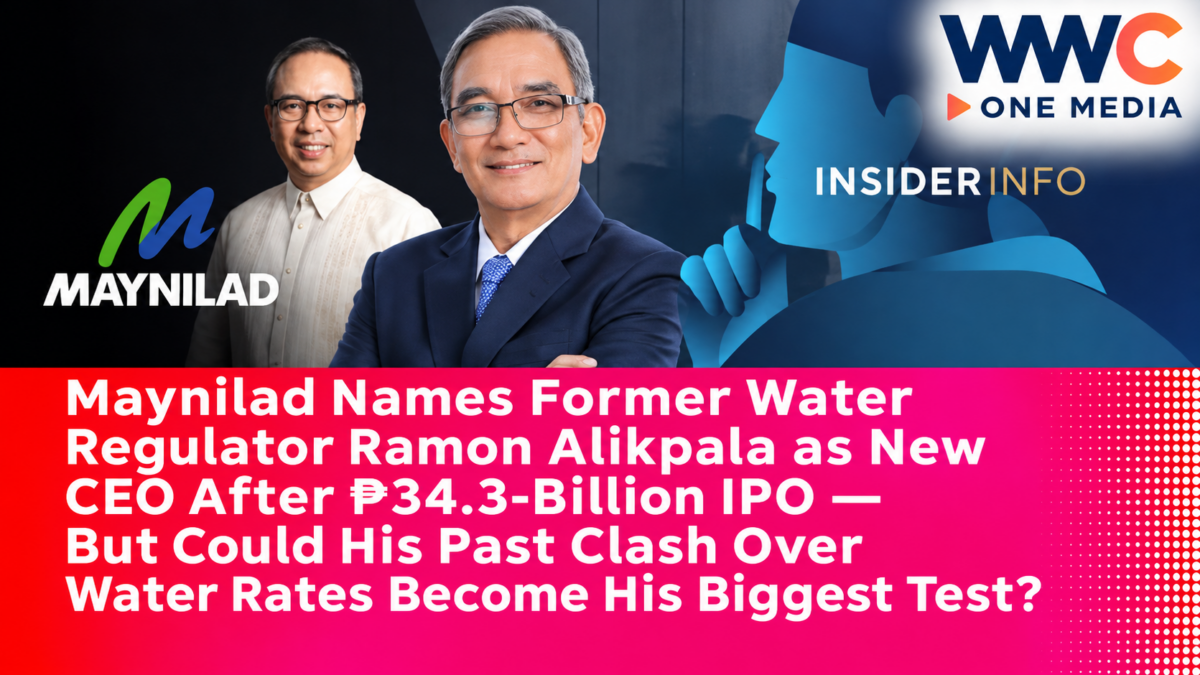
MANILA, PHILIPPINES — One of the Philippines’ largest water utilities is preparing for a major leadership transition as Maynilad Water Services Inc. names former government water regulator Ramon B. Alikpala as its next president and chief executive officer, replacing longtime executive Ramoncito S. Fernandez.
The appointment takes effect on January 1, 2027, marking the end of Fernandez’s 11-year tenure and the beginning of a new chapter for the Manuel V. Pangilinan-led water concessionaire.
But the leadership change carries an unusual twist.
Alikpala previously chaired the Metropolitan Waterworks and Sewerage System (MWSS), the government agency overseeing Metro Manila’s major water concessionaires, during a contentious regulatory dispute involving Maynilad’s proposed water-rate increases.
Now, the former regulator will be responsible for running the very company whose tariff proposals he once scrutinized.
The transition comes one year after Maynilad’s landmark ₱34.3-billion initial public offering, which brought the utility onto the Philippine Stock Exchange.
It also coincides with a major infrastructure expansion, improved water-distribution efficiency and renewed concerns about water security as the country prepares for potentially severe dry conditions.
According to InsiderPH’s November 5 report, the leadership change was confirmed through a stock-exchange filing, following the outlet’s earlier November 3 report identifying Alikpala as Fernandez’s likely successor.
As Maynilad prepares to serve millions of customers under new leadership, can Alikpala balance affordable water rates, investor expectations and multibillion-peso infrastructure spending—or will the same regulatory disputes that shaped his government career become his biggest challenge as CEO?
Ramon Alikpala to Take Over Maynilad on January 1, 2027
Maynilad’s leadership transition will formally begin at the start of 2027.
Incoming president and CEO Ramon B. Alikpala will succeed Ramoncito S. Fernandez, who has led the company since January 2016.
The announcement confirms an earlier InsiderPH report published on November 3, which identified Alikpala as the likely successor.
Fernandez’s retirement ends a period in which Maynilad expanded its infrastructure, strengthened its operations and completed one of the Philippines’ largest recent stock-market listings.
Alikpala, meanwhile, brings extensive experience in government water regulation, infrastructure policy and international development.
His appointment creates a potentially important change in perspective.
Rather than coming exclusively from the commercial side of the utility industry, Maynilad’s next chief executive has spent substantial time evaluating water management from a regulatory and public-policy standpoint.
That background could influence how the company approaches tariffs, investment requirements, environmental sustainability and service reliability.
However, the appointment itself does not establish that Maynilad will change its tariff policy or its existing investment commitments.
Those decisions will depend on management, the board, regulatory requirements and prevailing operating conditions.
Who Is Ramon ‘Dondi’ Alikpala?
Ramon B. Alikpala, also known as Dondi Alikpala, is a former senior government water official with experience in both Philippine and international water-management institutions.
He served as executive director of the National Water Resources Board, an important government body involved in water-resource administration and regulation.
He also chaired the MWSS board of trustees during the administration of former President Benigno Aquino III.
Beyond government service, Alikpala headed FutureWater Asia and held leadership positions in regional water organizations.
His professional background includes involvement with the ASEAN Working Group on Water Resources Management and the Philippine Water Partnership.
He has also provided advisory services connected with the Asian Development Bank, the United States Agency for International Development and Germany’s GIZ.
Those assignments involved issues such as water security, climate resilience, utility performance and infrastructure management.
Academically, Alikpala holds a degree in business economics from the University of the Philippines and an MBA in finance from Fordham University in New York.
He has also undertaken professional training at the London School of Economics and World Bank Institute.
For Maynilad, the combination of regulatory, financial and infrastructure experience may prove useful as the company balances public-service obligations with the expectations of shareholders.
The Surprising History: Alikpala Once Opposed Maynilad’s Water-Rate Increase
One of the most interesting elements of the leadership change dates back to 2013.
At the time, Alikpala chaired the MWSS board during a dispute over proposed water-rate adjustments by Metro Manila’s concessionaires.
The regulator rejected Maynilad’s requested increase, with the treatment of corporate income taxes among the disputed issues.
The disagreement involved whether certain tax expenses should be passed on to water consumers through regulated tariffs.
The issue became part of a broader national debate over the fairness and transparency of private water concessions.
More than a decade later, Alikpala is preparing to lead Maynilad itself.
That reversal gives his appointment considerable significance.
As a regulator, he was responsible for protecting public interests within the applicable legal framework.
As chief executive, he will be expected to manage the utility’s operations, financial performance, investment program and customer service.
The roles are different, although both involve water-sector policy and governance.
It would be inaccurate to assume that Alikpala has abandoned his previous regulatory views merely because he has accepted a corporate leadership position.
His future decisions will provide stronger evidence of how he intends to manage that balance.
Ramoncito Fernandez Retires After 11 Years at the Helm
Outgoing president and CEO Ramoncito S. Fernandez has spent decades working within the First Pacific and MVP corporate group.
Before taking over Maynilad in January 2016, Fernandez held senior positions in telecommunications, infrastructure and toll roads.
He previously led Metro Pacific Tollways Corporation from 2009 to 2015.
That role placed him at the center of major expressway operations and development projects.
He also held assignments involving PLDT and Smart Communications.
At Maynilad, Fernandez oversaw an extensive infrastructure investment program.
His tenure included efforts to improve wastewater management, reduce distribution losses, strengthen treatment facilities and expand access to reliable water service.
The company also navigated significant political and regulatory disputes during his leadership.
Perhaps his most visible recent corporate milestone was Maynilad’s November 2025 stock-market debut.
Fernandez Oversaw Maynilad’s ₱34.3-Billion IPO
Maynilad raised approximately ₱34.3 billion through its November 2025 initial public offering.
According to Reuters, the transaction was the Philippines’ largest stock-market listing since 2021.
The company began trading on the Philippine Stock Exchange under the ticker symbol MYNLD.
Its shares were offered at ₱15 apiece.
The listing attracted major institutional investors, including the International Finance Corporation and the Asian Development Bank.
The offering helped Maynilad raise capital to support water and wastewater infrastructure development.
It also subjected the company to additional public-market disclosure and shareholder expectations.
For Fernandez, the listing represented an important milestone following years of operational investment.
For Alikpala, it creates a different corporate environment.
Unlike a utility operating entirely outside the public stock market, Maynilad must now balance regulated service obligations with the expectations of public shareholders.
That includes communicating financial results, infrastructure spending, risks and business performance clearly.
Maynilad’s Financial Performance Strengthens Ahead of the Transition
The new leadership team will inherit a company reporting improvements in profitability and operating efficiency.
In its first-nine-month 2026 results, Maynilad reported ₱12.6 billion in net income, up approximately 10.2% from the previous year.
Revenue increased 3.5% to ₱28.6 billion.
Earnings before interest, taxes, depreciation and amortization rose approximately 5.1% to ₱20.1 billion.
The company’s EBITDA margin improved to 70.3%, from 69.2%.
Higher billed water volume, customer growth and better network efficiency helped support the results.
Maynilad also benefited from lower interest expenses and increased interest income.
This distinction matters because not all profit improvement came exclusively from higher water sales or stronger operations.
Some of the earnings growth reflected financing-related factors.
The company will need to demonstrate that its operational gains remain sustainable as capital spending continues.
Reducing Water Losses Will Be One of Alikpala’s Biggest Tests
Water lost before it reaches paying customers remains one of the most important challenges facing large distribution utilities.
These losses are commonly measured through non-revenue water, or NRW.
NRW can include physical leaks, unauthorized consumption and inaccuracies in measuring or billing water.
Maynilad reported that its NRW ratio improved to 29.3% as of September 2026, from 32.8% a year earlier.
The improvement means the utility is capturing more value from the water entering its distribution system.
It also reduces pressure on existing raw-water resources.
The company’s earlier disclosures showed that water losses had fallen by more than 150 million liters per day between June 2025 and June 2026.
That recovered volume was equivalent to the daily water requirements of approximately 770,000 people, based on the company’s comparison.
However, the equivalence is not proof that 770,000 new customers were connected to the system.
Reducing water losses remains a continuous task.
Pipes age, infrastructure conditions change and new leaks can develop.
For Alikpala, sustaining these improvements will be a major measure of operational performance.
Maynilad Invests Nearly ₱10 Billion in La Mesa Water Infrastructure
The leadership change also comes during a significant infrastructure rehabilitation program.
Maynilad recently disclosed nearly ₱10 billion in completed and ongoing improvements at its La Mesa water-treatment facilities.
The investment program is intended to strengthen water treatment, recovery operations and storage capacity.
WWC ONE MEDIA examined these developments in Maynilad Invests Nearly ₱10 Billion to Strengthen La Mesa Water Supply — But Will It Be Enough to Avoid Another El Niño Water Crisis?.
The report detailed upgrades to treatment facilities and raw-water recovery systems.
Maynilad’s planned improvements include additional water-recovery capacity and expanded storage infrastructure.
However, the nearly ₱10-billion figure describes a multiyear program.
It is not an entirely new allocation approved in October 2026.
Some projects have been completed, while others remain under development.
Alikpala will need to oversee the continued implementation of these investments and their effect on service reliability.
El Niño Could Become the New CEO’s First Major Challenge
Water security is expected to remain an important issue for Metro Manila.
The prospect of prolonged dry conditions associated with El Niño has renewed concerns about reservoir levels and raw-water availability.
Maynilad relies heavily on the Angat-Ipo water system, although it has developed alternative supply sources.
Low reservoir levels can make water allocation and treatment more challenging.
WWC ONE MEDIA previously covered government preparations in Six Water Treatment Plants Readied as Philippines Braces for Super El Niño.
The report examined plans to increase treatment capacity available to Metro Manila’s water concessionaires.
The six planned facilities were expected to provide a combined additional treatment capacity of approximately 452 million liters per day.
However, treatment capacity and guaranteed water supply are different measurements.
A facility cannot operate at its maximum capacity without sufficient raw water.
For Maynilad, the challenge involves ensuring that water sources, treatment facilities and distribution systems operate effectively together.
Alikpala’s experience in water-resource management could be particularly relevant.
But no leadership appointment can eliminate drought risk.
Customers Want Reliable Water, Not Just Stronger Profits
Maynilad serves approximately 10.5 million people across its concession area.
Its customers include households, commercial establishments, industrial facilities and public institutions.
For most customers, the importance of the company’s leadership change will be measured through everyday service.
Water pressure, service continuity, drinking-water quality and responses to interruptions matter more directly to households than executive appointments.
WWC ONE MEDIA previously covered the practical challenges in Water Alert: Parts of Metro Manila and Cavite to Go Without Water This Week — Is Your Barangay on the List?.
That article documented scheduled maintenance-related interruptions and the importance of checking official service advisories.
Temporary interruptions do not necessarily indicate a wider water shortage.
They may result from pipe repairs, preventive maintenance or equipment upgrades.
But interruptions demonstrate the importance of infrastructure reliability and effective customer communication.
The next Maynilad administration will be evaluated partly on its ability to minimize avoidable disruptions while maintaining essential rehabilitation work.
Water Rates Could Remain a Sensitive Issue
Water tariffs are among the most politically sensitive aspects of operating a public utility.
Maynilad must recover the costs of providing safe and reliable service while complying with its concession agreement and regulatory requirements.
Infrastructure investment can require substantial funding.
At the same time, customers are concerned about affordability.
Alikpala’s regulatory history makes this issue especially important.
His participation in the 2013 rate dispute provides relevant background, but it does not establish what tariff position he will take as CEO.
Water rates are subject to the applicable regulatory framework.
They cannot be changed solely through a new chief executive’s personal preference.
It would therefore be misleading to claim that Maynilad’s leadership transition automatically means higher or lower household water bills.
Customers should rely on approved tariff schedules and official notices rather than speculation about the appointment.
The Consunji Group and Japanese Investors Have a Stake in Maynilad’s Future
Maynilad’s shareholder structure includes interests associated with the Metro Pacific group, the Consunji family’s DMCI Holdings and Japan’s Marubeni.
The company’s performance therefore has implications beyond its direct water operations.
For investors, regulated utilities can offer exposure to essential services that remain in demand throughout economic cycles.
But the business also involves significant infrastructure costs, regulatory obligations and environmental risks.
WWC ONE MEDIA examined the wider governance responsibilities of Maynilad’s shareholders in DMCI Group Bags Seven Golden Arrows as First-Half Profit Rises 26% — But Can the Consunji-Led Conglomerate Sustain Its Governance Record?.
That report discussed the importance of oversight across the group’s different investments, including its exposure to water utilities.
For Maynilad, governance and transparency have become especially important following its public listing.
Its next chief executive must manage the interests of customers, regulators, employees and shareholders without treating any one group as the company’s only stakeholder.
Public Service and Corporate Governance Must Work Together
Maynilad’s legislative franchise and concession arrangements establish important obligations.
These include responsibilities related to water service, wastewater management and infrastructure investment.
The company cannot be evaluated only through financial profitability.
Its performance must also be considered in terms of public-service outcomes.
The new CEO will be responsible for overseeing a business that plays a critical role in the daily lives of millions of residents.
That includes responding to changes in climate conditions, water availability, population growth and demand from commercial customers.
It also requires continued investment in wastewater services and environmental protection.
The challenge is to build a financially sustainable utility while delivering reliable and reasonably priced essential services.
Manila Water Faces Similar Infrastructure Challenges
Maynilad’s East Zone counterpart, Manila Water, also operates within a complex infrastructure environment.
Both companies must maintain extensive distribution networks while coordinating with government agencies and major construction projects.
WWC ONE MEDIA previously covered one example in Metro Manila Subway Is Already 60% Complete — But These Underground Pipes Still Have to Get Out of Its Way.
The report examined Manila Water’s work to relocate important utility infrastructure affected by subway construction.
Although that project is separate from Maynilad’s operations, it demonstrates the complexity of operating water systems in a rapidly developing metropolitan area.
Large utilities must protect service reliability while coordinating construction, repairs and system expansion.
That operational challenge will remain central to Maynilad under its next leadership team.
Christopher Jaime Lichauco Provides Operational Continuity
Maynilad’s existing management team will remain important during the transition.
Chief Operating Officer Christopher Jaime T. Lichauco has extensive experience in the company’s operations.
He assumed the COO position in September 2025 after serving in other operational and customer-service leadership roles.
His responsibilities involve maintaining the company’s water and wastewater services.
The presence of an experienced operating executive may help support continuity as Alikpala assumes the chief executive role.
However, operational continuity will depend on the company’s actual management arrangements and decisions following the transition.
The leadership change does not automatically imply a wholesale restructuring of Maynilad’s senior management.
No such broad organizational overhaul has been established in the reporting reviewed.
Three Critical Questions Facing the Incoming CEO
First, can Maynilad continue reducing water losses?
The company’s improvement to a 29.3% NRW ratio is significant, but keeping losses down requires sustained investment in pipes, monitoring and maintenance.
Second, can the utility maintain reliable service during severe dry conditions?
Infrastructure upgrades and alternative sources provide greater flexibility, but drought and raw-water constraints remain important risks.
Third, can Alikpala balance shareholder returns with public-service obligations?
Maynilad is now publicly listed and must satisfy investors while operating within a regulated utility framework.
Those three issues will shape how customers, regulators and shareholders assess the new administration.
The Bigger Picture: A New CEO Faces a Very Different Maynilad
Ramoncito Fernandez is leaving a utility that has changed substantially during his tenure.
Maynilad completed a landmark ₱34.3-billion IPO.
It expanded infrastructure investment.
It improved water-distribution efficiency.
And it entered the public stock market with a stronger obligation to provide transparent financial reporting.
Ramon Alikpala will inherit those achievements.
But he will also inherit unresolved challenges involving water security, distribution efficiency, infrastructure costs and tariff regulation.
His experience as a former water regulator gives him an unusual perspective on the responsibilities of a major private concessionaire.
The question is how that experience will influence his decisions as a corporate leader.
For the millions of Filipinos relying on Maynilad’s services, the ultimate test will not be the size of its IPO or the reputation of its executives.
It will be whether the company can continue delivering dependable, safe and affordable water.
As Ramon Alikpala prepares to replace Ramoncito Fernandez after Maynilad’s landmark ₱34.3-billion stock-market debut, can the former regulator protect consumers while sustaining multibillion-peso infrastructure growth—or will rising costs, water-rate disputes and the threat of El Niño define his first years as CEO?