SYDNEY, AUSTRALIA / MANILA, PHILIPPINES — November 5, 2026 | WWC ONE MEDIA | Global Agriculture, Wheat Prices, Climate and Food Security
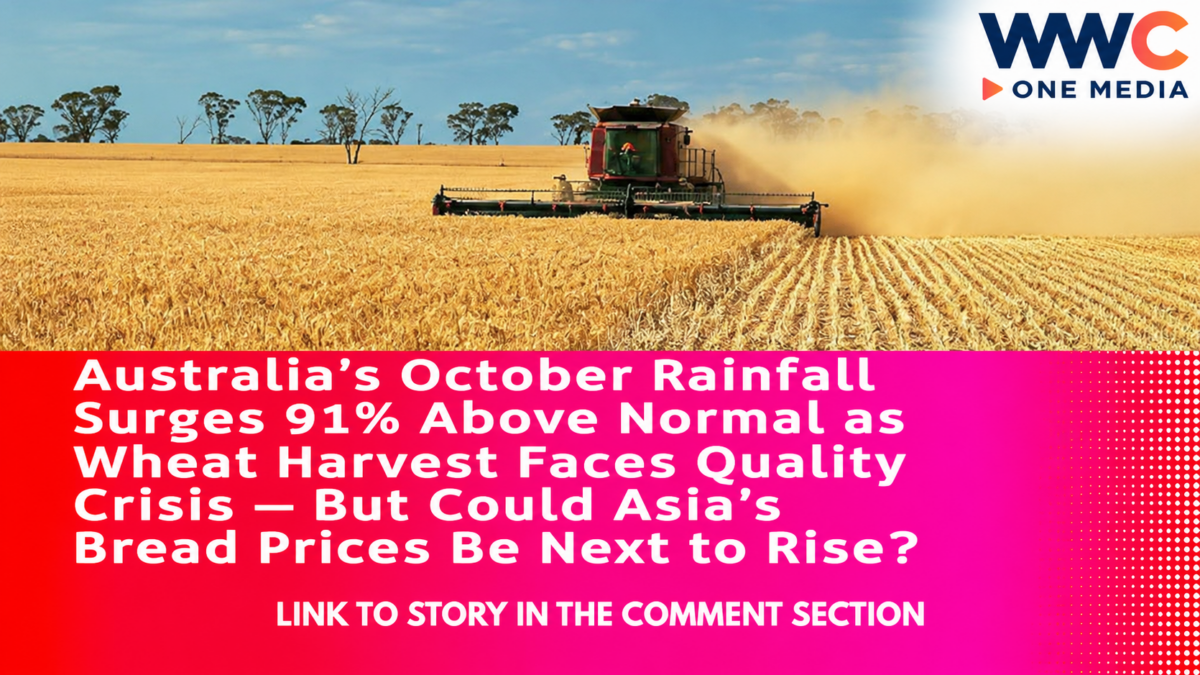
Australia’s grain industry is facing a growing harvest emergency after one of the wettest Octobers on record disrupted farming operations, threatened the quality of wheat and barley, and raised fresh concerns about the country’s ability to supply premium grain to international buyers.
The Australian Bureau of Meteorology confirmed that nationwide rainfall during October 2026 was 91% above the historical average, making it Australia’s ninth-wettest October since national rainfall records began in 1900.
The unusually heavy rainfall has arrived at a critical time for farmers harvesting winter crops.
Across Queensland and northern New South Wales, wet fields have forced harvesting machinery to stop, delayed grain deliveries and increased the risk that mature wheat and barley will lose their commercial quality.
According to Bloomberg’s November 4 report, Australia’s Heavy October Rainfall Sparks Grain Quality Concerns, the weather threatens to complicate an agricultural season already marked by unpredictable conditions and rising international demand for Australian grain.
Additional reports from Australia’s Department of Agriculture, the Commonwealth Bank of Australia, Cargill and Grain Central confirm that the immediate concern is not simply how much grain farmers can produce.
It is how much of that grain will meet the quality standards required by flour mills and international buyers.
The disruption comes as wheat-importing countries in Asia and the Middle East increasingly seek alternatives to grain shipments affected by the Russia-Ukraine war.
With international food markets already vulnerable to geopolitical disruptions, Australia’s harvest problems could have consequences beyond its borders.
The critical question is whether Australian farmers can recover their crops before further deterioration occurs — or whether another weather shock could tighten supplies of premium wheat and intensify food-price pressures across Asia.
Australia Records Its Ninth-Wettest October as Harvest Problems Spread
Australia’s Bureau of Meteorology issued its October climate summary on November 2, confirming an exceptionally wet month.
Rainfall was above average across most of the country, with Tasmania and some mainland areas among the exceptions.
Queensland, the Northern Territory and South Australia experienced particularly widespread above-average conditions.
The national rainfall total was 91% higher than the 1961–1990 average.
That figure measures the country’s area-averaged rainfall, rather than rainfall at every individual farm.
Some regions experienced intense storms, while others received more moderate precipitation.
For farmers, however, the timing of the rain has become as important as the amount.
Winter crops that are still developing can benefit from additional soil moisture.
But grain that has already matured can deteriorate if it remains exposed to prolonged wet conditions.
The result is an agricultural contradiction: rainfall that improves growing conditions for some producers can simultaneously damage the commercial prospects of others.
Queensland and New South Wales Farmers Face Serious Grain-Quality Risks
The disruption has been especially pronounced in southern Queensland and northern New South Wales.
Australia’s Department of Agriculture reported that storms brought substantial rainfall to these cropping regions during the final weeks of October.
Some locations received between 15 and 200 millimeters during the week ending October 28.
The department warned that further rainfall could delay winter crop harvesting and increase the risk of quality downgrades.
Industry reporting has already documented deteriorating conditions in some northern grain-producing districts.
Grain Central reported that certain farmers were harvesting wheat and barley with moisture contents as high as 17%.
That compares with a maximum moisture content of around 12.5% for deliveries into some bulk-handling systems.
The difference is commercially important.
Grain that contains excessive moisture may require drying before it can be stored safely or accepted by buyers.
If it remains wet for too long, it can begin to sprout, develop mold or lose weight and quality.
For farmers, each delay can increase costs and reduce the price their crops command.
Why Heavy Rain Can Turn Premium Wheat Into Lower-Value Grain
Wheat is not traded as a single uniform commodity.
Buyers evaluate grain according to characteristics including protein content, moisture, test weight, cleanliness and suitability for milling.
Higher-quality wheat can command a premium because it is suitable for products such as bread, noodles and other flour-based foods.
When mature grain is exposed to prolonged rainfall, some of these characteristics can deteriorate.
One major problem is pre-harvest sprouting.
If wheat begins germinating while still in the field, changes in enzyme activity can make it less suitable for certain types of flour production.
Grain may then be downgraded from premium milling classifications to lower-value categories.
Other problems include reduced test weight, discoloration, weather damage and higher drying expenses.
Farmers may still be able to sell affected grain, but often at a discount.
The consequence is that a large harvest does not necessarily translate into strong financial returns.
A producer can deliver substantial volumes while earning less than expected if buyers downgrade the quality.
Commonwealth Bank Warns Rain Could Damage Winter Crops
The Commonwealth Bank of Australia’s agricultural research team has also warned about the consequences of continued wet weather.
Agricultural economist Dennis Voznesenski said heavy rainfall was creating difficult conditions for farmers preparing to harvest winter crops.
The bank cautioned that additional rain could lead to quality downgrades.
However, the bank identified a contrasting benefit for Australia’s livestock industry.
The same rainfall has improved pasture conditions and supported cattle prices.
Commonwealth Bank reported that young cattle prices increased 3.3% during one weekly period, while heavy steer prices gained 2.1%.
The figures demonstrate why unusually wet weather does not produce the same economic outcome across every agricultural sector.
Livestock producers may benefit from stronger pasture growth.
Summer-crop growers may welcome improved soil moisture.
But wheat, barley and chickpea producers whose crops are ready for harvesting may face increasingly serious difficulties.
Australian Grain Deliveries Slow as Farmers Struggle to Reach Storage Facilities
The effects of the rain are also visible in grain logistics.
Grain Central reported on October 30 that harvesting activity across eastern Australia had developed more slowly than usual.
Only one of the country’s three major bulk-grain handlers had begun publishing regular harvest reports at that stage.
Bunge reported receiving approximately 290,855 tonnes of grain into its South Australian and western Victorian storage network.
Meanwhile, heavy rain and difficult road conditions were slowing operations in Queensland and northern New South Wales.
Harvest delays can create problems throughout the agricultural supply chain.
Farmers may be unable to operate heavy machinery in saturated fields.
Trucks may struggle to reach farms or storage terminals.
Grain handlers may receive less produce than anticipated.
Exporters can experience uncertainty over when contracted shipments will become available.
Some growers are also delaying sales until they understand the final quality of their grain.
However, reduced deliveries early in the harvest do not automatically mean that an equivalent amount of production has been lost.
Some grain may simply reach storage facilities later than originally expected.
Australia’s Wheat Harvest Could Still Be One of Its Largest
Despite growing weather concerns, the wider national harvest outlook remains substantial.
The Australian Bureau of Agricultural and Resource Economics and Sciences, or ABARES, forecast in September that winter-crop production would reach approximately 61 million tonnes in 2026–2027.
That would represent a 12% decline from the previous season but remain around 16% above the 10-year average.
If realized, it would be Australia’s fourth-largest winter-crop harvest on record.
ABARES projected wheat production of 29.9 million tonnes, barley production of 16.4 million tonnes and canola production of 7.3 million tonnes.
These were September forecasts, prepared before the full effects of October’s heavy rainfall became clear.
They should not be interpreted as confirmed final harvest totals.
The figures nevertheless provide important context.
Australia is not facing a verified nationwide grain-production collapse.
Instead, the immediate concern involves regional harvesting delays, varying crop conditions and uncertainty about the proportion of grain that will meet premium specifications.
Victoria and South Australia Offer a More Encouraging Outlook
While northern growing areas face substantial difficulties, southern Australia has reported more favorable crop prospects.
An October crop tour in Victoria, covered by Bloomberg News and BusinessMirror, found strong wheat and barley yields across many surveyed fields.
Participants reported generally healthy crops, with relatively limited damage at the time of inspection.
The findings strengthened expectations that Victoria could contribute substantial grain volumes.
South Australia also entered the harvest season with promising production estimates.
ABC News Australia reported that state authorities expected approximately 11.59 million tonnes of grain during the 2026–2027 season.
But even healthy crops remain vulnerable until harvesting is complete.
Additional rainfall, storms or logistical disruptions could change final yields and grain-quality results.
Australia’s mixed regional outlook illustrates why traders must distinguish between production volume and grain quality.
A strong harvest in Victoria may partly offset reduced production elsewhere, but it does not necessarily replace the exact grades of wheat affected in northern areas.
Black Sea War Makes Australia’s Grain More Important to Global Buyers
Australia’s harvest difficulties are unfolding against a volatile international wheat market.
The Russia-Ukraine war has disrupted grain exports through the Black Sea, forcing some buyers to explore alternative sources.
Australia is an important supplier to Asian and Middle Eastern markets, making its grain availability particularly relevant during periods of international disruption.
Bendigo Bank estimated that Australian grain shipments could reach approximately 2.6 million tonnes during October, compared with a five-year October average of about 1.8 million tonnes.
That represented a projected increase of approximately 47%.
The forecast was published before the final October shipment figures were available.
WWC ONE MEDIA previously examined the international supply disruption in Wheat Prices Surge as Russia-Ukraine War Disrupts Black Sea Grain Trade.
That report described how supply disruptions encouraged importers in Southeast Asia to seek additional wheat from Australia and other exporters.
The latest rainfall could complicate that shift if buyers struggle to obtain sufficient quantities of particular milling grades.
However, the effect on international prices will depend on actual quality assessments, available global supplies and future export shipments.
Could Premium Wheat Prices Rise While Lower-Grade Grain Becomes Cheaper?
One possible consequence of the wet harvest is a widening price difference between premium milling wheat and lower-quality grain.
If rainfall reduces the share of harvested wheat meeting strict milling requirements, supplies of premium grades could become relatively tighter.
That might support higher premiums for grain that passes quality testing.
At the same time, an increase in downgraded wheat could create additional supply for animal-feed markets.
The two categories could therefore experience different price movements.
Cargill Australia’s October market report highlighted growing uncertainty over wheat and barley grades in Queensland and northern New South Wales.
The company noted that farmers were waiting for more reliable quality information before making sales decisions.
Bendigo Bank similarly warned that protein content and grain quality would have an increasing influence on prices.
The outcome will depend on how much grain is downgraded and whether buyers can substitute supplies from other Australian regions or overseas producers.
A quality problem does not automatically mean all wheat prices will rise.
Chickpea and Barley Producers Also Face Risks
Wheat is not the only commodity affected.
Heavy rain has complicated harvesting of barley and chickpeas, particularly in northeastern Australia.
Grain Central reported concerns that repeated rainfall could affect chickpea quality and delay shipments from Queensland.
Chickpea crops can be vulnerable to staining, discoloration and other quality problems when exposed to persistent wet conditions around harvest.
The consequences matter because Australia supplies agricultural commodities to markets throughout Asia and the Middle East.
ABARES had already forecast a substantial reduction in national chickpea production for the 2026–2027 season, reflecting reduced planted areas and weaker northern growing conditions.
Additional harvest-related deterioration could create further commercial challenges.
However, a definitive assessment will require updated production reports and grading results.
Could the Rainfall Disruption Affect Food Prices in the Philippines?
The Philippines is exposed to developments in international wheat markets because it imports wheat for flour production and other uses.
Wheat is an important ingredient in bread, noodles, baked goods and processed foods.
Global grain costs can therefore influence expenses faced by Philippine millers, manufacturers and food businesses.
If premium Australian wheat becomes harder to obtain, importers may need to purchase alternative grades or source grain from other exporting countries.
That could affect procurement and transportation costs.
However, Philippine bread and noodle prices would not necessarily rise immediately.
Businesses may hold inventories or operate under existing supply contracts.
Retail prices also depend on exchange rates, domestic distribution costs, labor, energy and competitive conditions.
WWC ONE MEDIA previously examined another pressure facing imported commodities in BSP Vows to Defend Peso as Analysts Warn of Possible ₱69–₱70 Exchange Rate in 2027.
A weaker peso can make dollar-denominated grain purchases more expensive even when international commodity prices remain unchanged.
The combination of adverse weather in exporting countries and currency depreciation can therefore increase risk for import-dependent businesses.
But there is not yet sufficient evidence to conclude that Australia’s October rainfall has caused a specific increase in Philippine retail bread prices.
Extreme Weather Is Becoming a Bigger Challenge for Global Food Security
Australia’s difficult harvest illustrates the vulnerability of agricultural supply chains to weather shocks.
Different countries may experience drought, flooding or unusually warm conditions during the same agricultural year.
The resulting disruption can affect production, logistics and prices.
WWC ONE MEDIA previously covered the effects of extreme weather in India’s Weakest Monsoon in Over a Decade Sends Food Inflation Higher — But El Niño’s Bigger Economic Shock May Be Just Beginning.
The comparison highlights how agricultural risks differ.
India has experienced problems associated with insufficient rainfall, while parts of Australia now face the consequences of excessive rain during harvesting.
Both situations can influence food markets, although the size of the economic impact depends on crops, storage, trade and government policy.
China and Other Asian Importers Are Watching Global Grain Supplies
International grain availability is also important to China and other major Asian economies.
Large populations and substantial agricultural demand make reliable food supplies an economic and strategic concern.
WWC ONE MEDIA explored these vulnerabilities in China Has 1.4 Billion Mouths to Feed. How Vulnerable Is It to a Global Food Crisis?.
The report examined the importance of agricultural reserves, diversified imports and stable international trade routes.
Australia’s situation reinforces that lesson.
A major grain exporter may still produce a large crop while experiencing difficulties supplying particular grades of grain.
For importers, the difference between total production and usable supply can be commercially significant.
What Happens Next to Australia’s 2026–2027 Grain Harvest?
The next stage will depend heavily on weather conditions and the progress of harvesting.
A sustained period of dry weather could allow farmers to resume operations and reduce the risk of additional quality deterioration.
Grain handlers will begin receiving larger quantities as harvesting expands into other regions.
Quality assessments will help determine how much wheat qualifies for premium milling categories and how much must be sold at lower grades.
Exporters will also assess whether shipments can proceed according to contracts and customer specifications.
The most important indicators will include actual grain receivals, moisture levels, test weights, protein grades and shipping performance.
Updated government production forecasts will provide further evidence about the national crop.
Until those assessments are available, it would be premature to describe Australia’s entire harvest as destroyed or to calculate nationwide losses from the rainfall alone.
The Bigger Question: Can Australia Protect Its Grain Exports Before Food Markets Feel the Pressure?
Australia’s unusually wet October has created a difficult challenge for farmers, grain exporters and international buyers.
Nationwide rainfall reached 91% above the historical average.
Northern grain-producing regions experienced major harvesting disruptions.
Mature wheat and barley face quality-downgrade risks.
And some growers are delaying sales until the condition of their crops becomes clearer.
At the same time, southern growing regions still offer the prospect of substantial harvest volumes.
The country’s agricultural outlook is therefore mixed rather than uniformly disastrous.
The international consequences will depend on whether production losses and quality downgrades prove severe enough to affect the supply of grain demanded by food manufacturers.
For Australia, the challenge is harvesting as much high-quality grain as possible before additional unfavorable weather arrives.
For importers across Asia, the priority is securing reliable supplies at commercially sustainable prices.
And for consumers, the concern is whether weather disruptions in major exporting countries could eventually contribute to higher food costs.
As Australia records its ninth-wettest October and grain farmers race to protect mature crops, one question could determine the next major move in global wheat markets: Will the country’s promising southern harvest rescue international supplies — or could another wave of rain turn a grain-quality problem into a much bigger food-price shock?