
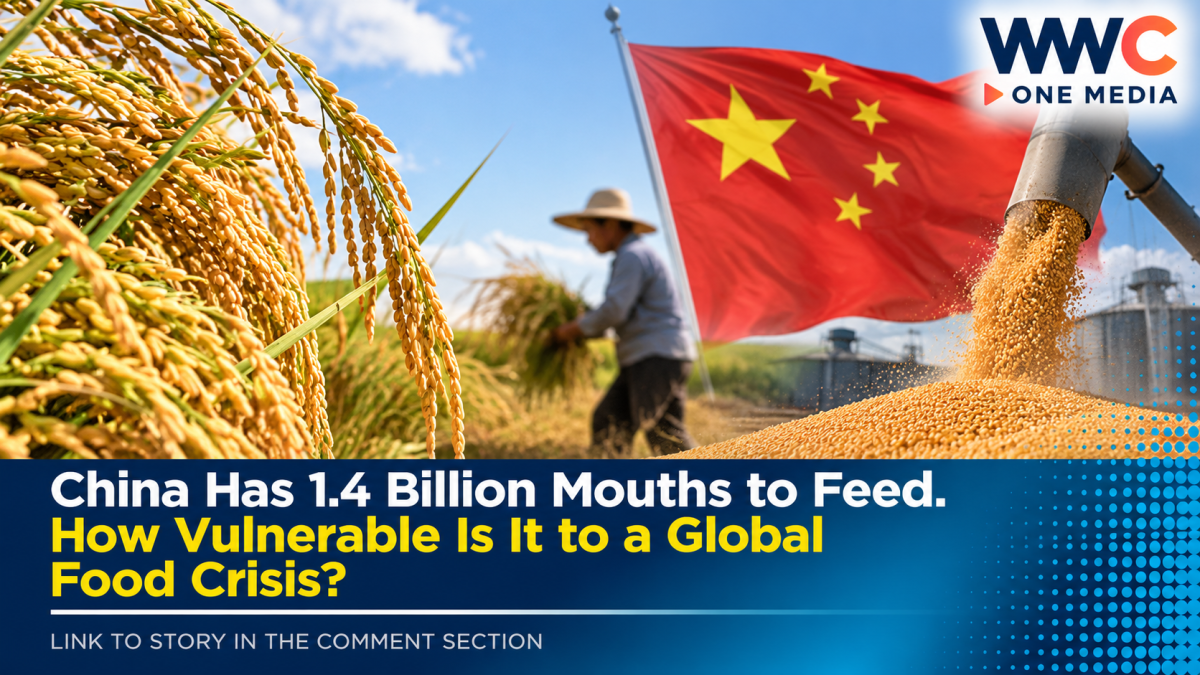
BEIJING — China has spent years preparing for a question that could become increasingly urgent in an unstable world: Can the country reliably feed its 1.4 billion people if a major global food crisis disrupts trade, production and supply chains?
The answer is complicated.
China produces enormous quantities of food and has repeatedly broken grain production records. Beijing also maintains strategic reserves, invests heavily in farmland and agricultural technology, and treats food security as a matter of national security.
But the world’s second-largest economy remains deeply exposed to several risks it cannot fully control — from extreme weather and geopolitical conflict to disrupted shipping routes and its heavy dependence on imported soybeans.
As global food prices climbed to their highest level since late 2022 in August, pressure on the world’s food system is once again raising questions about China’s vulnerabilities.
China Produces a Record Amount of Grain — But That Is Only Part of the Story
China has significantly strengthened domestic food production.
The country’s total grain output reached a record 714.9 million tonnes in 2025, according to China’s 2026 national development plan. Beijing is now pursuing another major initiative aimed at increasing grain production capacity by 50 million tonnes.
Rice, wheat and corn form the backbone of China’s food-security strategy.
The country has also invested in:
- High-standard farmland
- Improved seed technology
- Agricultural machinery
- Higher crop yields
- Grain reserves
- Rural infrastructure
- Agricultural insurance
On Sept. 7, Beijing announced further measures to strengthen food security and rural development through 2030, including expanded financing and support for major grain-producing regions.
That means China is far better positioned than many countries to withstand a temporary disruption to global food markets.
But self-sufficiency is not the same as complete independence.
The Soybean Problem Remains China’s Biggest Weakness
China’s most significant agricultural vulnerability is soybeans.
The country relies on imports for more than 80% of its soybean consumption, according to official figures cited by the South China Morning Post. Soybeans are particularly important because soybean meal is a major ingredient in animal feed, supporting China’s enormous pork, poultry and livestock industries.
That creates a strategic problem.
China may produce enough major staple grains to provide a strong domestic safety net, but its modern food system depends on international trade for other critical commodities.
China has therefore continued trying to diversify suppliers while simultaneously investing in domestic soybean production and new agricultural technology.
In August, Chinese scientists introduced a generative AI platform designed to accelerate soybean breeding and develop higher-yielding varieties. But researchers have warned that achieving soybean self-sufficiency remains unlikely in the near future.
Extreme Weather Is Becoming a Growing Threat
Even if international trade remains stable, China faces another major challenge: its own weather.
Recent heatwaves, flooding and heavy rainfall have threatened crops in important agricultural regions, including parts of northeastern China.
In late August, Reuters reported that extreme weather had placed corn, soybean and cotton production under pressure, potentially increasing the need for imports.
The concern is particularly serious because northeastern provinces including Heilongjiang and Jilin play a critical role in China’s food production.
Together, they generated nearly one-fifth of China’s grain output last year, according to SCMP reporting.
Premier Li Qiang recently visited the region and stressed the importance of protecting the autumn harvest, which accounts for the bulk of China’s annual grain production.
China’s food-security challenge is therefore increasingly linked to climate risk.
A major drought can damage crops.
Flooding can destroy farmland.
Extreme heat can reduce yields.
And changing weather patterns can make agricultural planning more difficult.
A Global Crisis Could Hit China From Multiple Directions
China’s greatest danger may not be one single disaster.
It could be several crises happening at the same time.
A major report on China’s global food policy warned that an interconnected crisis involving climate events, geopolitical conflict and other disruptions could create a “perfect storm” for the country’s food system.
Under such a scenario, grain production could fall sharply while food prices rise and imports increase.
That scenario is becoming easier to imagine.
The global food system is already dealing with:
- Extreme weather
- Conflict in major agricultural regions
- Shipping disruptions
- Rising fertilizer and input costs
- Volatile commodity markets
- Trade tensions
The United Nations’ Food and Agriculture Organization said global food prices rose sharply in August 2026, with extreme weather and geopolitical disruptions contributing to higher costs across cereals, vegetable oils, sugar, meat and dairy.
The Black Sea Crisis Shows How Quickly Food Markets Can Change
China is not the only country concerned about food security.
Recent disruptions to grain shipments through the Black Sea have forced buyers across Asia to search for alternative suppliers.
Wheat prices have risen sharply as attacks and security risks affected Russian and Ukrainian export infrastructure and shipping routes.
The crisis demonstrates a larger problem for food-importing countries.
A war in one region can affect bread prices thousands of kilometres away.
Ships can be delayed.
Ports can close.
Insurance costs can rise.
Alternative suppliers can charge more.
For China, which imports large quantities of agricultural products, such disruptions can quickly become an economic and political concern.
China Is Building a Bigger Safety Net
Beijing is not waiting for a global crisis to happen.
Food security has become one of the government’s most consistent strategic priorities.
China’s current policies include efforts to:
- Protect agricultural land
- Increase crop yields
- Expand high-standard farmland
- Improve seed technology
- Increase agricultural mechanisation
- Strengthen grain reserves
- Support major grain-producing regions
- Diversify overseas suppliers
- Reduce food waste
- Improve emergency supply systems
The government has also emphasized maintaining strategic reserves and improving its ability to coordinate regional emergency grain supplies.
This strategy reflects a lesson Beijing has repeated for decades:
Food security cannot depend entirely on foreign markets.
But Complete Food Independence May Be Impossible
China’s challenge is also shaped by geography.
The country has to feed a massive population with limited agricultural land relative to the number of people it supports.
Urbanisation has also reduced the agricultural workforce, while water shortages affect some regions.
At the same time, rising incomes have changed what people eat.
A population that consumes more meat, dairy and processed food requires more animal feed and agricultural resources.
That creates indirect demand for imported commodities.
China’s leaders therefore appear to be pursuing a more realistic strategy than complete self-sufficiency.
The goal is not necessarily to produce everything domestically.
It is to ensure that a foreign disruption cannot easily cause a national food emergency.
China’s 2026 rural blueprint signalled continued use of international agricultural markets while emphasizing diversified supply sources and stronger domestic production.
Could China Survive a Major Global Food Crisis?
Probably — but the cost could be enormous.
China’s huge domestic grain production, government reserves and increasingly sophisticated agricultural system provide a substantial buffer.
A temporary disruption to international trade would likely hurt prices and specific industries before creating an immediate nationwide shortage of staple food.
But a prolonged global crisis would be much more dangerous.
The greatest risk would come from multiple shocks happening simultaneously:
Extreme weather damaging Chinese crops.
War disrupting international grain exports.
Shipping routes becoming unsafe.
Soybean imports being restricted.
Global food prices surging.
Fertilizer and agricultural supplies becoming more expensive.
That combination could put China’s food system under far greater pressure than any single crisis.
The Food Battle Is Also Becoming Geopolitical
For Beijing, food is no longer simply an agricultural issue.
It is connected to national security.
Trade.
Climate change.
Technology.
Foreign policy.
And geopolitical rivalry.
China’s heavy soybean imports have become particularly important in its relationship with major suppliers such as Brazil and the United States.
The country is attempting to reduce strategic vulnerabilities without completely abandoning global trade.
That balancing act may become increasingly difficult if geopolitical tensions continue to grow.
China Can Feed Its People — But It Cannot Control the World
China has spent decades strengthening its ability to feed its enormous population.
Record harvests, strategic reserves, advanced machinery and government investment have made the country significantly more resilient than it was in the past.
But no amount of domestic planning can completely eliminate global risks.
China cannot control international wars.
It cannot control droughts.
It cannot control shipping disruptions.
And it cannot immediately replace every imported agricultural commodity.
China’s real strength is not that it has become completely food independent. It hasn’t.
Its strength is that it has spent years preparing for the possibility that the world could become less reliable.
But as climate extremes intensify, global conflicts disrupt trade routes and food prices climb, Beijing faces a difficult reality:
Feeding 1.4 billion people may be possible in normal times. The real test will come when the global food system is no longer normal.
WWC ONE MEDIA J.M.D



Leave a Reply