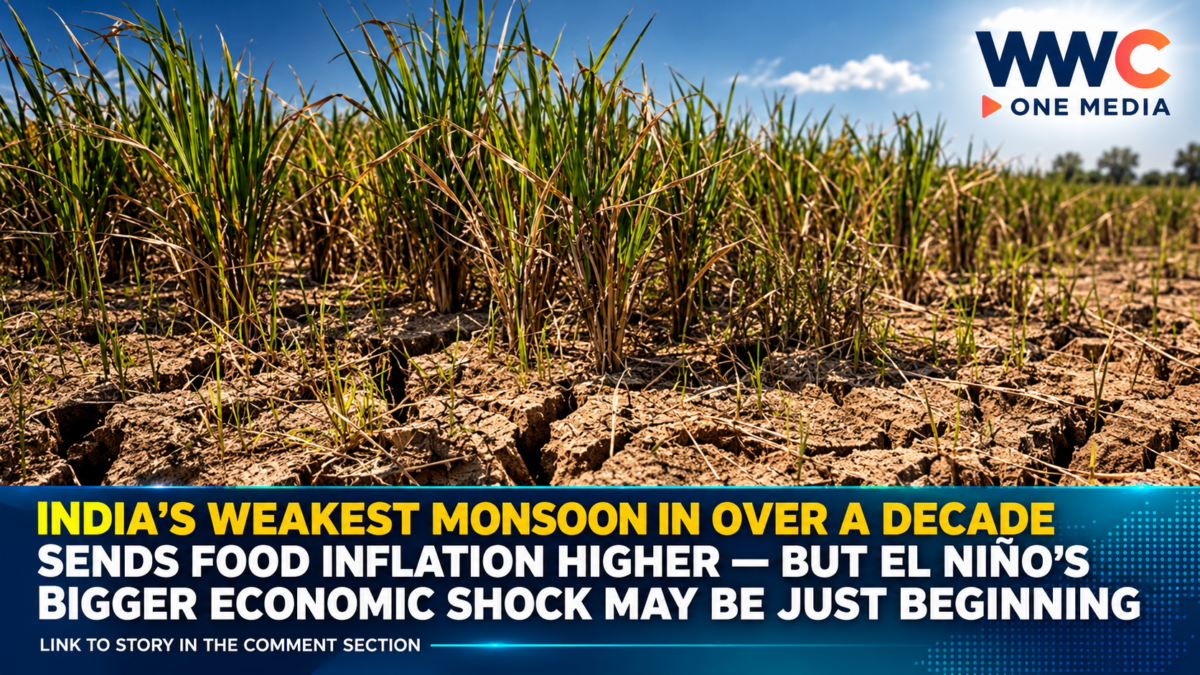
NEW DELHI, INDIA — El Niño has delivered India its weakest monsoon in more than a decade, raising fears that a weather shock beginning in the country’s farms could spread through food prices, household spending, interest rates and economic growth.
India’s crucial southwest monsoon ended the June-to-September 2026 season with rainfall 12.6% below the long-term average, according to the India Meteorological Department.
The country received approximately 759.4 millimeters of rain, compared with a normal level of around 868.6 millimeters.
It was India’s lowest monsoon rainfall since 2015 and the fourth-lowest total since 2001.
The shortage was closely associated with El Niño, the warming of equatorial Pacific Ocean waters that can disrupt atmospheric circulation and weaken India’s summer monsoon.
For the world’s most populous country, that matters far beyond agriculture.
A weaker monsoon can reduce harvests, lower rural incomes, increase food prices, weaken consumer spending and complicate decisions at the Reserve Bank of India.
And in 2026, those pressures are arriving while India is also confronting higher global oil prices and a weakening rupee.
The danger is that India could simultaneously face slower rural demand and higher inflation—a particularly difficult combination for policymakers.
Why India Is So Vulnerable to the Monsoon
India’s economy has become increasingly dominated by services, technology and manufacturing.
But agriculture remains enormously important.
Millions of households depend directly or indirectly on farming.
A significant share of cultivated land still depends heavily on rainfall rather than guaranteed irrigation.
The southwest monsoon also provides much of the country’s annual precipitation and replenishes reservoirs, rivers and groundwater.
That means the quantity and timing of rainfall can influence everything from rice and pulses to livestock feed and rural wages.
A weak monsoon does not create an economic shock instantly.
Instead, its effects move gradually from fields into household budgets.
The 2026 Monsoon Fell Well Below Normal
The IMD had warned before the season began that rainfall would likely be below average.
Its April forecast projected nationwide monsoon rainfall at approximately 92% of the long-period average, with an error range of plus or minus five percentage points.
The final outcome proved even weaker.
Rainfall finished approximately 12.6% below normal.
The season was also highly uneven.
Some areas experienced severe shortages while others received healthier rainfall totals.
Southern and eastern regions were among the worst affected, with rainfall substantially below their long-term averages.
This uneven distribution matters because national averages can hide local agricultural stress.
A farmer does not benefit from rain falling hundreds of kilometers away.
El Niño Does Not Always Cause a Drought—But It Raises the Risk
It would be inaccurate to say that every El Niño automatically causes a failed Indian monsoon.
India’s Ministry of Earth Sciences says there have been 16 El Niño years since 1950, and seven produced below-normal monsoon rainfall.
The relationship becomes stronger during the latter half of the monsoon season, particularly around September.
That distinction is important.
El Niño is a major risk factor, not a guaranteed outcome.
But in 2026, the feared rainfall weakness did materialize.
And forecasters expect El Niño conditions to remain influential into the final months of the year.
That raises concern not only about crops planted during the summer monsoon but also about soil moisture and water availability for the winter agricultural season.
Food Inflation Is Already Moving Higher
India entered the autumn with food-price pressures already building.
Official data showed annual consumer inflation of 4.82% in August 2026.
Food inflation was significantly higher at 5.95%.
Rural food inflation reached 6.13%, compared with 5.64% in urban areas.
Economists surveyed ahead of the September inflation release expect headline inflation to rise further.
A Financial Express poll forecasts September CPI inflation around 5.6%, which would be the highest in nearly two years.
Food inflation could move into the 7% to 8% range, driven particularly by vegetables and sugar.
The official September CPI release was not yet available at the time of writing, so those figures remain forecasts.
Why Food Inflation Matters So Much in India
Food represents a large portion of household spending, particularly for lower-income families.
That means increases in the price of vegetables, grains, pulses, edible oils and sugar can quickly affect consumer confidence.
Higher food prices also have a disproportionate impact on poorer households because necessities consume a larger share of their income.
The International Monetary Fund warned this week that repeated food and energy price shocks can have lasting effects on inflation expectations and poverty, even after the initial crisis fades.
For India, that means agricultural shortages can become macroeconomic problems.
When families spend more on groceries, they have less money available for clothing, electronics, travel and other discretionary purchases.
The Weak Monsoon Is Already Hitting Rural Demand
Evidence of that pressure is beginning to appear.
Reuters reported that India’s weak 2026 monsoon has hurt farm incomes and rural purchasing activity.
September tractor sales fell sharply.
Mahindra & Mahindra reported a 21% decline in tractor sales, while Escorts Kubota recorded a drop of nearly 17%.
Two-wheeler sales also weakened in some rural markets.
Farm-input companies have reported similar stress.
Rallis India said weaker rainfall reduced demand for pesticides, fertilizer and seeds as farmers became more cautious about spending on crops with uncertain yields.
This demonstrates how a weather shock can spread through the economy.
Less rain can mean weaker harvest expectations.
Weaker expectations reduce farmer spending.
That affects companies selling tractors, motorcycles, fertilizer, consumer goods and other products.
Rural India Is Still a Critical Consumer Market
India’s cities receive much of the international attention surrounding the country’s economic expansion.
But rural demand remains enormously important to consumer businesses.
Companies selling motorcycles, packaged food, household products and agricultural equipment depend on village and farming communities.
When agricultural income weakens, companies can feel the effect quickly.
That is why economists watch tractor and two-wheeler sales as indicators of rural economic health.
Historically, El Niño years have been associated with weaker agricultural output and higher food inflation, although the impact varies significantly from one episode to another.
Rice, Pulses and Oilseeds Are Particularly Important
The crops most exposed to an uneven summer monsoon include rice, pulses, maize and oilseeds.
Many are staples of the Indian diet.
A reduction in domestic production can tighten supplies and raise prices.
Pulses are particularly politically and economically sensitive because they are an important source of protein.
Edible-oil prices also matter because India imports large quantities from overseas.
This means domestic food inflation can be affected simultaneously by weather at home and commodity prices abroad.
The risk becomes greater when multiple shocks happen at once.
India Is Also Facing Problems With Imported Food
The food challenge is not limited to domestic agriculture.
India-bound shipments of Russian sunflower oil have recently faced cancellations and delays because of disruption to Black Sea infrastructure.
Reuters reported that October sunflower-oil imports could fall sharply, forcing Indian buyers to purchase additional palm oil.
That creates another source of inflation risk.
A country facing weaker domestic agricultural conditions would ideally compensate through imports.
But international supply disruptions can make that option more expensive.
Higher shipping costs and a weaker currency can add further pressure.
The Rupee Is Near Record Lows
India’s currency is another part of the problem.
The rupee fell to approximately 96.85 per U.S. dollar on October 7, close to its record low of 96.96.
The weakness persists despite intervention by the Reserve Bank of India.
A weaker rupee makes imported goods more expensive.
That matters particularly for India because the country is heavily dependent on imported crude oil.
It also imports large quantities of edible oils and other commodities.
Currency weakness therefore magnifies global price shocks.
India can experience higher costs even if the international dollar price of a commodity remains unchanged.
Oil Is Creating a Second Inflation Shock
The monsoon problem is arriving at a particularly bad moment because India is also dealing with expensive energy.
The Finance Ministry warned in its September economic review that high crude-oil prices and geopolitical tensions could fuel imported inflation.
India buys most of the crude oil it consumes from overseas.
Higher oil prices increase transportation and manufacturing costs.
They can also affect fertilizer, packaging and logistics expenses across the food chain.
That means the food-inflation problem cannot be separated entirely from energy.
A vegetable can become more expensive because the harvest is smaller, but also because transporting it to a city costs more.
RBI Responds With Its First Rate Increase in Years
The Reserve Bank of India responded to rising inflation risks on October 7 by increasing its benchmark repo rate by 25 basis points to 5.5%.
It was the central bank’s first rate increase in nearly four years.
The RBI also changed its policy stance from “neutral” to “calibrated tightening,” signaling that additional rate increases remain possible if inflation continues climbing.
The move demonstrates how the monsoon can ultimately influence monetary policy.
The RBI cannot make it rain.
But if food-price increases begin pushing overall inflation and inflation expectations higher, it can tighten financial conditions.
Higher Rates Create Their Own Economic Costs
Interest-rate increases can help reduce inflationary pressure.
But they can also make borrowing more expensive.
That affects mortgages, business loans, automobile finance and investment.
This creates an uncomfortable policy dilemma.
The same weak monsoon that is hurting rural incomes is contributing to inflation.
The RBI may therefore need to tighten monetary policy even while parts of the economy are already slowing.
That is one reason supply-driven inflation is so difficult to manage.
Higher interest rates cannot produce more rice or rainfall.
They primarily work by reducing demand elsewhere in the economy.
Households Are Expecting Prices to Rise
The RBI’s latest household survey shows that consumers themselves are becoming more concerned about inflation.
Expectations increased as families anticipated higher food and fuel prices.
Inflation expectations matter because they can influence behavior.
If consumers expect prices to rise, they may change when and how they spend money.
Workers may demand higher wages.
Businesses may become more willing to increase prices.
That can make inflation more persistent even after the original supply shock begins fading.
Central banks therefore pay close attention to household expectations.
But India Is Not Heading Into Recession
The economic picture is not entirely negative.
India remains one of the world’s fastest-growing major economies.
The RBI recently increased its forecast for fiscal-year growth to 7.1%.
The World Bank is also projecting approximately 7.1% growth for India in 2026-27.
That means the current challenge should not be described as an economy-wide collapse.
India continues to benefit from strong domestic demand, services, remittances and investment.
The risk is that El Niño and inflation reduce the strength of that growth.
India Is Better Prepared Than During Earlier El Niño Episodes
There are also reasons to believe the consequences could be less severe than during past droughts.
India now has better weather forecasting.
Irrigation coverage has improved.
Governments maintain food-grain reserves.
Authorities also have more experience using trade restrictions, buffer stocks and targeted measures to manage food shortages.
Scientists interviewed by The Indian Express said India is better prepared for the current El Niño than during severe episodes such as 2009.
This does not eliminate the risk.
It means historical drought outcomes should not automatically be projected onto 2026.
Food Buffer Stocks Could Limit the Damage
Government food stocks are one of India’s most important defenses.
Large reserves of rice and wheat can help stabilize supplies when agricultural production disappoints.
Authorities can release stocks onto the domestic market to reduce price pressure.
Trade policy provides another tool.
India can reduce import restrictions or adjust export rules when supplies become tight.
But such interventions can create consequences abroad.
India is a major producer and consumer of several agricultural commodities.
When it restricts exports, global prices can rise.
That means India’s domestic food-security policies can influence international markets.
Winter Crops Are Now the Next Big Risk
The summer harvest is only part of the story.
Weak monsoon rainfall can leave reservoirs and soil with less moisture going into the winter planting season.
India’s Finance Ministry has warned that a strong El Niño could hurt rabi, or winter, crops as well.
This creates the possibility that weather problems could last beyond one harvest cycle.
If winter wheat or other important crops are also affected, food-price pressure could continue into 2027.
Much will depend on irrigation availability, reservoir levels and rainfall during the coming months.
October Rainfall May Offer Limited Relief
The outlook does not yet point to a dramatic nationwide recovery in rainfall.
IMD-related forecasts indicate that October precipitation may remain below normal across significant parts of India while El Niño strengthens.
Southern India could receive some relief from the northeast monsoon.
But the situation varies sharply by region.
That means national agricultural risks will depend partly on local rainfall patterns over the next several weeks.
The Crisis Is About Water as Much as Food
Agriculture is not the only concern.
A weaker monsoon can affect reservoirs, groundwater and hydroelectric production.
Cities can also face tighter water availability.
Farmers may need to pump more groundwater for irrigation, increasing electricity demand.
These factors can reinforce one another.
More irrigation raises energy use.
Higher energy costs increase farming expenses.
Lower reservoir levels reduce flexibility.
The El Niño story is therefore fundamentally about the allocation of scarce water across agriculture, households, industry and electricity generation.
Climate Volatility Is Making Food Planning Harder
The challenge extends beyond the current El Niño.
Global food companies and governments increasingly face more unpredictable climate conditions.
Reuters reported this week that companies often fail to adequately model interacting climate risks such as drought, wildfire, pests and disrupted rainfall.
That matters because modern food systems are interconnected.
A crop failure in one country can change prices elsewhere.
An energy shock can increase fertilizer costs.
War can disrupt shipping.
When several problems occur simultaneously, the economic impact becomes much larger than any individual event.
India’s current situation combines exactly these types of pressures: dry weather, expensive oil, a weaker currency and supply-chain disruptions.
Poorer Families Feel the Shock First
Food inflation is particularly regressive.
A wealthy household can absorb a 10% increase in vegetable prices relatively easily.
A low-income family may have to reduce spending elsewhere.
This can mean buying less nutritious food, postponing healthcare or cutting other necessities.
The IMF’s latest research warns that cost-of-living crises can push millions of people into poverty and leave long-lasting scars on inflation expectations.
This makes the El Niño issue politically sensitive as well as economically important.
India’s Government Has Multiple Policy Options
Policymakers are not powerless.
The government can release food stocks.
It can adjust import duties.
It can restrict exports if necessary.
It can provide targeted financial support to farmers or vulnerable households.
It can expand irrigation assistance and crop insurance.
But each intervention has costs.
Broad subsidies can become expensive.
Export restrictions can hurt farmers and international buyers.
Price controls can distort markets.
The challenge is deciding which measures reduce hardship without creating bigger long-term problems.
The Bigger Economic Risk Is a Double Shock
India’s economy has enough momentum to withstand a poor monsoon.
But the 2026 situation is unusually complicated because the weather shock is happening alongside expensive imported energy.
A weak monsoon pushes food prices higher.
Oil raises transport and manufacturing costs.
A weaker rupee makes imports more expensive.
Higher inflation forces the RBI to increase rates.
Higher borrowing costs can then weaken consumption and investment.
That is the chain policymakers are trying to prevent.
El Niño Could Test India’s Growth Story
India remains one of the world’s strongest large economies.
Its growth rate is still expected to exceed that of most major peers.
But strong headline GDP does not mean every household experiences the same economic conditions.
Rural families can suffer even while national growth remains above 7%.
Urban consumers can feel squeezed by grocery and fuel prices.
Businesses can face higher financing expenses.
That is why the current El Niño deserves attention far beyond weather forecasting.
The Real Danger Is What Happens After the Rain Stops
India’s 2026 monsoon has already ended.
The economic consequences have not.
The country now has to manage weaker agricultural conditions, rising food inflation, stressed rural demand and expensive imported energy.
The RBI has already responded with higher interest rates.
Businesses are beginning to see weaker demand in some rural markets.
And households increasingly expect prices to rise.
Yet India retains significant defenses, including food reserves, improved irrigation and strong overall economic growth.
El Niño has not created an Indian economic crisis by itself.
But it has made one of the world’s fastest-growing economies more vulnerable at exactly the moment when high oil prices and currency weakness are creating additional inflation pressure.
The bigger question is whether India can contain the food-price shock before it spreads further into household spending, interest rates and economic growth—or whether the weakest monsoon in more than a decade is only the beginning of a much broader economic test.